Live chat for Free Pascal, Lazarus, Delphi and every Pascal programmer.
Catalog
30,060 projects in the catalog.
Free Pascal, Lazarus and Delphi components, libraries and programs from GitHub, SourceForge, Codeberg, GitLab and more. Rate them, mark what looks interesting, and talk about them on their benches.
LOOP (Language Object Oriented Parallel) is a visual programming language project dedicated to creating a full suite of components for simulation of hierarchical dynamical systems in discrete time.
The .Net Native Interface Library (DotNetNativeInterface) is a native programming interface which provides a way for programming languages such as C, C++, Fortran, Assembly, Pascal, Java, VB etc to interact with applications and libraries written in any of the .Net languages (such as C#, VB.Net etc). Programmers can use DotNetNativeInterface native methods to access .Net 3rd party libraries or .Net Framework Libraries without the need for registry entries, COM registrations or changes to the .Net libraries. The following examples illustrate when you need to use DotNetNativeInterface native methods: 1. You want to access and use .Net Framework Class Library in your application. 2. You want to access and use 3rd party .Net Libraries in your application. Competitive Advantages: 1. Access to .Net Framework Class Library. 2. No COM registration of .Net Libraries is required when deployed. 3. Allows any programming language to consume .Net libraries as if they were native code.
The .Net Native Interface Library (DotNetNativeInterface) is a native programming interface which provides a way for Delphi programming language to interact with applications and libraries written in any of the .Net languages (such as C#, VB.Net etc). Programmers can use DotNetNativeInterface native methods to access .Net 3rd party libraries or .Net Framework Libraries without the need for registry entries, COM registrations or changes to the .Net libraries. The following examples illustrate when you need to use DotNetNativeInterface native methods: 1. You want to access and use .Net Framework Class Library in your application. 2. You want to access and use 3rd party .Net Libraries in your application. Competitive Advantages: 1. Access to .Net Framework Class Library. 2. No COM registration of .Net Libraries is required when deployed. 3. Allows any programming language to consume .Net libraries as if they were native code.
The .Net Native Interface Library (DotNetNativeInterface) is a native programming interface which provides a way for Lazarus/Pascal programming language to interact with applications and libraries written in any of the .Net languages (such as C#, VB.Net etc). Programmers can use DotNetNativeInterface native methods to access .Net 3rd party libraries or .Net Framework Libraries without the need for registry entries, COM registrations or changes to the .Net libraries. The following examples illustrate when you need to use DotNetNativeInterface native methods: 1. You want to access and use .Net Framework Class Library in your application. 2. You want to access and use 3rd party .Net Libraries in your application. Competitive Advantages: 1. Access to .Net Framework Class Library. 2. No COM registration of .Net Libraries is required when deployed. 3. Allows any programming language to consume .Net libraries as if they were native code.
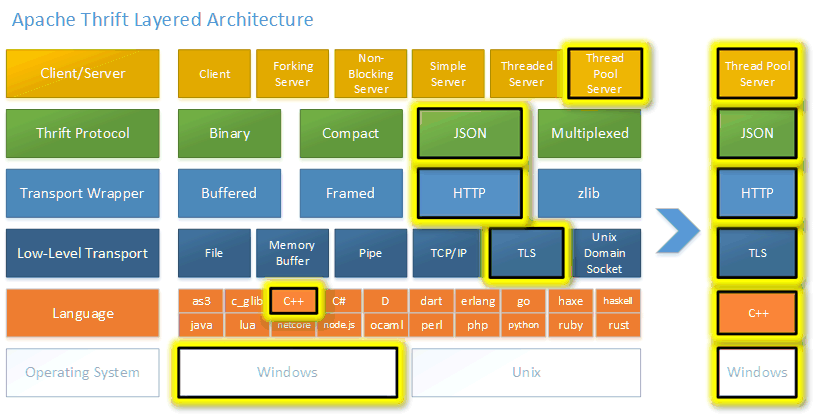
. Delphi Lightweight, language-independent software stack for point-to-point RPC implementation. Thrift provides clean abstractions and implementations for data transport, data serialization, and application level processing. The code generation system takes a simple definition language as input and generates code across programming languages that uses the abstracted stack to build interoperable RPC clients and servers. Thrift makes it easy for programs written in different programming languages to share data and call remote procedures. With support for 28 programming languages, chances are Thrift supports the languages that you currently use.
Code::Stats is a free stats tracking service for programmers. You will be awarded with experience points for the amount of programming you do. Watch as your levels grow for each language you use. Identify your strong skill sets and use the data to see where you still have room for improvement. Show your personal statistics page to your friends and compare your progress with others. For more information visit https://codestats.net.
CyberUnits is a cross-platform class library for rapid development of high-performance computer simulations in life sciences. It supports modelling for biomedical cybernetics and systems biology with Object Pascal.
The COMTAY coroutine manager makes it easy to create and manage coroutines in Delphi and Free Pascal. Download COMTAY at https://opensimply.org/comtay The approach implemented in COMTAY allows the use of cooperative multitasking in both procedural and class-based programming.
The PUMA Repository is a collection of Pascal units for medical informatics. It contains reusable source code for a wide field of health-care application development. The code includes a support engine for the European Data Format (EDF and EDF+), converting functions for units of measurement and an HL7 engine.
TRURL is a Reusable Universal RPN Library. It is a free class library (RPN Engine) as a toolbox for creating desktop calculators with reverse Polish notation (RPN) written in Object Pascal. Additionally, it comes with several ready-to-use calculator apps.
The PUMA Repository is a collection of Pascal units for medical informatics. It contains reusable source code for a wide field of health-care application development. The code includes a support engine for the European Data Format (EDF and EDF+), converting functions for units of measurement and an HL7 engine.
Sempare Template (scripting) Engine for Delphi allows for flexible dynamic text generation. It can be used for generating email, html, reports, source code, xml, configuration, etc.
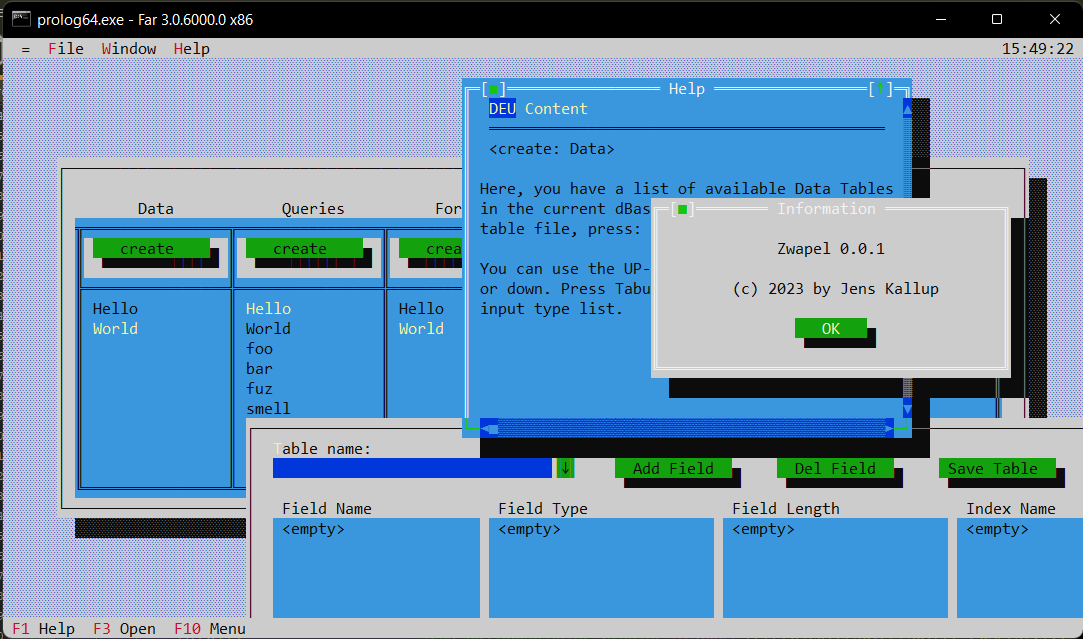
libPasnCurses is delphi and object pascal bindings around nCurses library. The nCurses library is a wrapper over working with raw terminal codes, and provides highly flexible and efficient API (Application Programming Interface). It provides functions to move the cursor, create windows, produce colors, play with mouse etc. The application programs need not worry about the underlying terminal capabilities.
CAI NEURAL API - Pascal based deep learning neural network API optimized for AVX, AVX2 and AVX512 instruction sets plus OpenCL capable devices including AMD, Intel and NVIDIA.
A Library bundled for the ITDevCon 2014 presentation "Immersive Audio Programming", which contains the necessary code to build a platform independent audio environment with Delphi.
LangVM is a Turing-complete language workbench for rapidly building custom programming languages. Using `.lvm` scripts, developers define lexing, Pratt parsing, semantics, MIR, and code generation without recompiling. It can run standalone or embedded in Delphi, enabling fast iteration and native, cross-platform language development.
Complete structure for developers quickly and easily using the programming model by layering Model View Presenter (MVP) with superclasses already be ready all the actions, persistence, validation, database, instance classes and layouts.
This is an unofficial library for reading MaxMind GeoIP databases as a DLL library. It provides a simple and easy-to-use interface for reading MaxMind GeoIP databases in your applications. You can use it in your Delphi, C#, C++ and other programming languages projects.
A mathematical syntax tree evaluation library for mathematical and logical program expressions. Encode expressions and programs into a tree for use in Genetic Programming.
The present work proposes a non-visual component developed in Object Pascal programming languages, for Genetic Algorithms called "TGAlgorithm". Developed in a fully object-oriented framework, the Component exploits this feature to facilitate its extension to genetic algorithms and specific problems, be they single-purpose. In this work an example of the use of "TGAlgorithm" for an implementation of a genetic algorithm mono-objective is presented.