

Catalog · How the catalog works
LangVM

LangVM is a Turing-complete language workbench for rapidly building custom programming languages. Using `.lvm` scripts, developers define lexing, Pratt parsing, semantics, MIR, and code generation without recompiling. It can run standalone or embedded in Delphi, enabling fast iteration and native, cross-platform language development.
- ★ 7 on GitHub
Anyone may press Interesting, signed in or not. It helps others find this project.
README
Project Archived: Development Continues with PaskalCPP
This project is now archived and read-only. No further development, updates, or bug fixes are planned.
Over the past year, I've explored various approaches to language and compiler design, particularly my long-term vision of bringing Pascal-style programming and modern C/C++ interoperability together.
Each of these projects has been an important part of that journey, providing valuable experience, ideas, and lessons that have ultimately led to PaskalCPP.
Going forward, PaskalCPP will be my primary focus and long-term language development project. All future development efforts, new features, improvements, and innovations will be concentrated there.
🚀 Follow the Journey
PaskalCPP Programming Language
- GitHub: https://github.com/tinyBigGAMES/PaskalCPP
- Website: https://paskalcpp.org
This repository will remain available for historical reference and for anyone who may find its code, ideas, or approach useful.
The journey continues with PaskalCPP. I hope you'll join me!
© 2026-present tinyBigGAMES LLC
What is LangVM?
A scriptable language workbench that takes you from language idea to native binary -- entirely from script. Write a .lvm script that defines your language's tokens, grammar, semantic rules, and code generation. LangVM executes that script and becomes a working implementation of whatever language you defined. Change the script, change the language. No recompilation of the VM itself.
language TestLang version "1.0";

tokens {
  casesensitive = true;
  token keyword.say = "say";
  token delimiter.semicolon = ";";
  token string.default = "\"";
}

grammar {
  rule stmt.say {
    expect keyword.say;
    let text: string = currentText();
    advance();
    let nd: handle = getResultNode();
    setAttr(nd, "message", text);
    requireToken("delimiter.semicolon");
  }
}

emitters {
  on stmt.say {
    println(getAttr(node, "message"));
  }
}

routine main() {
  let source: string = 'say "hello"; say "world";';
  let toks: any = lexSource(source, "test.say");
  let ast: any = parseProgram(toks, "test.say");
  runEmitters(ast);
}
Run it:
lvm -l saylang.lvmThe .lvm scripting language is Turing complete. This is not a configuration format or a template language -- it is a full programming language with variables, control flow, recursion, data structures, and ~200 builtins. Turing completeness is what makes the entire architecture possible: the x86_64 instruction encoder (890 lines), the PE image writer (928 lines), the ELF writer (1498 lines), and the ABI handling (521 lines) are all written in .lvm scripts.
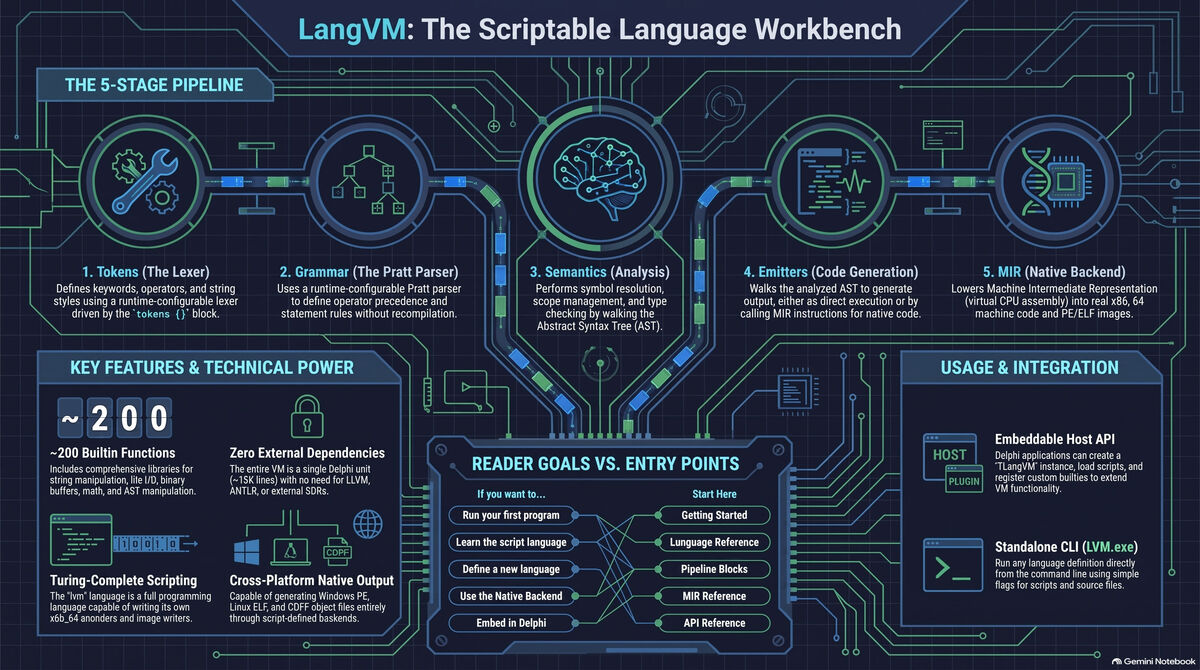
The pipeline has five stages, all defined in .lvm script: tokens{} configures the lexer, grammar{} defines Pratt parser rules, semantics{} runs analysis passes, emitters{} generates code (emitting MIR assembly instructions), and mir{} on-handlers lower those virtual assembly instructions to real x86_64 machine code. The entire native backend -- instruction encoding, Win64/SysV ABI, PE/ELF/COFF image writing -- lives in ~165KB of .lvm script.
LangVM is also embeddable. Delphi applications can create a TLangVM instance, load a script, register custom builtins, and call routines through a clean public API.
🎬 Media
https://github.com/user-attachments/assets/7ddda1a2-75eb-44e2-aa5a-3c819de966b0
🎯 Who is LangVM For?
- Language designers: Prototype a language without building a compiler. Define your syntax in
tokens{}andgrammar{}, add semantics and code generation, and get a working implementation immediately. - Compiler writers: Use LangVM as a scriptable frontend and backend. The pipeline architecture handles lexing, parsing, semantic analysis, and native code generation -- all configurable at runtime.
- Tool builders: Embed
TLangVMin a Delphi application and give it a scriptable language engine. Register custom builtins, exchange data through well-known globals, and capture output and diagnostics through callbacks. - Educators: Teach compiler construction with a system where every stage of the pipeline is visible, editable, and executable. Students can modify a language definition and see the effects immediately.
- Anyone who wants to go from "I have a language idea" to "I have a native binary" without leaving script.
✨ Key Features
- Turing-complete scripting: The
.lvmlanguage has variables, control flow, recursion, lists, maps, buffers, records, enums, routines, imports, and ~200 builtins. It is a full programming language, not a config format. - Pipeline architecture: Five scriptable stages --
tokens{},grammar{},semantics{},emitters{},mir{}-- define your entire language from lexer to native code generator. - Runtime-configurable lexer and parser: LangVM's generic lexer and Pratt parser configure themselves from your
tokens{}andgrammar{}declarations at runtime. No code generation step, no separate parser generator. - MIR virtual assembly: A complete virtual CPU assembly language with typed registers, arithmetic, comparison, branching, calling conventions, memory operands, and more. Emitters produce MIR; backend scripts lower it to real machine code.
- Backend in script: The entire x86_64 native backend -- instruction encoder, Win64/SysV ABI, PE64 image writer, ELF64 image writer, COFF .obj writer -- is written in
.lvmscripts (~165KB total). No Delphi code in the backend. - End-to-end proven:
mir_full_pipeline.lvmdemonstrates the complete chain in 181 lines: define a language, parse source, emit MIR, lower to x64, write a PE executable, and run it. - Zero dependencies: The VM runtime is a single Delphi unit (
LangVM.pas, ~13K lines). No external libraries, no build system, no toolchain installation. - Embeddable:
TLangVMprovides a clean Delphi API --Create,LoadScriptFile,Run,SetVar/GetVar,RegisterBuiltin, callbacks for output and diagnostics. - Semantic analysis: Scope management, symbol declaration, type checking, and attribute stamping via
semantics{}on-handlers withscope,declare,lookup,visit, and diagnostic builtins. - Binary data construction: Buffer builtins (
bufWriteU8..bufWriteU64,bufWriteRecord,bufSave,bufIsExec,bufCall) enable constructing and executing binary data from script -- essential for native code generation. - Structured error handling:
try/recoverfor runtime errors, pluserror/warning/hint/note/infodiagnostic builtins for semantic analysis. - Import system:
.lvmfiles can import other.lvmfiles. The entire x86_64 backend is composed from 7 imported scripts.
🚀 Getting Started
Every .lvm file starts with a language declaration and has a routine main() entry point. The simplest script:
language 1 version "1.0.0";

routine main() {
  println("Hello, LangVM!");
}
Run it:
lvm -l hello.lvmTo define a language, add pipeline blocks. Here is a complete language that parses say "text"; statements and prints the text:
language SayLang version "1.0";

tokens {
  casesensitive = true;
  token keyword.say = "say";
  token delimiter.semicolon = ";";
  token string.default = "\"";
  token comment.line = "//";
}

grammar {
  rule stmt.say {
    expect keyword.say;
    let text: string = currentText();
    advance();
    let nd: handle = getResultNode();
    setAttr(nd, "message", text);
    requireToken("delimiter.semicolon");
  }
}

semantics {
  on stmt.say {
    setShared("last_message", getAttr(node, "message"));
  }
}

emitters {
  on stmt.say {
    println(getAttr(node, "message"));
  }
}

routine main() {
  let source: string = 'say "hello"; say "world";';
  let toks: any = lexSource(source, "test.say");
  let ast: any = parseProgram(toks, "test.say");
  runEmitters(ast);
}
The same architecture scales to production languages. The Myrissa language definition is 5,000+ lines of pipeline script defining 70+ keywords, a full Pratt parser grammar, semantic analysis, and native code generation via MIR.
CLI Reference
lvm -l <script.lvm> [options]| Flag | Description |
|---|---|
-l, --lang <file> |
LVM script file (.lvm) [required] |
-s, --source <file> |
Source file for the script to process [optional] |
-h, --help |
Display help |
lvm -l hello.lvm                    # run a script
lvm -l mylang.lvm -s input.src      # run a language definition against a source file
Embedding in Delphi
uses
  LangVM;

var
  LVM: TLangVM;
begin
  LVM := TLangVM.Create();
  try
    LVM.LoadScriptFile('mylang.lvm');
    LVM.SourceFilename := 'input.src';
    LVM.Run('main');
    WriteLn('Exit code: ', LVM.ExitCode);
  finally
    LVM.Free();
  end;
end;
📖 Documentation
The full language reference, BNF grammar, pipeline blocks reference, MIR reference, builtins catalog, host API reference, and how-to recipes are in a single document:
| Document | Description |
|---|---|
| LangVM | Complete reference: the .lvm scripting language, pipeline blocks (tokens, grammar, semantics, emitters, mir), MIR virtual assembly, all ~200 builtins, the Delphi host API, formal BNF grammar, code style guide, and practical how-to recipes. |
🔨 Getting LangVM
Get the Source
git clone https://github.com/tinyBigGAMES/LangVM.gitOr download the repository as a ZIP from GitHub.
Prerequisites
| Requirement | |
|---|---|
| Host OS | Windows 10/11 x64 |
| Compiler | Delphi 12.x or higher |
| Runtime dependencies | None |
Build
- Open the project in the Delphi IDE
- Build the Testbed project:
projects\Testbed\ - Build the LVM CLI project:
projects\LVM\ - Or use the build scripts:
bin\build-testbed.cmdandbin\build-lvm.cmd
Run the Tests
bin\build-testbed.cmd
Testbed.exe -all -q
The test suite covers builtins, control flow, data structures, declarations, error handling, expressions, routines, types, variables, MIR, and backend integration.
System Requirements
| Requirement | |
|---|---|
| Host OS | Windows 10/11 x64 |
| Runtime dependencies | None |
| External toolchain | None |
🤝 Contributing
LangVM is an open project and contributions are welcome at every level:
- Report bugs: Open an issue on GitHub with a minimal
.lvmreproduction case. - Suggest features: Describe the use case first, then the syntax you have in mind.
- Submit pull requests: Bug fixes, documentation improvements, new test cases, and well-scoped features.
- Review and discuss: Reviewing open pull requests and issues helps move the project forward.
Join our Discord or Facebook Group to discuss development, ask questions, or share what you are building with LangVM.
💙 Support the Project
If LangVM saves you time, sparks an idea, or becomes part of something you ship:
- Star the repo -- helps others find the project
- Spread the word -- write a post, mention it on social media
- Join us on Discord -- share what you are building
- Become a sponsor via GitHub Sponsors -- directly funds development
📄 License
LangVM is licensed under the Apache License 2.0. See LICENSE for details.
🔗 Links
LangVM™ - Language Virtual Machine
Copyright © 2026-present tinyBigGAMES™ LLC
All Rights Reserved.