

Catalog · How the catalog works
6502-Snake

Classic Snake as a bootable ROM cartridge for the A.C. Wright 6502, with a high score that survives power cycles.
- ★ 1 on GitHub
Anyone may press Interesting, signed in or not. It helps others find this project.
README
Snake
A classic grid-based Snake game, built as a standalone ROM cartridge for the A.C. Wright 6502 family of computer systems, using the 6502-CRT template.
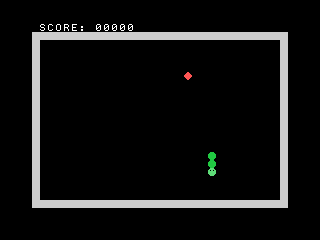
Boots directly from the cartridge: no BASIC, no loading screen. Grow by eating the food, avoid the walls and your own tail. Beats the high score? The title screen remembers it, across restarts and, on hardware with the RTC card fitted, across power cycles too.
Controls
- Joystick, either port: move (primary control)
- WASD or arrow keys: fallback for movement, used only when the joystick shows no direction that poll (including when no GPIO card is fitted at all)
- A button, or space: start/restart, and pause/resume during play
Building
Requires cc65 (brew install cc65 on macOS):
makeProduces Snake.crt, a 32 KB ROM image ($8000-$FFFF), ready to run in the
6502-EMULATOR or burn to a
28C256/27C256 EEPROM.
make run      # launch the emulator with Snake.crt loaded
make eeprom   # burn to an AT28C256 via a TL866 programmer + minipro
How it's built
- Graphics: TMS9918 Graphics I mode (32×24 cells), with five custom 8×8
tiles (head, body, food, wall, overlay frame) hand-authored as raw pattern
bytes; see
src/tiles.asm. The Kernal'sInitVideois used once at boot purely for its side effect of loading the CP437 font into VRAM, then the VDP is reprogrammed directly for Graphics I (src/vdp.asm). HUD text and the game-over overlay reuse the surviving CP437 letter/digit glyphs via direct name-table pokes, since the Kernal's text routines assume its own 40-column layout. Every multi-byte VDP register/address write is wrapped inPHP/SEI/PLP, since the VDP is itself an IRQ source and its own status read resets the same two-byte write latch our own writes depend on. An interrupt landing mid-sequence happens routinely at real frame rates (though never in headless turbo-speed testing) and would otherwise scramble the screen. - Title screen: lives entirely in Graphics I too, not the Kernal's separate text mode, so it shares the exact same tiles, palette, and black background as gameplay instead of looking like a bolted-on splash screen. Right down to a little snake-chasing-an-apple decoration built from the same head/body/food tiles.
- Game over: a highlighted box overlay centered on the board, not a footer line, shows the final score and, when it's a new record, calls that out explicitly. Otherwise it shows the standing high score for reference.
- High score: tracked for the whole power-on session in RAM, and
persisted across power cycles via the RTC card's 256-byte battery-backed
NVRAM when that card is fitted (
RtcReadNVRAM/RtcWriteNVRAM, gated onHW_RTC; seeLoadHighScore/SaveHighScoreinsrc/game.asm). The cartridge ROM itself is read-only and has no storage of its own. - Game logic:
src/game.asmhandles the state machine (title, playing, paused, game over), a ring buffer of snake segments, a 32×24 occupancy grid for O(1) collision checks, and a repeated-subtraction binary-to-decimal routine for score/high-score digit display. - Randomness: an 8-bit Galois LFSR (
src/rng.asm), seeded from reaction-time entropy at the title screen plus the RTC clock if fitted. - Sound:
src/sound.asmtriggersSidPlayNoteon eating but does not gate it off (SidSilence) in the same breath. The SID's envelope has a real (if short) attack ramp; silencing microseconds after triggering cuts the note off before it reaches an audible peak, so it plays as a soft, mistimed-sounding fade rather than a crisp hit. Silencing is instead deferred a full game tick, serviced at the top of the nextTickcall, giving the envelope time to actually ring. - Input:
src/input.asmuses the shared6502-Libinput module (core/input.asm) for its primitives.PollJoyCombinedpolls bothReadJoystick1andReadJoystick2(gated onHW_GPIO, since neither call checks hardware presence itself) and combines them, active-low AND, so a single-player controller works the same regardless of which port it's plugged into. Joystick is primary:DrainKeyboardCombined(WASD or arrow keys) is only consulted as a fallback, on a poll where the joystick shows no direction at all. Button naming (A/B/X/Y) follows this platform's own documented convention (its BASICJOY()reference and assembly input guide), not the generic "fire" of Atari-style joysticks.
Project layout
| File | Purpose |
|---|---|
Snake.asm |
Cartridge entry point, main loop, CPU vectors |
src/zeropage.inc |
Zero-page variables and RAM array layout |
src/tiles.asm |
Graphics I constants and custom 8×8 tile bitmaps |
src/vdp.asm |
TMS9918 register/VRAM primitives and Graphics I setup |
src/rng.asm |
LFSR pseudo-random generator |
src/input.asm |
Joystick-first input, WASD/arrow-key fallback (uses 6502-Lib/core/input.asm) |
src/sound.asm |
Eat/death sound effects |
src/game.asm |
State machine, title screen, HUD, game over, high score |
6502.inc / 6502.cfg |
Vendored system include and linker config (unmodified) |
BUGS.md |
Emulator issues found while building this, not bugs in this repo |
Verification
Built and tested against the emulator's headless CLI and JSON-RPC debug
protocol (6502 run --headless --debug, 6502 dbg ...): title screen,
Graphics I rendering, movement, turning, pause/resume, food/growth/scoring,
wall and self collision, restart-from-game-over, high score tracking, and
the no-video-card fallback were all exercised and confirmed there.
A few things only ever showed up in the real desktop app, not in headless
testing, and were tracked down by connecting a debug session directly to
the running app (Settings panel: Debug Server): an interrupt-timing bug in
the VDP write sequence (now fixed, see above), and an emulator-side issue
with unloading a cartridge that left the VDP in a custom graphics mode,
logged in BUGS.md.
License
The code is released under the MIT License, see LICENSE.
The game's name, logo, and icons, and the original artwork and audio in this repository, are not covered by that license and remain all rights reserved. If you fork it, please give your version its own name and look.