

delphi-service-host

Long-lived services that each own a thread and only ever talk through an event bus. Delphi and Free Pascal.
- Active · last change 9-23-2026
- ★ 1 on GitHub
README
delphi-service-host
Long-lived services that each own a thread and only ever talk to each other
through an event bus. Delphi and Free Pascal, no dependencies beyond the RTL and
delphi-concurrent-pool,
which is vendored in lib/concurrent-pool.
Quick start
git clone https://github.com/ramonruanxc/delphi-service-host(or download the ZIP from GitHub — nothing else to fetch). No project options, search paths, defines or package manager.
Delphi XE7 or later: open demo/Newsroom.dpr and press F9. The console
stays open until you press Enter when run under the debugger.
Free Pascal 3.2.2, from the repository root:
fpc demo/Newsroom.dpr
./demo/Newsroom        # demo\Newsroom.exe on Windows
It runs for about three seconds and ends with:
  events from the poller after Stop returned: 0
  ...
  published 21, delivered 34, dropped 0

Newsroom: OK
Exit code 0 on Newsroom: OK, 1 on Newsroom: FAILED. The event counts vary a
little from run to run; the 0 and the OK do not.
Compiler status. Free Pascal 3.2.2 is verified by CI on every push, including the quick start command above exactly as written. Delphi XE7 and later is the intended target and the code is written for it, but no Delphi build is executed by CI or was executed for this layout — treat Delphi as unverified until you have pressed F9 yourself.
Host := TServiceHost.Create;

Host.Register(TPollerService.Create);          { publishes 'depth' }
Host.Register(Watchdog);                       { has never heard of TPoller }
Host.Bus.Subscribe(Watchdog.OnDepth, saBackground, 'poller', 'depth');

Host.StartAll;
...
Host.Stop('poller');   { cancel, join, discard — then it is gone }
Two services, two threads, no reference from either one to the other. The wiring lives at the call site, where someone reading it can see the whole graph.
Execution flow
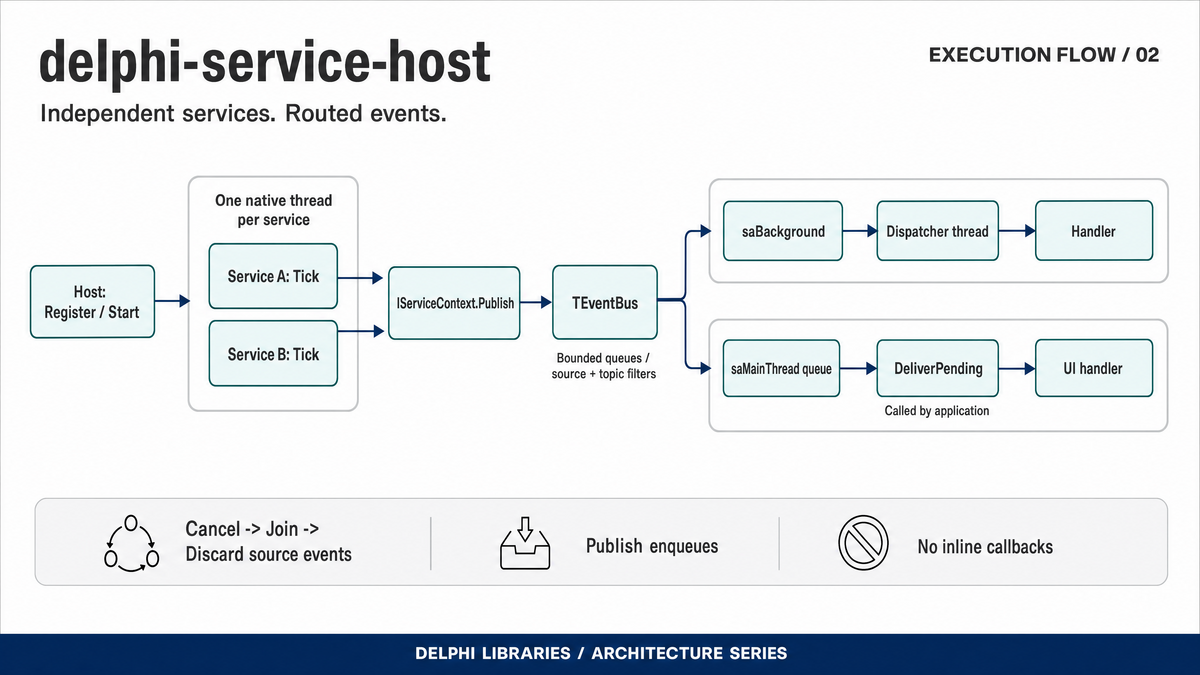
Each service owns a native thread and publishes through an event bus. Background subscribers run on the dispatcher; main-thread subscribers run when the application calls DeliverPending.
Why this exists
A background service is easy. Six of them, running at once, needing to react to each other, is where it stops being easy — because the obvious solution is to hand each service a reference to the others, and then the shutdown order starts to matter, and then a callback runs on the wrong thread, and then a service that you stopped is still heard from a moment later.
This is that problem solved once: services publish, subscribers subscribe, and nothing in the middle knows both ends.
What it guarantees
Each of these is a test, and each has a negative build — a compile-time switch that removes the protection and makes CI fail. A guarantee nobody can break on purpose is a guarantee nobody has checked.
| Guarantee | Removing it breaks |
|---|---|
| Publishing never blocks the publisher | PROVE_SYNC_PUBLISH |
| A subscriber runs on the thread it asked for | PROVE_NO_AFFINITY |
After Stop returns, nothing of that service is left pending |
PROVE_NO_DISCARD |
| A rejected registration is still owned by someone | PROVE_CONST_REGISTER |
The last one is the interesting one, and it is the reason the list is worth having. It breaks no assertion — with the protection removed the suite still passes, 59 of 59, and the process still exits 0. The only thing that changes is that a service refused for having a duplicate name is never freed. Only the leak gate sees it, so its CI step asserts the opposite of the other three: the run must succeed and heaptrc must report unfreed memory.
The four ideas
A service does not know its audience. IServiceContext gives a service its
name, a cancellation token, and a way to publish. It does not give it the host,
the bus, or any other service. What a service can do to the rest of the system
is bounded by that interface, not by discipline.
The source is stamped, not passed. AContext.Info('depth', ...) publishes
under the service's own name because the context fills it in. A service cannot
publish as another service, so a subscriber filtering on a source is filtering
on something the publisher could not forge.
Delivery has a lane. saBackground runs the handler on the dispatcher.
saMainThread runs it where VCL work is legal. The subscriber declares this
once, at Subscribe, and never has to think about it again.
Stopping is three steps, in order. Cancel the token, join the thread, then
discard that service's pending events from both lanes. Skipping the third leaves
a stopped service audible for another few milliseconds — which is exactly the
bug PROVE_NO_DISCARD reintroduces.
Install
With boss:
boss install github.com/ramonruanxc/delphi-service-hostBy hand: add src/ and lib/concurrent-pool/ to your search path. The pool is
a verbatim copy of an exact upstream commit, plus two small Delphi XE7 patches —
PROVENANCE.md records which commit and
which patches — so what you build is what CI builds, not whatever that
project's main branch happens to be today.
Writing a service
Descend from TBaseService and override Tick. The interval is how often the
host calls it; the rest has defaults.
type
  TPollerService = class(TBaseService)
  protected
    procedure Tick(const AContext: IServiceContext); override;
  public
    constructor Create;
  end;

constructor TPollerService.Create;
begin
  inherited Create('poller', 120, 'reports a queue depth');
end;

procedure TPollerService.Tick(const AContext: IServiceContext);
begin
  AContext.Info('depth', 'queue depth sampled', MeasureDepth);
end;
Starting and Stopped run once each, on the service's own thread, either side
of the ticks — so neither needs a lock against them.
A tick that raises does not kill the service. The fault is counted, published as
an error event, and the next tick happens on schedule. FaultCountOf reports
the tally.
Subscribing
{ everything }
Bus.Subscribe(Archivist.Handle, saBackground);

{ one source }
Bus.Subscribe(Auditor.Handle, saBackground, 'poller');

{ one source, one topic }
Bus.Subscribe(Watchdog.OnDepth, saBackground, 'poller', 'depth');

{ anything that needs the VCL }
Bus.Subscribe(StatusBar.Update, saMainThread, 'poller', 'depth');
An empty filter means no filter. Subscribers are plain of object methods, so
anything can subscribe — a service, a form, or a bare object like the demo's
archivist.
saBackground needs nothing from you: the dispatcher thread delivers it.
saMainThread needs one line in your application, because the bus will not
invent a main thread to run on:
procedure TMainForm.ApplicationIdle(Sender: TObject; var Done: Boolean);
begin
  Done := Host.Bus.DeliverPending = 0;
end;
DeliverPending delivers on the calling thread and returns how many it
delivered, capped so idle handling stays responsive under a burst.
Carrying something bigger than an integer
TServiceEvent has a Datum: Integer for the common case and a
Payload: IEventPayload for everything else. The payload is an interface, and
that is the whole ownership story: three subscribers can each hold the same
payload, the publisher lets go immediately, and it is freed when the last one
does — by nobody in particular.
type
  TScanResult = class(TInterfacedObject, IEventPayload)
  public
    Files: TArray<string>;
    function Describe: string;
  end;

AContext.Emit('scan-complete', TScanResult.Create, Length(Files));
The design this was extracted from handed the same raw Pointer to every
listener. Whoever freed it first left the others reading freed memory; if
nobody did, it leaked. There was no third option, only a convention.
Running the demo
See Quick start: open demo/Newsroom.dpr in Delphi and press
F9, or run fpc demo/Newsroom.dpr from the repository root.
Three services on three threads plus a non-service subscriber. Partway through, the poller is stopped while it still has a backlog in flight, and the demo exits non-zero if a single one of those events arrives afterwards.
  0.004s  host       all running
  0.265s  watchdog   depth 13 is above 12
  1.004s  watchdog   depth 11 is back under 12

  1.619s  host       stopping the poller mid-flight
  2.032s  host       events from the poller after Stop returned: 0

  what the archivist saw:
    poller     13 events
    watchdog   1 event
    ticker     7 events

  published 21, delivered 34, dropped 0

Newsroom: OK
delivered exceeds published because one event reaches several subscribers.
dropped is what a full lane discarded — publishing never blocks, so a bus that
cannot keep up drops and says so rather than stalling the service.
Tests
mkdir -p build/normal
fpc -B -Mdelphi -Sa -Fusrc -Futests -Fulib/concurrent-pool \
  -FUbuild/normal -obuild/Tests tests/Tests.dpr
./build/Tests
59 assertions. -Sa matters: without it the pool's internal guards compile out
and part of the suite proves nothing. -B matters locally for the same reason:
the quick start leaves .ppu files built without -Sa next to the sources, and
without -B Free Pascal reuses them.
Every test is bounded, and a watchdog thread turns an overrun into a named failure and exit 2 rather than a hung run:
WATCHDOG: test "waiting for the slow subscriber to catch up" exceeded 60 s
and is presumed deadlocked.
CI verifies the watchdog itself, with --watchdog=0. A safety net that has
never been dropped into is not known to hold.
Two things worth knowing about Pascal
Both cost real time here, and neither is obvious from the documentation.
A const interface parameter takes no reference. Register is written to
be called with the service created inline — Host.Register(TPoller.Create) —
and declared const, a registration refused for a duplicate name would leave an
object that no reference ever counted. Nothing frees it. It is by value on
purpose, which is what PROVE_CONST_REGISTER restores.
A managed temporary lives until its routine returns, not until its statement ends. Measured on FPC 3.2.2: a refcount read many statements after the temporary was created, but still inside the same routine, counts it; the same read after that routine returns does not. This is not a leak — but it will make an ownership test in a single long routine report a number that is off by one, and send you looking for a bug that is not there. The payload test's body is a separate routine for exactly this reason.
Where it came from
A service manager inside a personal project, with nineteen registered services and a listener mechanism I wrote and ran for years. This is that idea, extracted and rebuilt: the same shape, with the ownership question answered by refcounting rather than by convention, and every claim under a test that can fail.
Licence
MIT.