

Catalog · How the catalog works
MacClassicBitMIner

A bitcoin miner specifically made for a Mac Classic or similar vintage computer with custom assembly code optimized for 68000 cpu.
- ★ 1 on GitHub
Anyone may press Interesting, signed in or not. It helps others find this project.
README
MacClassicBitMiner
A real Bitcoin Stratum pool miner for classic Macintosh computers running Mac OS 6.0.8, written in THINK Pascal with an optional hand-written 68000 assembly SHA-256. It builds real block headers, does real double-SHA256, and submits real shares to real pools.
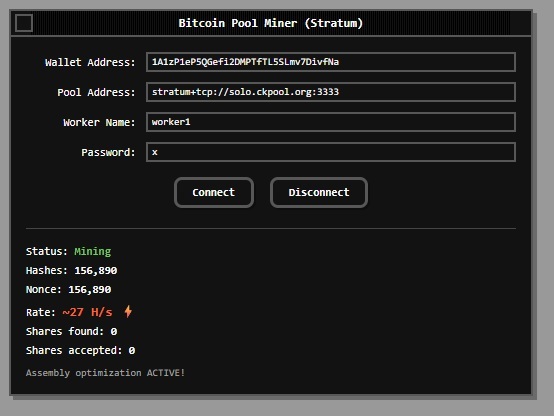
It will not earn meaningful Bitcoin — a Mac Plus does ~20 hashes/second and a modern ASIC does ~100,000,000,000,000. That is the whole point. This is a retro-computing art project that happens to be a technically correct miner.
Status
This is an in-progress revival. The mining logic has been rebuilt from a validated reference implementation and ported into Pascal; it has not yet been recompiled on real hardware (the author's vintage Mac is temporarily down).
| Area | State |
|---|---|
| SHA-256d, header assembly, merkle root, difficulty math | ✅ proven — see reference/ (46 automated checks, incl. reproducing the real genesis block hash) |
mining.notify / subscribe / set_difficulty parsing |
✅ proven — see reference/test_pascal_parser.py |
BitcoinMiner.pas port of the above |
✅ written; ⏳ not yet recompiled on hardware |
| On-device Self-Test (proves the crypto compiled correctly) | ✅ built in — click the button |
| MacTCP networking + DNS | ⏳ needs the Apple DNR glue added to the project (or a numeric IP) |
sha256.a assembly speedup |
⚠️ experimental / unverified (Pascal path is the default) |
If you build it, click Self-Test first — it hashes the genesis block header
on your Mac and must display Self-Test: PASS. That single check proves the
whole SHA-256d + byte-order pipeline compiled correctly, with no pool required.
What was fixed in this revival
The earlier code looked complete but did not actually mine or compile cleanly. The important fixes:
- It now hashes a real 80-byte block header. The previous loop hashed only 4 bytes of the nonce, so it wasn't mining any real work.
- It parses the actual job.
mining.notifyis fully decoded (prevhash, coinbase parts, merkle branch, version, nbits, ntime) and the coinbase + merkle root + header are assembled correctly. - Shares are submitted correctly — real job id, extranonce2, ntime, and a big-endian nonce — so a pool can accept them.
- DNS works. Pool hostnames like
solo.ckpool.orgare resolved via the MacTCP DNR (numeric IPs also accepted). The old code treated the hostname as a dotted-quad IP and could never connect. - Compile/logic bugs fixed: the
OpenDriver/ioCRefNumMacTCP setup; a SHA-256 word-load that byte-swapped on the (big-endian) 68000 and would have produced wrong hashes; and a case-insensitivity clash between the PascalSigma0/sigma0helpers. - Long messages no longer truncate — Stratum lines are buffered instead of being forced into a 255-byte string.
Requirements
Hardware: any 68000/68020/68030 Mac, 1 MB RAM recommended, MacTCP installed, a network connection.
Software: Mac OS 6.0.8+, THINK Pascal 4.0+, MacTCP configured with an IP.
For DNS you also need Apple's DNR glue (dnr.c, from the MacTCP developer kit)
added to the project — or just enter a numeric IP for the pool.
Building
- Open
BitcoinMiner.pasin THINK Pascal. - For DNS support, add Apple's DNR glue (
dnr.c) to the project. To build without it (numeric-IP pools only), change the line near the top:{$SETC USE_DNR := 1}to{$SETC USE_DNR := 0}. - Project → Build, then run.
- Click Self-Test. It must say
Self-Test: PASS.
Optional: assembly speedup (experimental)
sha256.a provides 68000 assembly versions of the SHA-256 helpers. It is
unverified on hardware — the Pascal path is the validated default. To try it:
- Add
sha256.ato the project and add{$L sha256.a}toBitcoinMiner.pas. - Comment out the seven Pascal functions
ROTR,Ch,Maj,BigSigma0,BigSigma1,SmSigma0,SmSigma1and declare eachexternalinstead, e.g.function ROTR(x: LongInt; n: Integer): LongInt; external;. - Rebuild and click Self-Test. If it does not say PASS, revert to Pascal.
Usage
- Launch the miner.
- Enter:
- Wallet Address — your Bitcoin address (used as the worker username on solo pools).
- Pool Address — e.g.
stratum+tcp://solo.ckpool.org:3333(orIP:port). - Worker Name and Password (
xis typical).
- Click Connect. Status moves Connecting → Subscribing → Authorizing → Mining, and the hash rate and share counters update live.
Example pools
| Pool | Address |
|---|---|
| Solo CKPool | stratum+tcp://solo.ckpool.org:3333 |
| (others) | any Stratum v1 pool host:port |
The reference implementation
reference/ contains the Python ground truth the Pascal was
ported from, plus its test suite. Run it with:
python reference/test_reference.py       # crypto + pipeline
python reference/test_pascal_parser.py    # Stratum parser + wiring
It validates SHA-256 against NIST vectors, reconstructs and re-hashes the real Bitcoin genesis block header, checks merkle-branch folding, cross-checks the no-bignum difficulty test against native big integers over 20,000 random cases, and verifies every Stratum field lands in the right slot.
Not yet verified against a live pool: the prevhash word-swap (genesis can't exercise it — its prevhash is zero). If a pool rejects otherwise-valid shares, check that first.
Reality check
You will not make money, find a block, or reach a payout threshold — the numbers are astronomical against you. You will do real SHA-256d, submit real shares, appear on a pool dashboard, and run 2009 cryptocurrency on 1991 hardware.
License
CC0-1.0 (public domain). Experimental/educational software, no warranty.
Acknowledgments
Drewy Nucci for the fever dream; Satoshi Nakamoto for Bitcoin; Apple for the Macintosh; Motorola for the 68000; and everyone who said you can't mine Bitcoin on a Mac Plus.