

Catalog · How the catalog works
least-squares-method

This is an experiment in reviving legacy code. The original source code was photographed from a printed listing and can be found in the `data/` folder. I modified the code to compile and run on **Turbo Pascal 5.5**
- ★ 1 on GitHub
Anyone may press Interesting, signed in or not. It helps others find this project.
README
METODA NEJMENSICH CTVERCU (Least Squares Method)
!!!! Pull requests are welcome!
Dedicated to Frantisek — whom I admired as a child. He was a great programmer and always repaired our family computer when it was broken.
This is an experiment in reviving legacy code. The original source code was photographed from a printed listing and can be found in the data/ folder. I modified the code to compile and run on Turbo Pascal 5.5 (the original was written for TP 3.x).
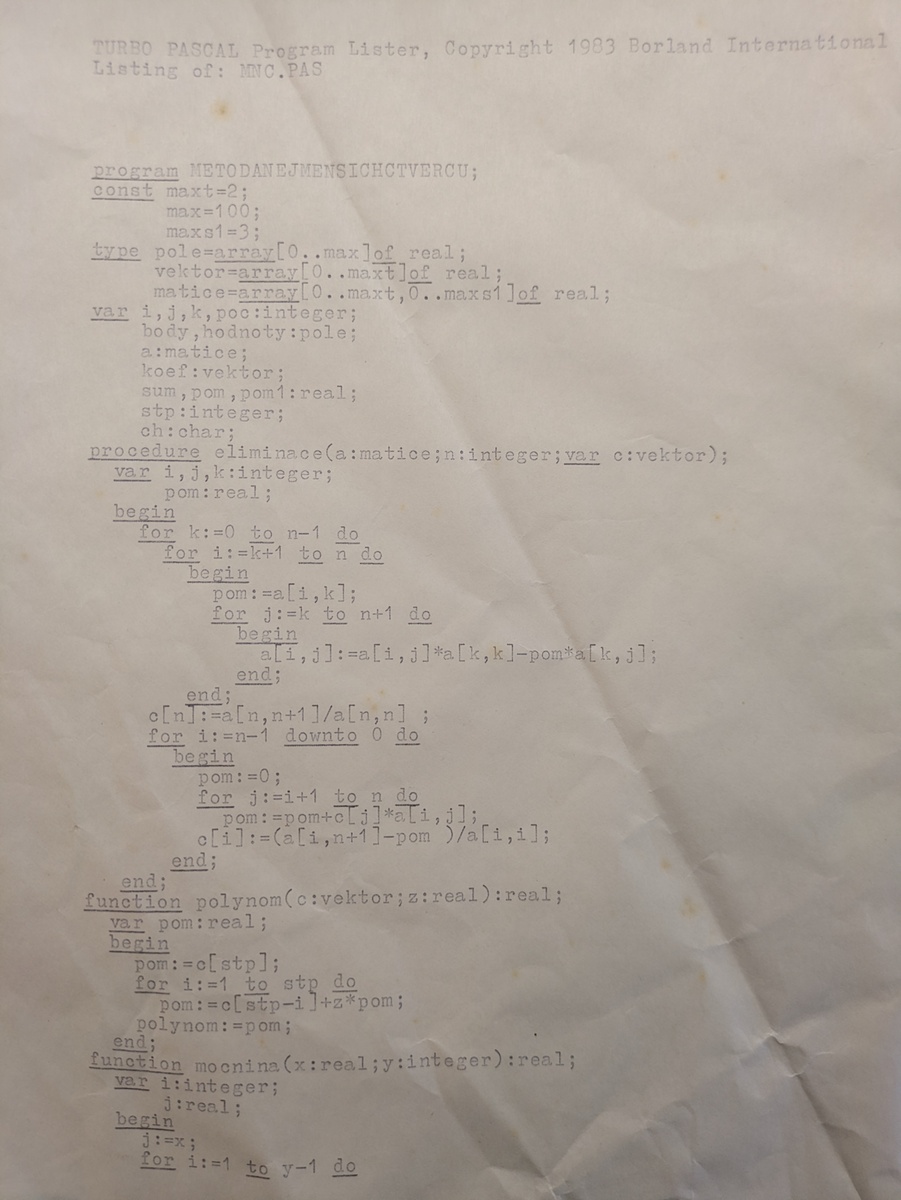
The original source: a printed listing, photographed.
My plan is to compare the results with a modern Python implementation to verify correctness and explore the numerical differences.
Legacy Turbo Pascal (DOS) program for computing a least-squares polynomial approximation of measured data points. Originally written for Borland Turbo Pascal and intended to run in a DOS environment.
Note: The program interface is in Czech. An English version is planned for the future.
📌 Overview
This program implements the method of least squares to approximate a set of measured points
((x_i, y_i)) using a polynomial of low degree.
The user:
- Enters measured data points
- Chooses the degree of the polynomial
- The program computes polynomial coefficients
- Displays approximation errors
- Allows evaluation of the polynomial for arbitrary
x
🧮 Mathematical Background
The program constructs a polynomial:
[ P(x) = a_0 + a_1 x + a_2 x^2 + \dots + a_n x^n ]
Coefficients (a_i) are computed by solving the normal equations:
[ (A^T A) a = A^T y ]
Where:
- (A) is the Vandermonde matrix of input
xvalues - (y) is the vector of measured
yvalues
A custom Gaussian elimination routine is used to solve the linear system.
🗂 Program Structure
Constants
maxt = 2— maximum polynomial degreemax = 100— maximum number of data points
Data Types
pole— array of real values (input data)vektor— vector of polynomial coefficientsmatice— augmented matrix for linear equations
🔧 Main Components
eliminace
Performs Gaussian elimination and back-substitution to solve a linear system.
polynom
Evaluates the polynomial using Horner’s method.
mocnina
Computes integer powers of a real number.
🖥 User Interaction
- Text-based interface using the CRT unit
- Single-key input with
ReadKey - Interactive correction of entered points
- Live evaluation of polynomial values
⚠ Limitations
- Requires DOSBox + Turbo Pascal 5.5 to run
- Limited polynomial degree (
maxt = 2) - Numerical robustness — see Numerical Stability Considerations below
▶ How to Run
Requirements
- DOSBox - DOS emulator
sudo apt install dosbox
First Time Setup
After cloning, extract Turbo Pascal from the included disk images:
cd turbo_pascal
./setup_turbopascal.sh
Run the Program
cd turbo_pascal
./run_mnc.sh
This opens DOSBox, compiles and runs the program.
More Info
See turbo_pascal/README.md for:
- Turbo Pascal IDE usage
- Code changes from original TP3 to TP5.5
- Troubleshooting
🔢 Numerical Stability Considerations
The implementation of the least squares method in this program uses normal equations combined with a hand-written Gaussian elimination routine.
While this approach is simple and historically common, it has known numerical drawbacks:
- Forming normal equations squares the condition number of the system
- No pivoting is used during Gaussian elimination
- Rows are not normalized during elimination
- Intermediate values can grow rapidly
As a result, the algorithm may suffer from:
- Loss of precision for closely spaced
xvalues - Large rounding errors for higher polynomial degrees
- Numerical instability for larger datasets
Practical Impact
In its current configuration, the program is reasonably safe only for:
- Very low polynomial degrees (
maxt = 2) - Small numbers of data points
- Well-scaled input values
Future Improvements
If this code is ever modernized, recommended improvements include:
- Using QR decomposition instead of normal equations
- Adding partial or full pivoting to Gaussian elimination
- Scaling or normalizing input data
- Using numerically stable linear algebra libraries
🔄 Future Plan (Optional)
Phase 2 — Porting & Modernization
Potential future improvements:
- Port to Free Pascal or modern Pascal
- Remove CRT dependencies
- Numerical fixes — see Future Improvements above
- Increase supported polynomial degree
- Add file-based input/output
📁 Files
????????? README.MD                        # This document
????????? data/                            # Photos of original printed code
????????? turbo_pascal/
    ????????? README.md                    # Technical details & setup
    ????????? MNC.PAS                      # Working TP5.5 version
    ????????? MNC_ORIGINAL.PAS             # Original TP3 source (historical)
    ????????? installed/                   # Turbo Pascal 5.5 installation (created by setup_turbopascal.sh)
    ????????? *.sh                         # Run scripts
🕰 Historical Note
This code reflects classic 1980s numerical programming practices:
- Manual matrix handling
- Custom solvers
- Text-mode UI
Preserved for educational, historical, and experimental purposes.
✍ Author / Origin
- Original program: DALSAN soft
- Turbo Pascal program lister © 1983 Borland International
- Documentation & execution plan added later