

GamePi

A project creating a handheld retro gaming system from scratch
- Active · last change 8-1-2025
- ★ 1 on GitHub
README
🎮 GamePi
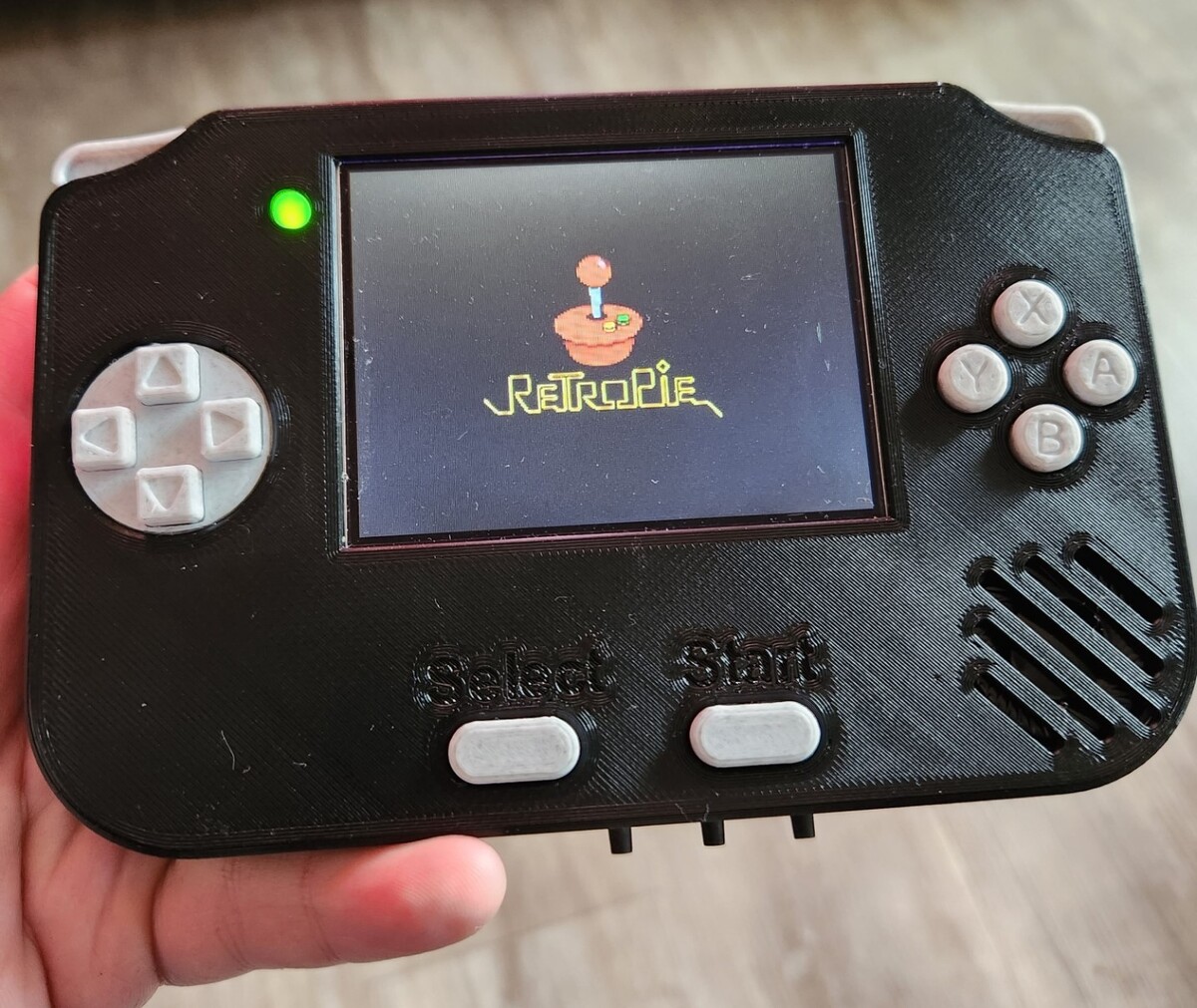
A portable handheld retro gaming console powered by a Raspberry Pi Zero W. The GamePi is designed as a low‑cost, DIY‑friendly device capable of running classic game console emulators with full physical controls, a compact display, and portable power.
🎯 Project Goals
- Design a portable handheld retro gaming console that supports targeted retro console emulators with a complete control interface:
- NES
- Sega Genesis
- SNES
- Game Boy, Game Boy Color, Game Boy Advance
- Include all essential controls:
- Directional pad (D‑Pad)
- A, B, X, Y buttons
- R/L bumpers
- Start & Select buttons
- Mono audio with volume control
- Reuse already‑owned components from college program where possible to keep costs low.
- Keep the design affordable and iterative — the current revision is a working prototype, to be refined over time.
🛠 Design & Features
- 3.5‑inch LCD screen for retro game visuals
- Display settings interface via 3 front‑mounted buttons
- Mono audio output with adjustable volume wheel
- Portable — powered by onboard AA batteries or external micro‑USB
- Removable Raspberry Pi Zero W
- Accessible ports — micro‑USB (power), USB (devices), and mini‑HDMI
- Removable battery compartment cover
- Removable Pi cover with convenient port cutouts
🧩 Hardware Overview
- Main Processor: Raspberry Pi Zero W
- PCB: Designed in Altium
- Enclosure & Buttons: Designed in Fusion 360
- Display: 3.5" LCD
- Audio: Mono speaker with volume control
- Power:
- AA battery pack (portable mode)
- External micro‑USB (bench power mode)
🖼 Enclosure & Assembly
The enclosure is designed for both ease of access and durability:
- Rear battery cover allows quick battery changes
- Rear Raspberry Pi cover enables Pi removal for other projects
- Pi connects to PCB via female header rail for tool‑free removal
- Port access slots in the Pi cover for power, USB devices, and HDMI
📜 Design Philosophy
This prototype intentionally uses mixed component types (axial + SMD resistors, etc.) for the sake of component availability:
Some unintuitive design choices may be noticed in the PCB files. For example, the use of both axial and SMD resistors. This stems from goal #3 — “Reuse already‑owned components from college program.” Some SMD components were not available during development, so axial/radial parts were substituted.
📂 Repository Structure
GamePi/
????????? Enclosure/          # Fusion 360 CAD models for case & buttons
????????? PCB/                # Altium PCB design files
????????? media/              # Images and demonstration video
????????? README.md
🚀 Future Improvements
- Refine PCB layout for cleaner component selection
- Improve enclosure ergonomics
- Integrate rechargeable lithium battery + charging circuit
- Implement conductive silicon button pads for quieter buttons
- Add stereo audio support
- Explore Pi 4 CM for improved performance
👤 Author
Cameron Stauffer
Electrical Project Engineer | Hardware & Embedded Systems Enthusiast
LinkedIn