

Catalog · How the catalog works
clifford

Geometric Algebra for FreePascal
- ★ 1 on GitHub
Anyone may press Interesting, signed in or not. It helps others find this project.
README
Clifford
Geometric Algebra (a.k.a. Clifford algebra) package for the Free Pascal compiler, with a toolkit that generates a ready-to-use unit for any algebra Cl(p,q) with p + q up to 6.
Contents
| Unit | Algebra | Basis vectors |
|---|---|---|
cl2 |
Cl(2,0), 2D Vectorspace geometric algebra | e1, e2 |
cl3 |
Cl(3,0), 3D Vectorspace geometric algebra | e1, e2, e3 |
cl4 |
Cl(4,0), 4D Vectorspace geometric algebra | e1 .. e4 |
cl13 |
Cl(1,3), Spacetime algebra (STA) | g0 .. g3, g0^2 = +1 |
Each unit provides a multivector type, one type per grade (vectors, bivectors, trivectors...), the basis blades as constants, and the usual operations: geometric, dot and wedge products (and the cross product in 3D), reverse, involution, conjugate, dual, norms, inverse, projection, rejection, reflection and rotation.
Requirements
- Free Pascal 3.2 or later.
- Lazarus, to install the package or to build the toolkit GUI.
The units depend on the Free Pascal RTL only.
Installation
Install the clifford.lpk package in Lazarus, or add the units to your
project.
Usage
uses
  cl3;

var
  a, b, v: TVector;
  R: TMultivector;
begin
  a := 1*e1;
  b := 1*e2;
  v := 2*e1 + 3*e3;
  R := b * a;                        // rotor: twice the angle from a to b
  Writeln(v.Rotation(a, b).ToString);
  Writeln((R * v * R.Inverse).ToString);
end.
Spacetime algebra: a Lorentz boost is a rotor too. Here a particle at rest is boosted to v = 0.6c along g1, and its squared norm (the invariant mass) is preserved:
uses
  Math, cl13;

var
  phi: double;
  p, q: TVector;
  R: TMultivector;
begin
  phi := ArcTanh(0.6);                     // rapidity for v = 0.6c
  p := 1*g0;                               // particle at rest, unit mass
  R := Cosh(phi/2) - Sinh(phi/2)*g01;      // boost rotor along +g1
  q := TVector(R * p * R.Reverse);
  Writeln(q.ToString);                     // +1.25g0 +0.75g1 (gamma, gamma*v)
  Writeln(p.SquaredNorm:0:6, ' ', q.SquaredNorm:0:6);  // 1.000000 1.000000
end.
Conventions
Dotis the "fat" dot product: e_A . e_B = e_A e_B when one index set contains the other, 0 otherwise (scalars included).Involuteis the grade involution,Conjugatethe Clifford conjugate.SquaredNormis <X ~X>_0,NormisSqrt(Abs(SquaredNorm)).Dualis X * I, with I the unit pseudoscalar.Inverseis the multiplicative inverse: X * X.Inverse = X.Inverse * X = 1. Dividing by a non-invertible value raises a floating-point exception.X.Rotation(A, B)is B A X A⁻¹ B⁻¹, the composition of two reflections: it rotates X in the plane A ∧ B by twice the angle from A to B. For example, with A = e1 and B at 45° from e1 towards e2, e1 is rotated to e2.- Widening to
TMultivectoris implicit; narrowing (to a k-vector or todouble) is explicit:TVector(M),double(M). Components[...]reads and writes single coefficients, e.g.B.Components[bc12],M.Components[mc123].ToStringwrites the non-zero components, e.g.+2 -1.5e1 +3e3;ToString(APrecision, ADigits)sets the number format.
Toolkit
The toolkit/ folder contains the generator of the units, as a GUI
and as a command-line program. Build them with:
lazbuild toolkit/clgengui.lpi                  # GUI: toolkit/build/clgengui
lazbuild toolkit/clgen.lpi                     # command line: toolkit/build/clgen
GUI
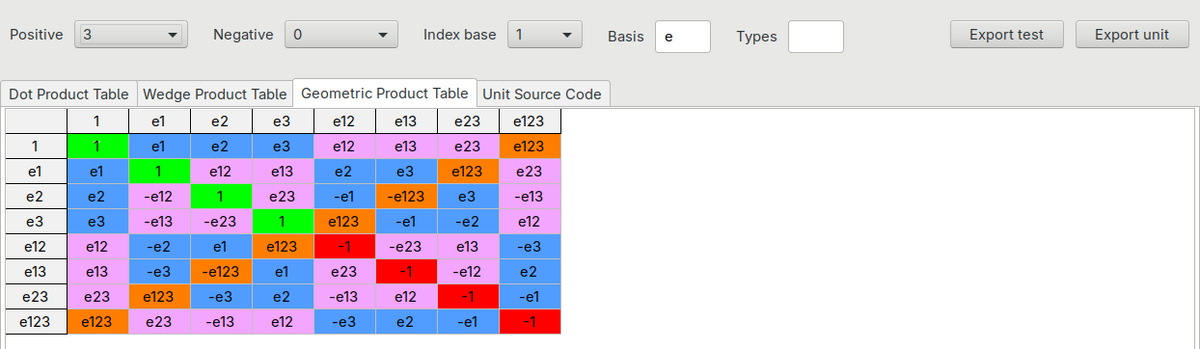
Choose the number of positive and negative basis vectors, the index base, the basis prefix and the type prefix. The tabs show the dot, wedge and geometric product tables, with the cells colored by grade, and the generated source; Export unit saves the unit and Export test saves a program that checks it.
Command line
clgen -p <positive> [-q <negative>] [-b <0|1>] [-n <basis prefix>]
      [-x <type prefix>] [-u <unit>] [-o <file>] [-t <test file>]
[-i <test iterations>]| Option | Meaning | Default |
|---|---|---|
-p, -q |
number of basis vectors squaring to +1 and to -1 | -q 0 |
-b |
index of the first basis vector | 1 (e1, e2...) |
-n |
prefix of the basis names | e |
-x |
prefix of the type names, inserted after the T (CL3 gives TCL3Vector, TCL3Versor1...) |
none |
-u |
unit name | cl or cl<q> |
-o |
output file | <unit>.pas |
-t |
also write a program that checks the unit | none |
-i |
iterations of the check program | chosen from the dimension |
Examples:
clgen -p 3 -t cl3check.lpr                     # Euclidean 3D space
clgen -p 1 -q 3 -b 0 -n g -u cl13              # spacetime algebra: g0..g3, g0^2 = +1
clgen -p 4 -q 1 -u cga3                        # conformal model of 3D space
Tests
Each unit has a test program and a check program in tests/:
lazbuild tests/cl3test.lpi  && tests/build/cl3test
lazbuild tests/cl3check.lpi && tests/build/cl3check
Author
Melchiorre Caruso (melchiorrecaruso@gmail.com)
References
- C. Doran, A. Lasenby, Geometric Algebra for Physicists, Cambridge University Press, 2003.
- E. Hitzer, S. Sangwine, Multivector and multivector matrix inverses in real Clifford algebras, Technical Report CES-534, 2016.
- D. S. Shirokov, On computing the determinant, other characteristic polynomial coefficients, and inverse in Clifford algebras of arbitrary dimension, Computational and Applied Mathematics, 2021.
License
MIT License, Copyright (c) 2024-2026 Melchiorre Caruso.