

Catalog · How the catalog works
advpas350

Ports of Colossal Cave Adventure for classic and modern Pascal compilers
- ★ 2 on GitHub
Anyone may press Interesting, signed in or not. It helps others find this project.
README
Adventure(s) in Pascal (aka "Colossal Cave")
This repository contains ports of Barry C. Breen's "Adventures in Pascal" (1980-1983) to various old and modern Pascal compilers. The original is known as BREE0350 in Arthur O'Dwyer's collection of Adventure versions. It is a translation of Kent Blackett's FORTRAN-IV-PLUS version of Crowther and Woods' Colossal Cave Adventure (350 points), written in OMSI Pascal V1.2 for RSX-11M on a PDP-11/23 and distributed via DECUS. The original distribution is in original (see README.md there), the sources extracted from it in src/omsi. The ported sources are in the other subfolders of src.
The goal was to stay as close to the original as possible for each port,
applying changes only where the specific compiler needs them. There is one file per original module, with the same name (in lower case), and all comments have been kept. Changes are marked with comments starting with CHANGED:, so grep CHANGED: src/tp3/*.pas lists them for one platform. Only purely mechanical changes are not marked individually:
removed EXTERNAL declarations, added OVERLAY prefixes (PASTA/80 only), disabled {$C ...} blocks and removed form feeds.
The ports have been conducted with the help of Claude Code Opus 5.5.
Status
Ready-to-run versions for the Agon, Spectrum Next, CP/M, DOS, Linux, Windows and macOS (with data files) are available on the releases page.
The following compilers are currently supported:
The following table shows the status per compiler and target.
| Compiler | Target | Status | Screenshot |
|---|---|---|---|
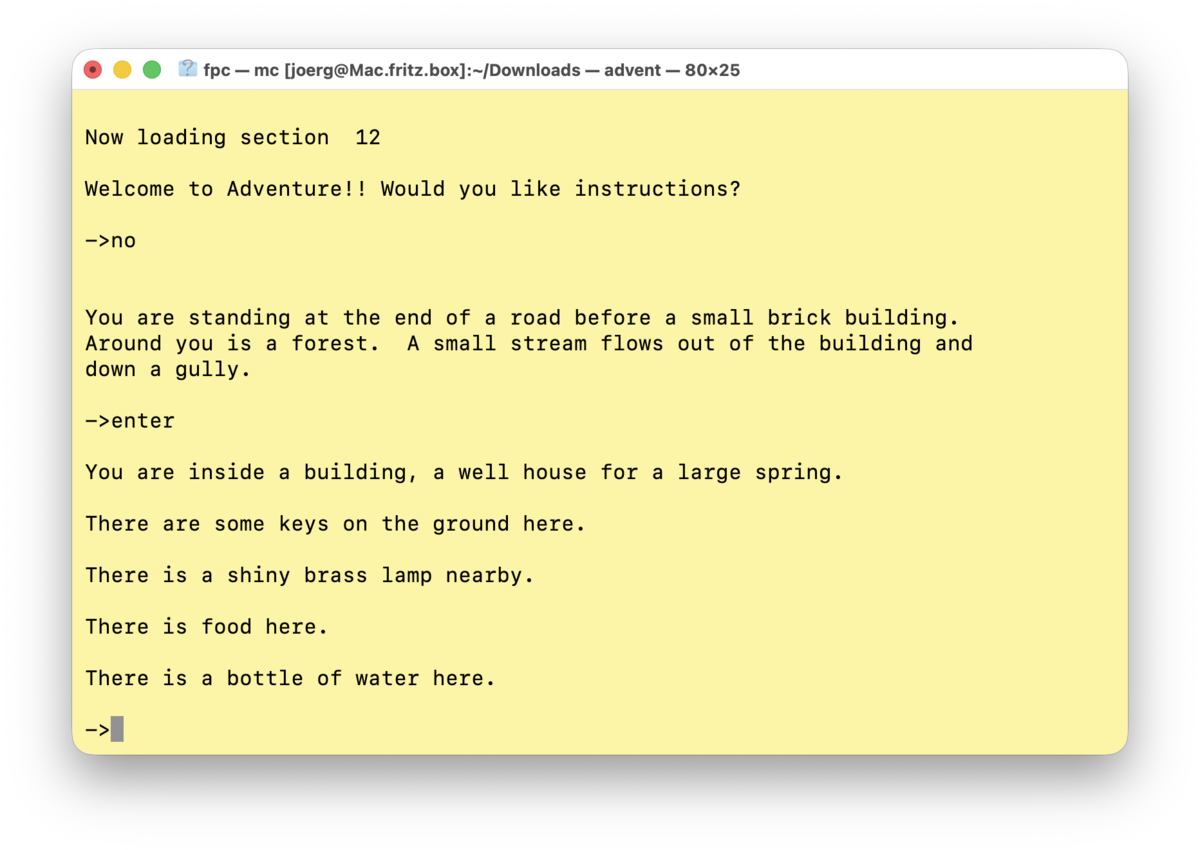
| Free Pascal | Any | Works ({$MODE TP} in the source), completes the 350 point walkthrough. Tested on Linux, Windows and macOS (see Other systems below). |
 |
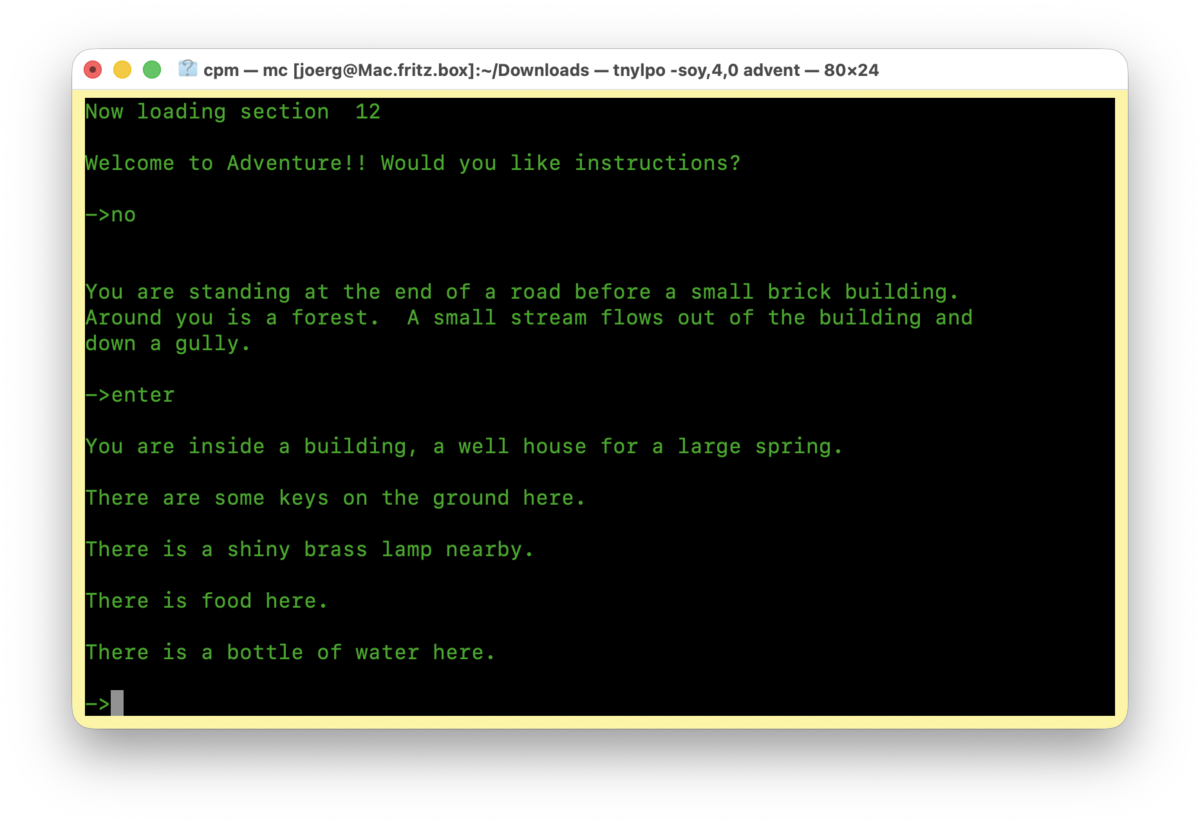
| Turbo Pascal 3 | CP/M | Works (advent.com 43,136 bytes plus 6.4K data at run time, no overlays needed), completes the 350 point walkthrough. |
 |
| Turbo Pascal 5.5 | DOS | Works (33K code), completes the 350 point walkthrough. | 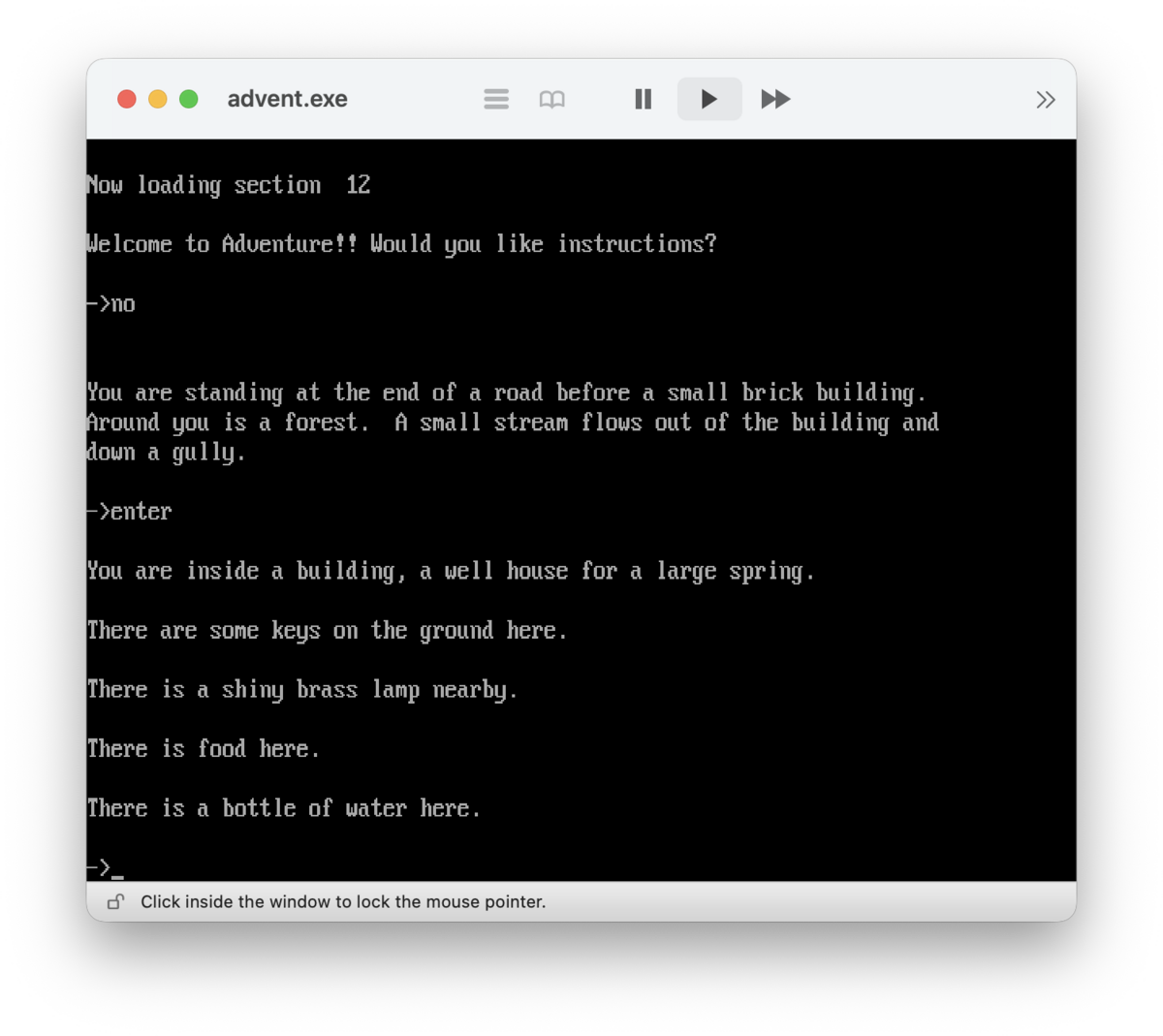 |
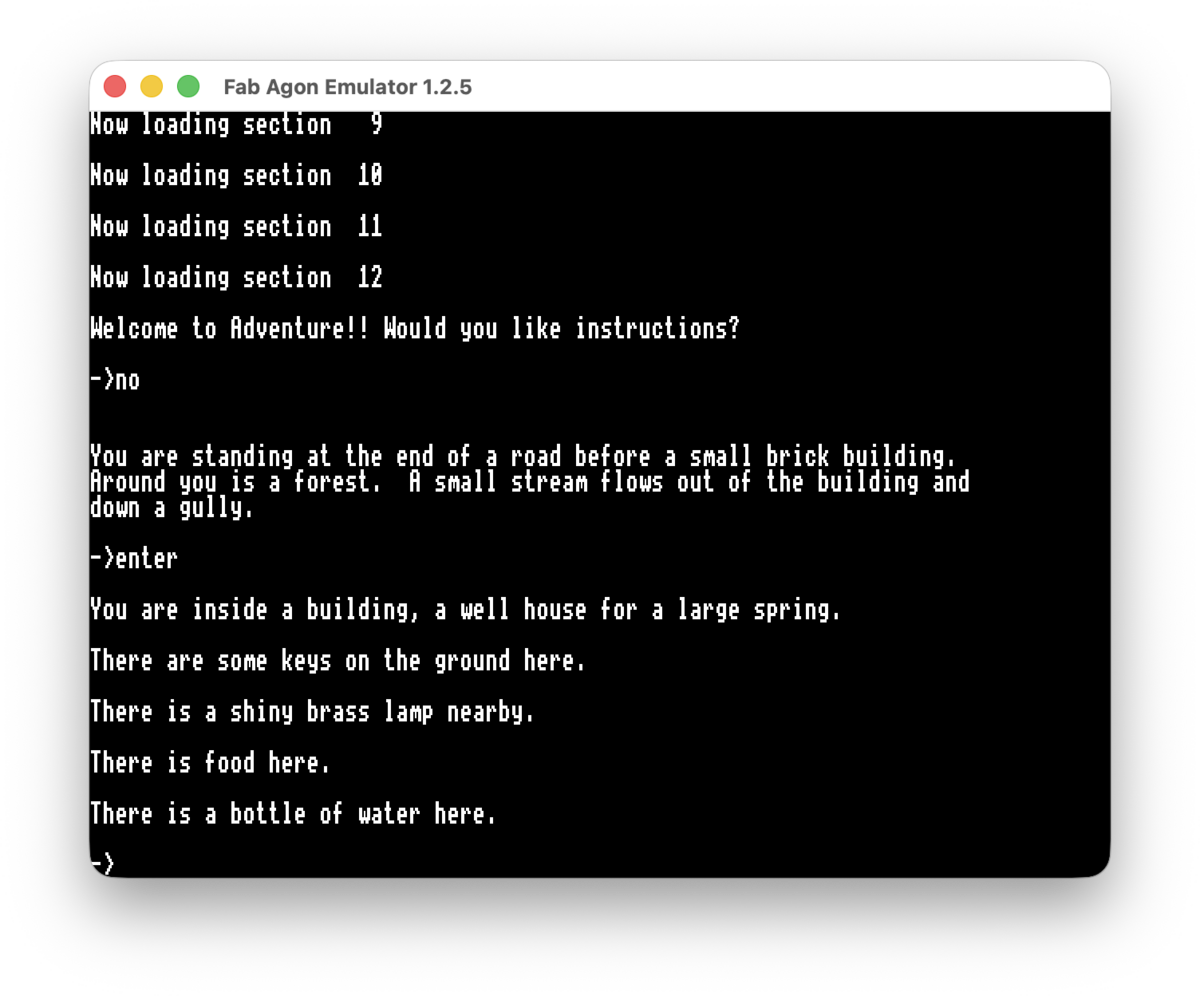
| PASTA/80 | Agon | Works, with overlays (advent.bin 24,223 bytes, advent.ovr 65,536 bytes for eight 8K slots). Completes the 350 point walkthrough. Also played on a real Agon, including saving and restoring a game. |
 |
| PASTA/80 | Spectrum Next | Works with overlays, at 28 MHz. Needs to be compiled to start address $6000 (resident part 22.8K, leaving 7.9K heap). Played manually in CSpect and on a real Next (up to the bird and the rod, including saving and restoring a game), walkthrough not yet run due to lack of automation. | 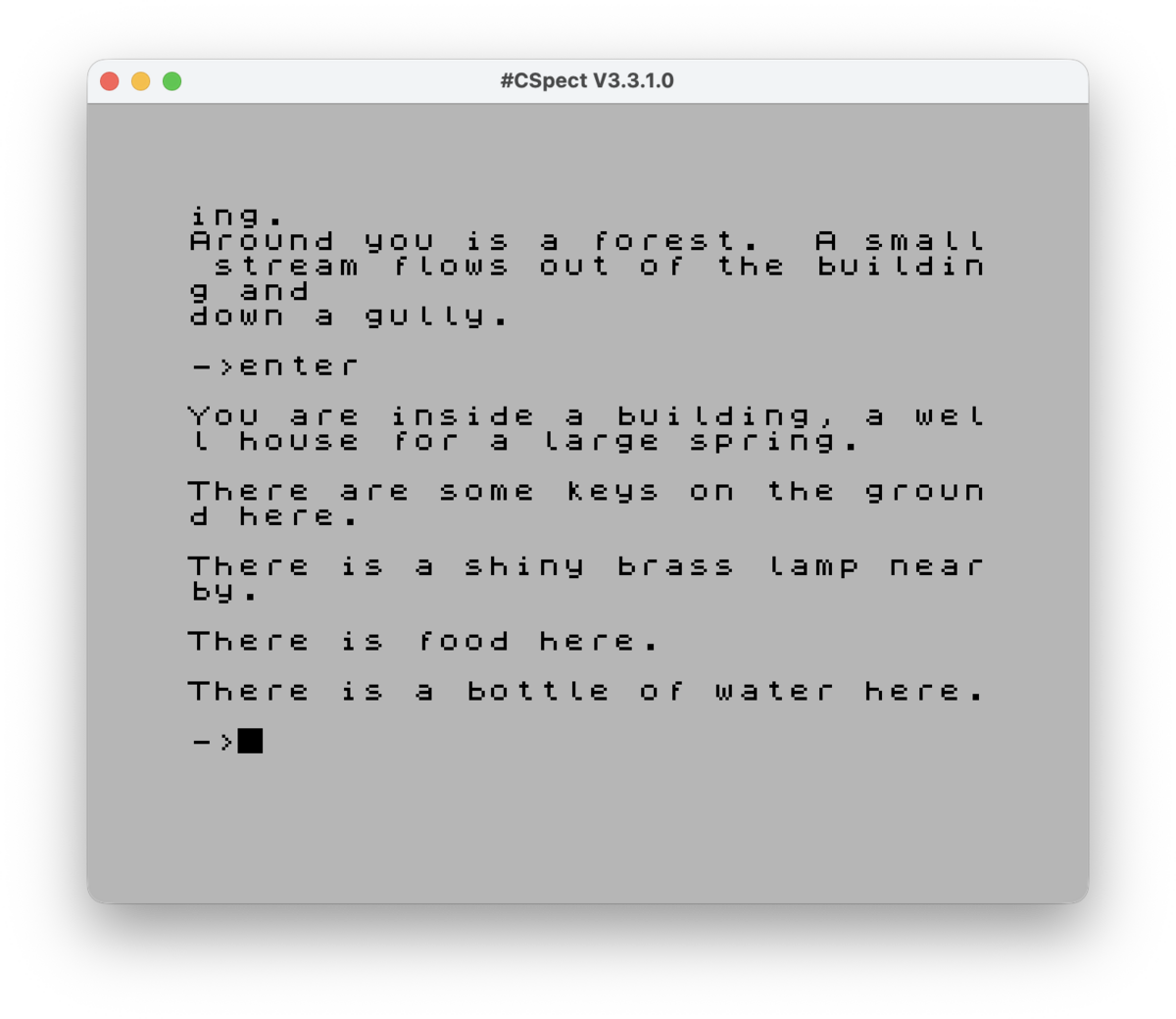 |
| PASTA/80 | CP/M | Too large (about 63.8K without overlays, including 4.5K static data, and PASTA/80 has no overlays on disk yet). | n/a |
| PASTA/80 | Spectrum 128K | Not yet. Has overlays, but no file I/O and too little resident memory. Maybe later with esxDOS. | n/a |
| PASTA/80 | Spectrum 48K | Not yet. Has no overlays, no file I/O and too little resident memory. Maybe later with esxDOS. | n/a |
Source trees
The sources in src exist four times, once per compiler. Each tree compiles
as is, without any preprocessing, and each one deviates from the original only
where its compiler requires it. The trees are maintained by hand; the
walkthrough test (see below) makes sure that they all play the same game.
| Directory | Compiler | Target |
|---|---|---|
| src/fpc | Free Pascal (TP mode) | macOS (Linux etc. untested) |
| src/tp3 | Turbo Pascal 3 | CP/M |
| src/tp55 | Turbo Pascal 5.5 | DOS |
| src/pasta | PASTA/80 | Agon, Spectrum Next (later 128K) |
The original sources in src/omsi make comparisons easy:
diff src/omsi/subs1.pas src/tp3/subs1.pas shows exactly what the port changed
for one platform, and diff src/tp3/subs1.pas src/fpc/subs1.pas what differs
between two platforms. Note that the main program is main.pas in the
original and advent.pas in the port.
Each tree has the same files:
| File | Contents |
|---|---|
advent.pas |
Main program (formerly MAIN). Includes all other modules. |
advgbl.pas |
Global declarations (formerly ADVGBL). |
compat.pas |
New. Helpers that emulate OMSI's file buffer semantics, plus SAYLINE for text output. |
advfls.pas |
Separate program that creates the data files from ADVENTURE.DAT (formerly ADVFLS, now also does POOF's job). |
| everything else | One file per original module, e.g. subs1.pas for SUBS1. |
Helper scripts are in tools, the walkthrough test in tests.
Building
Each source tree (except src/omsi) has three scripts that can be called from
anywhere:
| Script | Does |
|---|---|
build.sh |
Builds the data files and the game from scratch into build/fpc, build/cpm, build/tp55 or build/agon and build/next. |
run.sh [seed] |
Starts the game from there, in the emulator if needed. Saved games are kept in that directory. |
test.sh |
Plays the 350 point walkthrough and compares the transcript with the expected one (see Testing). |
tools/build.sh calls the build scripts of all trees, and with --test also
the test scripts:
$ tools/build.sh           # Data files and all versions
$ tools/build.sh --test    # Additionally plays the 350 point walkthrough on each
$ src/tp3/build.sh         # Only the CP/M version
$ src/tp3/run.sh 1234      # Play it under tnylpo, with random seed 1234
$ tools/package.sh         # Zip files for all versions in build/release
$ tools/package.sh fpc     # Only the zip for the host (e.g. advpas350-macos.zip)
The scripts share their settings via tools/common.sh. They need PASTA/80 (with
sjasmplus),
tnylpo and Turbo Pascal 3 for CP/M (the
directory containing TURBO.COM, TURBO.MSG and TURBO.OVR goes into
TP3DIR). Free Pascal and Turbo Pascal 5.5 (TP55DIR with TPC.EXE and
TURBO.TPL, run under emu2 given by EMU2)
are optional; their build scripts skip them if they're missing. PASTA points
to the pasta80 binary if it isn't the default one. Running and testing the
Agon version needs the
Fab Agon emulator (FAB,
AGON_CLI, see tools/run-agon.sh). Doing it by hand works
like this:
Data files. The game reads its text, vocabulary and tables from random access files, just like the original. These are created by ADVFLS. Each tree has its own version and creates its own data files. For PASTA/80, ADVFLS is compiled for CP/M and run under tnylpo:
$ cd src/pasta
$ pasta80 --cpm advfls.pas
$ cp ../../original/files/adventure.dat adventur.dat    # 8.3 name for CP/M
$ tnylpo advfls
This creates ADVTXT.DTA, KATAB.DTA, ADVDAT.DTA, ADVENT.DTA and
ADVWIZ.DTA (the latter holds saved games). tnylpo maps CP/M file names to
lowercase names on the host, so ADVENTUR.DAT must be named adventur.dat
there, and the data files come out as advtxt.dta etc. tools/verify-data.py
compares the first four record by record with the original 1983 files in
original/files. They are identical. Turbo Pascal 3 uses the same typed
file format; its ADVFLS gives the same records (only unused bytes behind the
strings differ). Free Pascal and Turbo Pascal 5.5 use typed files without a
header, so their files are different. Both Turbo Pascals need ADVENTUR.DAT
with CRLF line endings; with LF only, TP3's ADVFLS hangs.
Host. fpc advent.pas in src/fpc. On macOS, src/fpc/build.sh builds a
universal binary for Apple Silicon and Intel Macs (it compiles for both and
combines them with lipo).
Other systems. The GitHub Actions workflow
.github/workflows/build.yml builds the Free
Pascal version for Linux (x86_64 and ARM64), Windows and macOS (ARM64, with
FPC from Homebrew; the universal binary needs a local build), plays the
walkthrough on each and packs the zips. It only runs when started by hand, with "Run
workflow" on the repository's Actions page or gh workflow run build.yml. The
zips end up as artifacts of the run, and optionally (if a release tag is given
when starting it) attached to that release.
CP/M. tools/tp3c.sh src/tp3 advent compiles the game with Turbo Pascal 3
under tnylpo by remote-controlling the TURBO.COM menu (it converts the line
endings to CRLF, which TP3 needs, in a build directory). Copy advent.com and
the five .DTA files to a CP/M disk and run
advent. Of course the sources can also be compiled with TP3 directly.
DOS. tpc advent.pas in src/tp55.
Agon. pasta80 --agon --ovr --release advent.pas in src/pasta gives
advent.bin and advent.ovr. Copy advent.bin,
advent.ovr and the five .DTA files into the same directory on the SD card,
change into it and type advent. The game opens its files without a path, so
it must be started from that directory. MOS 3 is required; MOS 2.x reports
"Invalid executable".
Random seed. All versions take an optional integer on the command line
(advent 1234), which is used as the seed of the random number generator.
The same seed gives exactly the same game on every platform. Without it, the
seed is random. (The Spectrum targets of PASTA/80 have no command line, so
there the seed will always be random.)
Changes compared to the original
All platforms
- Separate compilation. The original modules were compiled separately
with ADVGBL in front of each and linked into an overlaid task (see
ADVBLD.ODL). Now
advent.pasincludes everything. TheEXTERNALdeclarations are gone, and the include order follows the call dependencies, since Pascal requires declaration before use. - Forward declarations. Besides the
FORWARDdeclarations within modules that the original already had, two call cycles across modules remain:SAYITcallsPARSErecursively (PARSEis declaredFORWARDinadvent.pas), andSAVEcallsSAVNAMEandSAVVAR, which call back into VERBS4 (declaredFORWARDinverbs4.pas). Like in Turbo Pascal 3.0, the body of a forward declared routine doesn't repeat the parameter list, so it is kept as a comment there. - File buffer variables. Turbo Pascal has no
F^,GETandPUT, andRESET/REWRITEdon't take a file name. All accesses go throughSEEK,READandWRITEnow, with the recordsTXTRECandKATRECtaking the place of the buffer variables for the text and vocabulary files. The helpersSEEKTXT,GETTXTandSEEKKATincompat.pasemulate OMSI's semantics, whereSEEKalso loads the record into the buffer. - Record numbers. OMSI numbers file records from 1, Turbo Pascal from 0. Every data file has a dummy record 0, so all record numbers (and hence all pointers stored in the data files) are the same as in the original.
- Character arrays.
WORD = ARRAY[1..5] OF CHARandLINE = ARRAY[1..72] OF CHARbecameSTRING[5]andSTRING[72], since PASTA/80 can't compare character arrays with string literals or write them withWRITELN. The other ports do the same to keep the sources alike. Words are always padded to five characters, so comparisons likeWRD1='WEST 'work unchanged. Input lines are padded to 72 characters like OMSI did. - Procedure parameters.
ASKreceivedRSPEAKorMSPEAKas a procedure parameter, which Turbo Pascal doesn't support. A Boolean flag selects the output procedure now. UNSIGNED = 0..65535is gone. It was only used for dates, times and the random number seed. The seed is anINTEGERnow.- Random numbers.
RANstill uses the original generator (SEED*13077+6925), now withAND 32767instead ofMOD 32768, sinceSEEDis a signed integer. This gives exactly the same numbers as OMSI's unsigned arithmetic, with all four compilers. The seed comes from the command line or the runtime'sRANDOMinstead of the time of day. - Minor stuff. The octal constant
33Bbecame#27. The{$C ...}blocks with embedded MACRO-11 code are disabled ({ $C ...}).
Per platform
| Issue | Free Pascal | TP3 | TP 5.5 | PASTA/80 |
|---|---|---|---|---|
OMSI's EXIT leaves the innermost loop |
BREAK |
GOTO 9 (no BREAK) |
GOTO 9 (no BREAK) |
BREAK |
Loop variable of the enclosing procedure (GETWORD, GETDT, ADVFLS' NEWREC) |
local variable | as is | local variable | as is |
VAR parameter as loop variable (SAVNAME) |
local variable | local variable | local variable | as is |
Local procedure OBJECT in PARSE (reserved word) |
OBJCT |
as is | OBJCT |
as is |
| Boolean evaluation | complete via {$B+} |
complete (default) | complete via {$B+} |
complete (default) |
| Pointer accessed before checking for NIL (5 places) | checked first | as is | checked first | as is |
| Directives | {$MODE TP}, {$B+} |
{$A-}, {$C-} |
{$B+} |
{$A-} (locals on stack), {$M 2048} |
| Overlays | none | none | none | OVERLAY prefixes |
Some notes on these:
{$MODE TP}makes Free Pascal accept the bodies ofFORWARDdeclared routines without a parameter list and assignments toFORloop variables (the original leaves loops this way in VERBS3 and LOOP0). It also keepsINTEGERat 16 bits.- Complete boolean evaluation. Free Pascal and Turbo Pascal 5.5 short-circuit by default. This would skip calls of the random number generator in some conditions, so games with the same seed would differ from the other versions.
- NIL pointers. Five places in the original access a pointer before
checking it for NIL, e.g.
(LINK2^.VERBVAL<>K) AND (LINK2<>NIL)inSEARCH. On modern systems this crashes, so the Free Pascal and Turbo Pascal 5.5 versions check first (inSEARCH,MOVE,TAKEIT,BACKUPandINITIALIZE), with the same results. On the PDP-11 and the Z80 it just reads some word near address 0, so the TP3 and PASTA/80 versions keep the original. {$C-}turns off TP3's ^C check, which would otherwise eat characters typed ahead.{$A-}means "locals on the stack" in TP3 and PASTA/80. It is needed for the recursionSAYIT->PARSE, and on the Agon because static locals of an overlay would be reset when the overlay is reloaded. In Free Pascal and Turbo Pascal 5.5$Ameans alignment and would change the record layout.{$M 2048}reduces PASTA/80's stack to 2K, which is plenty (checked with{$K+}during the full walkthrough).- Overlays. With
--ovr, PASTA/80 puts the game into eight overlays, all below 8K. The grouping loosely follows ADVBLD.ODL: base routines (SUBS0, SUBS1, SPEAK, GETIN, ASK, ...) stay resident, the rest is grouped by usage (input parsing, main loop, verbs, travel, initialization etc.). Without--ovrtheOVERLAYmarkers are ignored. The TP3 version fits into a CP/M TPA without overlays. - Heap. Compiled with
HEAPINFOdefined, the PASTA/80 version shows how much heapINITIALIZEuses (about 7.2K for the travel table). - Spectrum Next.
src/pasta/build.shalso builds the Next version, withpasta80 --zxnext --ovr --run --start '$6000' --release advent.pas, intobuild/next/advent.run(a directory the Next starts directly, including the data files). The resident part only fits if it starts at$6000. The main program switches the Next to 28 MHz (SETCPUSPEED(3), only compiled forSYS_ZXNEXT). On all Spectrum targets,SAYLINEsets the ROM's scroll counter (SCR_CT, address 23692) to 255 before each line, so long messages never stop with "Scroll?". To try it in an emulator, startbuild/next/advent.runthere (e.g. CSpect with an SD card image containing it).
Removed: wizardry
The original contained a lot of code for running the game on a multi-user system: prime time (cave hours) with demonstration games, holidays, a message of the day, a magic mode for maintenance, a wizard check with magic word and number, and a latency for restoring saved games. All of this has been removed, along with the modules MAGICM, WIZMAG, PRIMET and DATIME and the separate programs POOF, PEEK and 100FLS.
STARTonly checks for saved games now.HOURS(the "hours" command) prints what the original printed with the initial settings created by POOF: open all day.- The "magic mode" check in
RESPONSEis gone. DEMOis always false, so demonstration games never happen.
Saving and restoring games
"Suspend" works like in the original, including the three named slots and
the wizard who appears when you restore. Saved games still live in
ADVWIZ.DTA, with the same record layout. ADVFLS creates the initial file
(formerly POOF's job), and only the parts needed for saved games are written.
Date and time of saving are no longer recorded (zeroes keep the layout), and
there's no latency anymore. Hence magic message 50 ("...but you will have to")
followed by "wait at least N minutes before continuing." has been replaced by
"I can suspend your Adventure so you can resume later."
Removed: VT-100 database
The original asked "Are you using a VT100?" and then used a second set of
text files with double width and double height characters. This is not
supported, so the question is gone. Note that ADVENTURE.100 in the
distribution is identical to ADVENTURE.DAT, so the VT-100 source text seems
to be lost. The compiled VT-100 texts still exist in ADVTXT.100, though.
ADVFLS
- Reads
ADVENTURE.DATline by line and splits it up itself, since PASTA/80'sREADcan neither read comma-separated integers nor integers directly followed by text. - Uses the file name
ADVENTUR.DAT, since CP/M only allows 8.3 names. - Creates
ADVWIZ.DTA(see above).
Things worth knowing
- The data is verified. The files created by the ported ADVFLS are
identical, record by record, to the 1983 files from RSX. This also shows that
STRING[72]truncates long lines exactly like the original did. - Quirks of the original are preserved. For instance, the first line of
ADVENTURE.DATis a lone "1", which gives location 1 an empty first line.ADVTXT.DTAin the original distribution contains four stale records beyond the end of the data (from an older, longer version of the file). - Loading messages. "Be patient...", "Now loading sections 1-7" and
"Now loading section 8" to "12" are original. The latter are magic messages
32 to 36 from
ADVENTURE.DAT. - CP/M memory. TP3 places the data at the end address of the system it
compiles on, which under tnylpo is $FC31, almost 64K. That would crash on
most real CP/M machines, so the build sets the end address to $E800
(
TP3ENDin tools/tp3c.sh, TP3's options menu). This leaves 34.9K code (plus TP3's 8K runtime), 6.4K data and 9.7K free memory for heap and stack, so the game needs a TPA up to at least $E800. The walkthrough still works with $E500 but not with $E400 (run-time error FF, heap and stack collide while loading), so the game needs about 8.7K heap and stack under TP3. Not tested on real hardware. - Comparing sizes. PASTA/80 puts the static variables into the binary,
Turbo Pascal doesn't (they are allocated at run time). So the 63.8K of
PASTA/80's CP/M version (4.5K of which are static data) compare to about
- K for TP3 (43.1K
advent.complus 6.4K data), not to 43.1K.
- K for TP3 (43.1K
- Original limitations stay. The lamp lasts 330 turns (1000 if you ask
for instructions, which costs 5 points). The 350 point walkthrough in
tests/walkthrough.txtneeds 424 turns. The lamp runs out of power just after reaching the plover room, which is lit, so waiting for the cave to close there works. With this random seed, getting out of Witt's End takes 33 attempts, and the game offers a hint on the way (answered with "no").
Testing
src/*/test.sh (or tools/build.sh --test for all of them) plays
tests/walkthrough.txt with each version, using
the random seed 1234 from the command line: on the host, under tnylpo, under
emu2 and in the Fab Agon CLI emulator. It compares the transcripts with
tests/expected.txt (results in build/test). Since the random number generator is the same
everywhere, there is a single expected transcript for all platforms.
tools/normalize.sh strips emulator banners and blank lines
before the comparison, and tools/echo-input.py inserts the
input lines into the transcripts of the host and DOS versions, which read from
a redirected stdin. The walkthrough collects all 15 treasures, deals with the
troll, bear, dragon, pirate and dwarves, drops the magazine at Witt's End,
waits for the cave to close and ends with the blast at the right end of the
repository: 350 out of 350 points.
The stock Agon CLI emulator feeds at most one input line per second, so its
run of the 427 input lines takes more than seven minutes. Setting AGON_CLI to a build with a shorter delay
(the constant is in agon-cli-emulator/src/main.rs) brings this down to about
20 seconds. tools/play.py only sends the next line after the
game has printed its prompt, so nothing gets lost either way.
tools/route.py finds routes between locations using the travel table, which helps with writing walkthroughs.