

Catalog · How the catalog works
steampipe-mod-oci-thrifty

Are you a Thrifty Oracle Cloud dev? This mod checks your Oracle Cloud account(s) for unused and under-utilized resources using Powerpipe and Steampipe.
- ★ 7 on GitHub
Anyone may press Interesting, signed in or not. It helps others find this project.
README
Oracle Cloud Thrifty Mod for Powerpipe
An Oracle Cloud cost savings and waste checking tool.
Run checks in a dashboard:
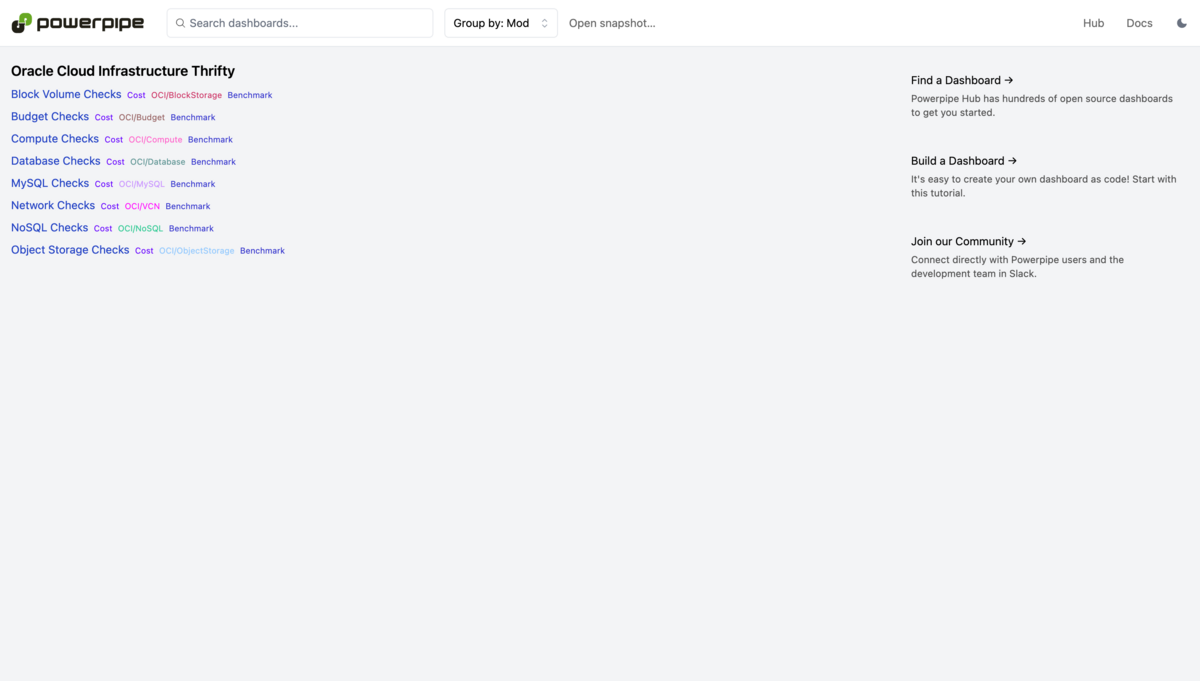
Includes checks for:
- Underused Autonomous Databases
- Unused, underused and oversized Compute Instances
- Unused, underused and oversized Block Volumes and Backups
- Object Storage Buckets without lifecycle policies
- Unattached Network Public IPs
- #TODO List
Documentation
Getting Started
Installation
Install Powerpipe (https://powerpipe.io/downloads)) or use Brew:
brew install turbot/tap/powerpipeThis mod also requires Steampipe with the OCI plugin as the data source. Install Steampipe (https://steampipe.io/downloads)) or use Brew:
brew install turbot/tap/steampipe
steampipe plugin install oci
Steampipe will automatically use your default Oracle Cloud credentials. Optionally, you can setup multiple tenant.
Finally, install the mod:
mkdir dashboards
cd dashboards
powerpipe mod init
powerpipe mod install github.com/turbot/steampipe-mod-oci-thrifty
Browsing Dashboards
Start Steampipe as the data source:
steampipe service startStart the dashboard server:
powerpipe serverBrowse and view your dashboards at http://localhost:9033.
Running Checks in Your Terminal
Instead of running benchmarks in a dashboard, you can also run them within your
terminal with the powerpipe benchmark command:
List available benchmarks:
powerpipe benchmark listRun a benchmark:
powerpipe benchmark run oci_thrifty.benchmark.block_volumeDifferent output formats are also available, for more information please see Output Formats.
Configure Variables
Several benchmarks have input variables that can be configured to better match your environment and requirements. Each variable has a default defined in its source file, e.g., controls/sql.sp, but these can be overwritten in several ways:
It's easiest to setup your vars file, starting with the sample:
cp powerpipe.ppvars.example powerpipe.ppvars
vi powerpipe.ppvars
Alternatively you can pass variables on the command line:
powerpipe benchmark run oci_thrifty.benchmark.block_volume --var=boot_and_block_volume_max_size_gb=100Or through environment variables:
export PP_VAR_boot_and_block_volume_max_size_gb=100
powerpipe benchmark run oci_thrifty.benchmark.block_volume
These are only some of the ways you can set variables. For a full list, please see Passing Input Variables.
Common and Tag Dimensions
The benchmark queries use common properties (like connection_name, region and tenant_id) and tags that are defined in the form of a default list of strings in the variables.sp file. These properties can be overwritten in several ways:
It's easiest to setup your vars file, starting with the sample:
cp powerpipe.ppvars.example powerpipe.ppvars
vi powerpipe.ppvars
Alternatively you can pass variables on the command line:
powerpipe benchmark run oci_thrifty.benchmark.block_volume --var 'common_dimensions=["connection_name", "region", "tenant_id"]'Or through environment variables:
export PP_VAR_common_dimensions='["connection_name", "region", "tenant_id"]'
export PP_VAR_tag_dimensions='[ "Department", "Environment"]'
powerpipe benchmark run benchmark.block_volume
Open Source & Contributing
This repository is published under the Apache 2.0 license. Please see our code of conduct. We look forward to collaborating with you!
Steampipe and Powerpipe are products produced from this open source software, exclusively by Turbot HQ, Inc. They are distributed under our commercial terms. Others are allowed to make their own distribution of the software, but cannot use any of the Turbot trademarks, cloud services, etc. You can learn more in our Open Source FAQ.
Get Involved
Want to help but don't know where to start? Pick up one of the help wanted issues: