

Catalog · How the catalog works
Delphi11LlamaCppBindings

Delphi 11+ bindings for llama.cpp (b11900+) with full GPU acceleration. Updated from the original Embarcadero fork: new memory API, vocab object, backend loader, CUDA 13, RTX 30xx/40xx/50xx support, Flash Attention, quantized KV cache, Jinja2 chat templates, and multimodal vision inference via the mtmd API.
- ★ 9 on GitHub
Anyone may press Interesting, signed in or not. It helps others find this project.
README
llama-cpp-delphi — Updated for llama.cpp b11900 · Delphi 11+
Based on the original work by Lucas Moura Belo (lmbelo) for Embarcadero: github.com/Embarcadero/llama-cpp-delphi
This fork updates the Delphi bindings from the original llama.cpp build b3 (January 2025) to build b11900 (October 2026) and extends compatibility down to Delphi 11 Alexandria.
Why this fork?
The original bindings were written against the llama.cpp b3 API, which has since changed substantially. Between b3 and b9050, llama.cpp introduced a series of breaking changes: new struct layouts, renamed functions, a redesigned backend loader, a separate llama_vocab object, and a new memory API replacing the old KV-cache interface.
Since the Embarcadero version included specific new features from Delphi 12+ for some reason and I am still working with Delphi 11, I had to remove a handful of them and replace them with classes and functions compatible with Delphi 11. That is why this fork is likely not 100% backward compatible with the Embarcadero version.
To use AI at a practical speed, accelerators such as GPUs and TPUs are required. Compared to current CPUs, GPUs are about 5 to 10 times faster. NVIDIA graphics cards are particularly well-suited for this purpose and are reasonably cost-effective when used with CUDA. Tested with a RTX4080 with 16GB VRAM via CUDA 13.
The CUDA 13 build of llama.cpp for RTX graphics cards belongs in lib\win_x64_cuda_13.
Download the ZIP from the llama.cpp release page and extract its contents into that directory:
llama-b11900-bin-win-cuda-13.4-x64.zip
The b11900 ZIP no longer contains the Visual C++ runtime. If it is not installed system-wide,
copy msvcp140.dll, msvcp140_codecvt_ids.dll, vcruntime140.dll and vcruntime140_1.dll
(14.50 or newer) into the same directory.
If CUDA is not installed or not supported, the samples fall back to the CPU automatically.
For a different GPU or CUDA version, replace the files in lib\win_x64_cuda_13 with the
matching build from the llama.cpp release page,
or create a new folder and adjust the DLL path in the sample's initialization section.
Highlights
- llama.cpp b11900 — fully updated API, including the new backend loader, vocab object, memory API, and sampler chain.
- Delphi 11+ (Alexandria and newer) — tested on Delphi 11; compatible with Delphi 12 and 13 via the same package set (
packages/d11+/). - CUDA 13: RTX 30xx/40xx/50xx ready — backend DLL loading via
ggml_backend_load_all_from_path, Flash Attention support, quantized KV cache (Q8_0). OnLogevent — intercept llama.cpp log output directly in Delphi, including the per-device buffer sizes reported during model load (VRAM vs. RAM split).- New settings —
NSeqMax,AttentionType,TypeK,TypeV, correctedUseMMapwiring. - Jinja2 chat template support — built-in model templates are applied automatically via
llama_chat_apply_template; EOT markers are probed at load time for reliable stop detection.
Motivation: Qwen3-27B on a single 16 GB GPU
The immediate trigger for this fork was running Qwen3-27B (4-bit quantized, ~16 GB model weight) on a single RTX 4080 (16 GB VRAM) in a Delphi application - without any middleware between the application and the model.
With the correct settings the model fits comfortably:
Settings.NGpuLayers := -1;                             // all layers to GPU
Settings.FlashAttn  := True;                           // Ada Lovelace FA2
Settings.TypeK      := TGGMLType.GGML_TYPE_Q8_0;      // ~50 % KV-cache VRAM savings
Settings.TypeV      := TGGMLType.GGML_TYPE_Q8_0;
Settings.NCtx       := 8192;
Settings.NBatch     := 512;
Settings.NUBatch    := 512;
Settings.OffloadKQV := True;
Flash Attention combined with Q8_0 KV-cache reduces the context memory footprint enough that even a 27B model leaves headroom for a usable context length on 16 GB of VRAM.
llama.cpp directly vs. Ollama
Ollama is a convenient wrapper, but it introduces a full HTTP server layer between your application and the model. Using llama.cpp directly through these bindings gives you:
| llama.cpp direct | Ollama | |
|---|---|---|
| Latency | Zero network round-trips | HTTP request overhead per call |
| Memory | Model + runtime only | Model + Ollama service overhead |
| Parameters | Full API access | Subset exposed via Modelfile |
| KV cache control | TypeK/TypeV, NSeqMax, OffloadKQV | Not configurable |
| Flash Attention | Direct enum control (Auto/On/Off) | Managed internally |
| Speculative decoding | Supported | Not exposed |
| Custom samplers | Yes (grammar, logit bias, DRY, …) | Limited |
| Embeddings | Full pooling control | Basic |
| Process model | In-process, no service to manage | Background daemon |
| Integration | Native Delphi component (TLlama) | REST client boilerplate |
For a Delphi desktop or server application that needs tight control over inference parameters, memory usage, and throughput, in-process bindings are the cleaner and more efficient choice.
What changed from b9090 to b11900
Needed e.g. for ModernBERT embedding models such as granite-embedding-97m-multilingual-r2 (new pre-tokenizer and SiLU feed-forward, llama.cpp PR #22716). No bound function was removed; the changes are struct layouts, two sampler signatures and one mtmd helper signature.
TLlamaModelParams:UseMMap,UseDirectIoandUseMLockwere replaced byLoadMode: TLlamaLoadMode(AUTO/NONE/MMAP/MLOCK/MMAP_MLOCK/DIRECT_IO); newLazyModeandLoadMtp.TLlamaSettings.UseMMap/UseMLockstill exist and are mapped ontoLoadMode.TLlamaContextParams: newNRsSeq,NOutputsMax,NOutputsMaxPerSeq(default 1 — raise it if several tokens per sequence are marked as output),CtxType,MoeCacheSizeandCtxOther.TLlamaModelQuantizeParamsandTLLamaPerfContextDatawere already too small for b9090 (missingdry_run,tt_overrides,prune_layersresp.n_reused); since both are returned by value, the DLL wrote past the Delphi record. Both now match b11900 (+max_buf_size, +n_reallocs_same/diff).TLlamaSamplerI:BackendInitgetsn_outputs_max_per_seq, the backend callbacks have their real signatures, newBackendResetandCopyState.- Samplers:
llama_sampler_init_penaltiestakesn_vocabfirst and rejectspenalty_last_n = -1(the bindings map negative values to 0 = disabled);TLlamaSampler.AddPenaltieshas a new first parameterNVocab.llama_sampler_init_drylostn_ctx_train. - mtmd:
TMtmdContextParams+Device,BatchMaxTokens, progress callback;TMtmdInputText+TextLen(length ofTextin bytes, must be set). - mtmd helper:
mtmd_helper_bitmap_init_from_file(ctx, fname, placeholder, opt)now takesAPlaceholderand aTMtmdHelperInitOpt(from the newmtmd_helper_init_opt_default) and returns aTMtmdHelperBitmapWrapperrecord (Bitmap,VideoCtx) instead of a bitmap pointer. With the old declaration the DLL took the context pointer as its hidden result address and overwrote the mtmd context. Free a non-nilVideoCtxwith the newmtmd_helper_video_free.TLlamaCppApis.VisionAvailablenow also requiresmtmd_helper_init_opt_default, andWarningsreports an mtmd.dll that predates the new signature. - Jinja2 chat formatter (bug fix): template, roles and message contents were converted
through the ANSI code page (
AnsiString) instead of UTF-8. Western European text survived the round trip, but Cyrillic, CJK or emoji reached the model as?. Now usesUTF8String/UTF8ToString. - Enums:
TLlamaVocabType(+PLAMO2, TEST, PLAMO3),TLlamaFType(+MXFP4_MOE, NVFP4, Q1_0, Q2_0), newTLlamaLoadMode,TLlamaLazyMode,TLlamaContextType. - New binding:
llama_version.
What changed from b3 to b9090
1. Backend / DLL loader
llama.cpp now loads backends as separate shared libraries (ggml-base.dll,
ggml-cpu.dll, ggml-cuda.dll, …). The bindings call
ggml_backend_load_all_from_path(dir) before the first model load. Without this
step, CUDA acceleration is silently unavailable.
2. Struct layouts
TLlamaModelParams, TLlamaContextParams, and TLlamaSamplerChainParams have
new fields, reordered members, and changed types. All records were rewritten
to match the current C headers exactly, with explicit offset comments to make
future drift visible at a glance.
Notable additions to TLlamaContextParams:
NSeqMax— maximum parallel sequences (required for recurrent models)AttentionType— causal vs. non-causal attentionFlashAttnType— replaces the former boolean; now an enum (Auto/Enabled/Disabled)OpOffload,SwaFull,KvUnified— new GPU/memory control flagsNoPerformance— disable perf counters
Notable additions to TLlamaModelParams:
UseDirectIo— bypass OS file cacheCheckTensors— validate tensor data on load (useful for debugging)UseExtraBufts— weight-repacking optimization
3. Function renames
| Old name | New name |
|---|---|
llama_load_model_from_file |
llama_model_load_from_file |
llama_free_model |
llama_model_free |
llama_new_context_with_model |
llama_init_from_model |
llama_n_vocab |
llama_vocab_n_tokens |
llama_token_bos |
llama_vocab_bos |
llama_tokenize(model, …) |
llama_tokenize(vocab, …) |
4. Vocab as a separate object
llama_vocab is now an opaque struct retrieved via llama_model_get_vocab(model).
All tokenizer and token-info functions take vocab instead of model.
TLlamaModel.Vocab exposes the pointer; all wrapper methods use it transparently.
5. Memory API (replaces KV-cache API)
llama_kv_cache_* and llama_kv_self_* are gone. The new API:
llama_get_memory(ctx)  ???  llama_memory_t
llama_memory_clear / seq_rm / seq_cp / seq_keep / seq_add / seq_div / seq_pos_max
TLlamaContext methods (KVCacheClear, KVCacheSeqRm, …) are preserved as Pascal
names and route to the new API internally.
6. Sampler updates
llama_sampler_init_grammar and llama_sampler_init_infill now take vocab
instead of model. The penalties sampler signature is simplified.
TLlamaSamplerI gains four experimental GPU-side sampling fields
(BackendInit, BackendAccept, BackendApply, BackendSetInput).
7. Batch API
llama_batch_get_one no longer takes pos_0 and seq_id — they are tracked
automatically. The batch struct and TLlamaBatch wrapper are updated accordingly.
8. Chat template (Jinja2)
llama_chat_apply_template no longer accepts a model argument — it takes the
raw template string (or nil to use the model's built-in template).
llama_model_chat_template(model, name) retrieves the built-in template.
TJinja2ChatFormatter now probes the template at load time: it applies the
template with a sentinel string as the last assistant message and extracts
whatever follows as the EOT marker (e.g. </s>, <|im_end|>, <|eot_id|>).
The marker is added to the stop sequence list, ensuring generation halts correctly
on models where llama_vocab_is_eog alone is insufficient.
9. FPU / SSE exception masking
Delphi unmasks certain floating-point exceptions by default; llama.cpp and ggml
expect all FP exceptions masked (matching C/C++ runtime defaults). All DLL calls
that perform numerical computation are wrapped with SetExceptionMask / restore,
eliminating spurious FLOAT_INVALID_OPERATION and FLOAT_DIVIDE_BY_ZERO exceptions.
10. Bug fixes
TLlamaSettings.UseMMapwas never applied toTLlamaModelParams. Fixed.- Speculative decoding passed an out-of-range logit index to
llama_sampler_samplewhenLogitsAll = false. Fixed. TGGMLTypeenum had a gap at values 4–5 (removed quantisation types), causing Delphi's RTTI to hideTypeK/TypeVin the Object Inspector. Fixed.- Closure lifetime bug: captured
LData/LTextin the streaming anonymous method could be freed before last access. Fixed by capturing raw pointers instead. TCompletionLogprobsAV: genericTDict<string, Single>as aTArrayelement type caused Delphi to emit invalid TypeInfo, corrupting the stack over streaming. Fixed by introducing a named concrete typeTTopLogprobMap.- Stop strings from the chat formatter were silently discarded because
TChatFormaterAdapter.PreparetookTLlamaChatCompletionSettingsby value (a record). Fixed by changing the parameter tovar. Detokenizewas called withspecial=Falsein the generation loop, so EOT tokens (e.g.</s>) never appeared in the accumulated text and stop-string matching failed. Fixed by passingspecial=True.- Default chat temperature was 0.2, causing severe repetition loops on many models
(the distribution is so peaked that
repeat_penalty=1.1cannot escape a loop). Changed to 0.8, matching the llama.cpp and Ollama defaults.
11. New TLlama features
OnLogevent (TLlamaLogEvent) — receives all llama.cpp log messages, including the per-device buffer-size lines emitted during model load:llm_load_tensors: CUDA0 buffer size = 15234.56 MiB llm_load_tensors: CPU buffer size = 312.00 MiBNSeqMaxandAttentionTypeadded toTLlamaSettings.FlashAttn(boolean) correctly maps to the newFlashAttnTypeenum (LLAMA_FLASH_ATTN_TYPE_ENABLED/DISABLED);AUTOis available viaTLlamaFlashAttnTypedirectly.
Project structure
packages/
  d11+/          Delphi 11, 12, 13+ (Alexandria and newer)
src/
  Api/           Low-level DLL bindings (LlamaCpp.Api.*.pas)
  Common/        Settings, types, samplers, chat, grammar, cache
  CType/         C-type translations (Ggml, Llama, Llava)
  Wrapper/       Mid-level wrappers (LlamaModel, LlamaContext, LlamaBatch)
  LlamaCpp.Llama.pas   TLlama component (main entry point)
  LlamaCpp.*.pas       High-level subsystems
samples/
  VclChat/                   Minimal VCL chat sample (Windows)
  VclVision/                 VCL multimodal sample ??? image + text inference (Windows)
  SimpleChatWithDownload/    FMX sample with HuggingFace model download
test/            DUnit test suite
lib/
  win_x64_cuda_13/    DLLs for CUDA 13 ??? extract llama-b11900-bin-win-cuda-13.4-x64.zip here
Package installation (Delphi 11+)
- Open
packages/d11+/LlamaCpp.dproj→ Compile → Install - Open
packages/d11+/dclLlamaCpp.dproj→ Compile → Install
dclLlamaCpp depends on LlamaCpp, so the order matters.
Delphi 12/13 will offer to migrate the project format on first open — accept.
DLL setup (CUDA 13)
- Download llama-b11900-bin-win-cuda-13.4-x64.zip from the llama.cpp releases.
- Extract the ZIP contents directly into
lib/win_x64_cuda_13/. The directory must contain at leastggml.dll,ggml-base.dll, theggml-cpu-*.dllfiles,llama.dllandggml-cuda.dll. The CUDA runtime is a separate download (cudart-llama-bin-win-cuda-13.4-x64.zip); without it the CPU backend is used. - The ZIP no longer contains the Visual C++ runtime. If it is not installed system-wide, copy
msvcp140.dll,msvcp140_codecvt_ids.dll,vcruntime140.dllandvcruntime140_1.dll(14.50 or newer) into the same directory. - For vision support,
mtmd.dllmust also be present — it is included in the same ZIP.
For a different GPU or CUDA version, use the matching build from the llama.cpp release page and adjust the DLL path in the sample's
initializationsection accordingly.
Quick start
procedure TForm1.FormCreate(Sender: TObject);
begin
  Llama1.ModelPath := 'C:\models\qwen3-27b-q4_k_m.gguf';
  Llama1.Settings.NGpuLayers := -1;
  Llama1.Settings.FlashAttn  := True;
  Llama1.Settings.TypeK      := TGGMLType.GGML_TYPE_Q8_0;
  Llama1.Settings.TypeV      := TGGMLType.GGML_TYPE_Q8_0;
  Llama1.Settings.NCtx       := 8192;
  Llama1.OnLog               := HandleLlamaLog;
  Llama1.Init();
end;

procedure TForm1.HandleLlamaLog(Sender: TObject;
  const ALevel: TGgmlLogLevel; const AText: string);
begin
  if ALevel >= GGML_LOG_LEVEL_WARN then
    Memo1.Lines.Add('[WARN] ' + Trim(AText))
  else
    Memo1.Lines.Add(Trim(AText));
end;
Chat completion
var
  LMessages: TArray<TChatCompletionRequestMessage>;
  LSettings: TLlamaChatCompletionSettings;
begin
  LMessages := [
    TChatCompletionRequestMessage.System('You are a helpful assistant.'),
    TChatCompletionRequestMessage.User('What is the capital of France?')
  ];

  LSettings := TLlamaChatCompletionSettings.Create(LMessages);
  // Optional overrides (defaults match Ollama):
  // LSettings.Temperature  := 0.8;   // default
  // LSettings.RepeatPenalty := 1.1;  // default
  // LSettings.MaxTokens    := 512;

  Llama1.CreateChatCompletionStream(LSettings);
end;
VclVision sample
samples/VclVision/ is a Windows VCL application for multimodal (vision) inference.
It lets you load an image alongside a text prompt and have the model describe or answer
questions about it.
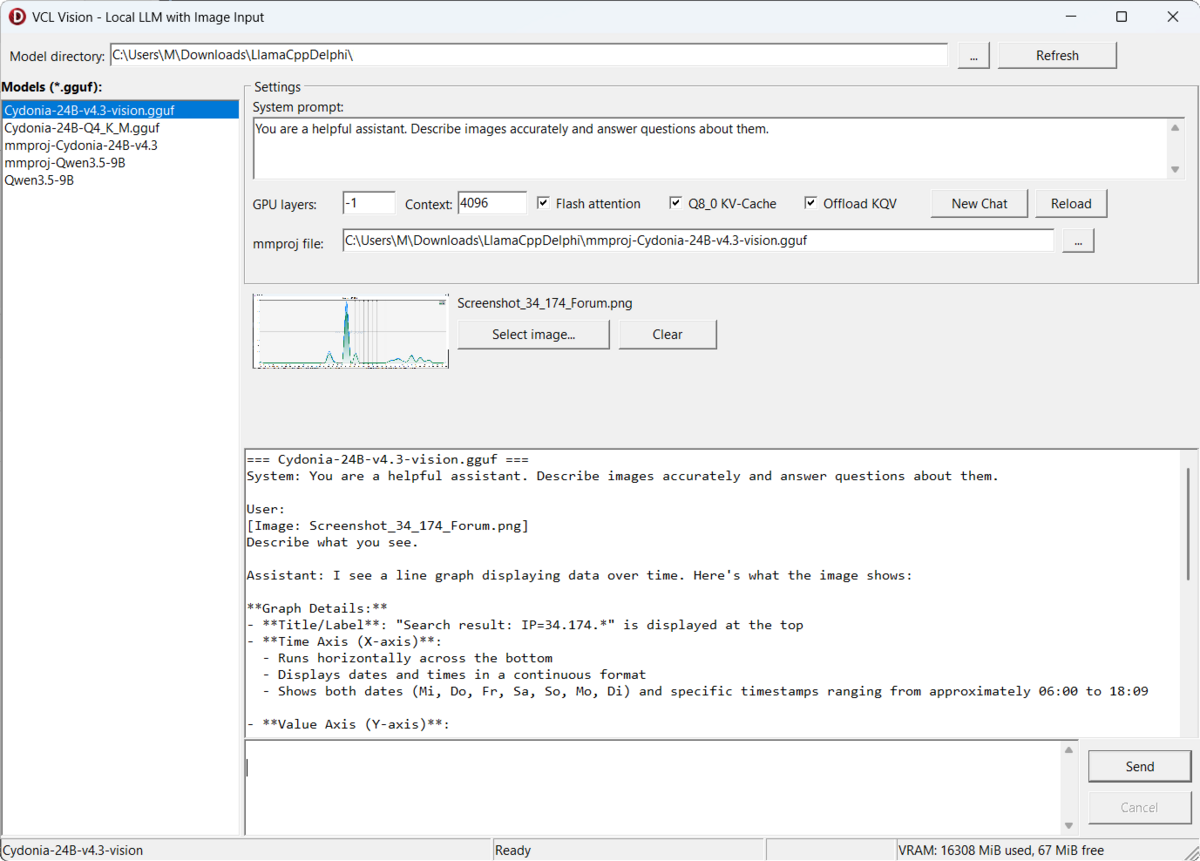
What you need
| File | Description |
|---|---|
*.gguf |
The text model (same as for chat) |
mmproj-*.gguf |
The matching multimodal projector file |
mtmd.dll |
Ships with llama.cpp b11900; must be in the DLL directory |
The text model and the mmproj file must come from the same model release —
mixing them from different versions will cause mtmd_init_from_file to fail.
Tested models
| Model | mmproj | Notes |
|---|---|---|
| Qwen2.5-VL-7B-Instruct | mmproj-qwen2.5-vl-7b-q8_0.gguf |
Strong multilingual vision model |
| LLaVA-1.5-7B | mmproj-llava-1.5-7b.gguf |
Widely available reference model |
| Gemma3-12B | mmproj-gemma3-12b.gguf |
High quality, needs ~12 GB VRAM |
| MiniCPM-V-2.6 | mmproj-minicpm-v2_6.gguf |
Compact, good for limited VRAM |
| SmolVLM-500M-Instruct | mmproj-SmolVLM-500M-Instruct-Q8_0.gguf |
Tiny (~0.6 GB), verified with b11900 |
How it works
The sample uses the mtmd API (llama.cpp b9050+, helper signatures of b11900):
- The text model is loaded via the standard
TLlamacomponent. mtmd_init_from_filecreates a multimodal context from the mmproj file and the loaded text model (Llama1.LlamaModel).- For each user turn with an image:
- The image is decoded into a raw RGB bitmap via
mtmd_helper_bitmap_init_from_file(returns aTMtmdHelperBitmapWrapper; the bitmap is in itsBitmapfield). - The prompt is built with the model's built-in chat template
(
llama_model_chat_template+llama_chat_apply_template): the system prompt and a user message containing the<__media__>marker plus the question. Models without a supported template fall back to a plainUSER:/ASSISTANT:layout. - Prompt and bitmap are tokenized together with
mtmd_tokenize. - All chunks (text tokens and image embeddings) are written into the KV cache
via
mtmd_helper_eval_chunks. - Token generation then proceeds through the standard
TLlama.Generatecall, withAReset = Falseso the KV cache populated by mtmd is preserved. Generation stops at any end-of-generation token (llama_vocab_is_eog).
- The image is decoded into a raw RGB bitmap via
- Text-only turns (no image selected) use the same template and go through the normal
Eval+Generatepath.
Settings
The settings panel exposes the same knobs as VclChat (GPU layers, context size, Flash Attention, Q8_0 KV cache, KQV offload). The mmproj path is a separate field; both the text model and the mmproj are loaded together when Load is clicked.
Recommended models
Any GGUF model that fits in your VRAM works. Well-tested choices:
| Model | Size (Q4_K_M) | Notes |
|---|---|---|
| Qwen3-8B | ~5 GB | Multilingual, fast, thinking mode |
| Qwen3-27B | ~16 GB | High quality, fits 16 GB VRAM with FA+Q8 KV |
| Mistral-7B-Instruct | ~4 GB | Fast, reliable for English |
| LLaMA-3.1-8B-Instruct | ~5 GB | Good general purpose |
Models are available at huggingface.co in GGUF format.
Credits
Original project: llama-cpp-delphi by Embarcadero https://github.com/Embarcadero/llama-cpp-delphi
llama.cpp: ggml-org/llama.cpp https://github.com/ggml-org/llama.cpp
License
MIT — see [LICENSE] for details.
About
Developed by Cypheros as a personal exploration of AI-assisted Delphi development, using Claude Code (Anthropic).