

Catalog · How the catalog works
cassotis-ime

Cassotis IME - a native Delphi/TSF Chinese Pinyin IME for Windows 10/11. 言泉输入法 —— 基于 Delphi/TSF 的 Windows 10/11 原生开源中文拼音输入法,支持全拼、简拼、六种双拼,并通过语料训练的本地语言模型与神经重排提升输入质量。
- ★ 302 on GitHub
Anyone may press Interesting, signed in or not. It helps others find this project.
README
Cassotis IME

English | 简体中文 | 繁體中文 | Linux version | macOS version
Cassotis IME (言泉输入法) is an experimental Chinese Pinyin input method for Windows 10/11, built primarily with Delphi on top of TSF (Text Services Framework). Candidate ranking runs entirely on the local CPU, around a single character-level language model trained by the project.
The project focus is:
- build a stable TSF-based IME foundation,
- keep the architecture modular (TSF DLL + host process + tools),
- rank long sentences, short words and completions with one local language model and a small set of corpus-trained rankers.
Name Origin
The English name Cassotis comes from the sacred spring inside the Temple of Delphi. Before delivering oracles, the priestess Pythia was said to drink from this spring to enter a prophetic state. The spring was regarded as the true source of prophecy and inspiration, where oracles were born, which resonates with the path from Delphi to human language.
The Chinese name 言泉 (Yanquan, "Spring of Words") matches Cassotis as a prophetic spring, while also carrying the meaning of 言如泉涌 ("words flowing like a spring"), reflecting our expectation of a fluent and intelligent input experience.
Features
-
TSF text service. Registration, activation and the composition lifecycle are in place, including the TSF COM-less capability category for hosts that use that activation path. The TSF DLL is built for Win64 and Win32 (
svr.dll/svr32.dll); the host process is Win64 only. -
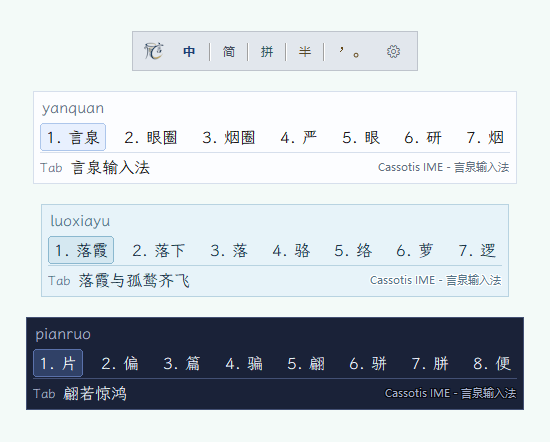
Candidate window. Paging, selection and text commitment, with an optional expanded view showing up to three rows when paging. Number keys select from the active row; the Tab completion area is unchanged.
-
English recognition. In Chinese full-Pinyin, half-width mode, letters that are an English word or name (
pro,markdown,Effie), that are typed with a capital, or that were committed as letters before appear before the numbered candidates. When the input has no Chinese reading as a whole they are selected and Space commits them as typed; when it has one (bug,mac), the language model weighs the letters against it with the preceding text and selects them, shows them unselected, or leaves the candidates alone. Chinese selection numbers stay unchanged. Enabled by default and optional in General settings; Double Pinyin keeps its normal behavior. -
Mode label beside the caret. Switching between Chinese and English (Shift by default, the configured shortcut, or the taskbar's input indicator) briefly shows the Cassotis mark and 中 or 英 just above the caret, and so does switching to Cassotis from another input method (Win+Space, Alt+Shift, or the taskbar's input indicator). A text field that takes the focus in English mode gets the same reminder, since English types letters without any sign of the input method; Chinese mode shows itself with the first key. The label takes neither the focus nor clicks, goes away with the next key, and is not shown in password fields or where the caret cannot be located. On by default and optional in Appearance settings.
-
One-key completion, original to Cassotis. Exactly one trusted continuation is shown and accepted with the configured key. Exact completions from the user and base dictionaries and offline-vetted strong-transition completions appear at once; the language model then reranks them in the background, using the text before the cursor when there is any. In a long sentence it finishes the current word or continues with the next phrase, and shows nothing when its confidence is insufficient.
-
Custom phrases. Save phrases under letter shortcuts in Settings > Custom Phrases. Typing a shortcut in full shows its phrase in the one-key completion area, and the completion key commits it exactly as written, line breaks included; numbered candidates and Space are unchanged. The list keeps its order and can be imported and exported as JSON.
-
Long sentences. Lexicon-constrained path search builds complete candidates (for example
womenjintian→我们今天) while keeping prefix candidates for partial commitment. The language model chooses among the complete candidates and then corrects small homophone errors in the chosen sentence against the typed Pinyin and the text before the input. -
Short words. The language model resolves competing exact candidates, using the text already committed before the cursor when there is any.
-
Short phrases. An input of three to five syllables that the dictionary does not contain (for example
jiuguize→旧规则) gets whole phrases put together from dictionary words. The language model picks one, using the text before the cursor when there is any, and corrects its homophones against the typed Pinyin; when the choice is close, up to two more whole phrases follow the first. -
Pinyin schemes. Full Pinyin and seven selectable Double Pinyin schemes (Microsoft, Xiaohe, Ziranma, Sogou, Ziguang, Pinyin Jiajia, and Zhineng ABC) share the same candidate ranking and user-learning data. Fuzzy Pinyin is configurable for common initial and final pairs, and initial-letter abbreviations are supported (for example
jt→今天). -
Dictionaries. Separate simplified and traditional base databases and a user database. Word frequencies exported by another input method can be imported in Advanced settings (one word a line: word, Pinyin and count, separated by commas or tabs); they go into the user database as the user's own choices.
-
Quick input. Use
ufhfor symbols,uxhfor numbered markers,usxfor mathematical symbols, andurqfor the current date.i123.45orv123.45offers Chinese numbers and uppercase currency amounts; digits keep entering the number, so select with the displayeda/b/c/dkeys, arrow keys and Space, or the mouse. Double Pinyin requires Shift+U/I/V to enter these modes. See the quick-input guide (Chinese). -
Chinese punctuation. With Chinese punctuation and half-width input, the symbols that stay as typed can be edited in General settings, or set to the Markdown preset or to standard Chinese punctuation with one click. The default Markdown preset keeps
-#*+_=`~[]<>|@; commas, full stops, question and exclamation marks, parentheses and quotation marks stay Chinese, and the backslash gives the enumeration comma、. -
Application context. Surrounding text and key state are synchronized with the application.
-
Local by design. No network and no GPU. While the language model is loading or unavailable, candidates are ranked without it.
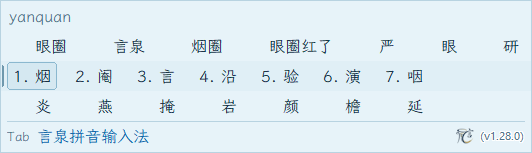
Three-row candidate view, with selection numbers on the active row.

A text field taking the focus in English mode: the mode label above the caret.
Download and Install
- Download. Get
cassotis_ime_setup_<version>.exefrom the Releases page. The installer is about 290 MB and includes the simplified and traditional base dictionaries and the language model. - Requirements. 64-bit Windows 10 or Windows 11; installing needs administrator rights. No network and no GPU are needed.
- Install. Run the installer, then switch to "Cassotis 言泉拼音输入法" in the system's input method list (
Win + Space). One installation serves every Windows account on the computer: the base dictionaries are installed with the program and shared by all accounts, and each account keeps its own user dictionary and settings. - Upgrade. Run the new installer over the installed version; there is no need to uninstall first, and Windows is never asked to restart. Applications that still have the previous text service loaded are listed: exit them first, or continue and restart them later. When necessary the installer restarts Windows Explorer, and the taskbar disappears for a moment. The user dictionary and the settings stay in each account's
%LOCALAPPDATA%\CassotisIme; the base dictionaries come with the new version, and the copies earlier versions kept in an account's folder are removed. - Uninstall. Use Apps in Windows Settings. The uninstaller removes the program with its base dictionaries and asks whether to remove the settings, user dictionary and logs under
%LOCALAPPDATA%\CassotisIme; by default they are kept.
Architecture
src/tsf: TSF COM in-proc server (text service integration).src/engine: Pinyin parsing, candidate generation, ranking, and user learning.src/host: external host process for engine/UI orchestration and language-model inference.src/ui: candidate window and tray UI.src/common: config, logging, IPC, sqlite wrapper, shared utilities.tools: registration, dictionary build/import/diagnostics, helper executables.data: database schema and the language model (data/models/char_lm, stored as numbered parts).out: scripts for build, registration, rebuild and tests; build outputs land here.installer: Inno Setup script.third_party: vendored third-party binaries (SQLite, ONNX Runtime).
Runtime Files
cassotis_ime_svr.dll/cassotis_ime_svr32.dll: Win64 and Win32 TSF in-proc COM servers.cassotis_ime_host.exe: Win64 host process; it runs the engine and the language model.cassotis_ime_tray_host.exe: Win64 tray/status host for the tray menu, floating status window, and input-state indicator.cassotis_ime_profile_reg.exe: TSF profile/category registration utility.cassotis_pinyin_transformer_ort.dll, the ONNX Runtime DLLs andchar_lm\: the language-model bridge, its runtime and the model. Only the host process loads them, never the TSF DLL.sqlite3_64.dll: SQLite runtime.
Without the TSF DLL and the main host process, IME input will not work. Without the tray/status host, the core input path may still run, but the tray menu, floating status window, and state indicator will be unavailable. Without the language-model files, the IME still works and ranks candidates without the language model.
Build and Run (Quick Start)
Prerequisites:
- Windows 10/11
- Delphi 10.4
- Visual Studio 2022 C++ build tools (x64), for the language-model bridge
- the SQLite and ONNX Runtime binaries are included under
third_party/
From out/:
.\rebuild_all.ps1
.\cassotis_ime_profile_reg.exe register_tsf -dll_path .\cassotis_ime_svr.dll
.\rebuild_dict.ps1
rebuild_all.ps1 also builds the language-model bridge and joins the model parts in data/models/char_lm into the runtime's char_lm.onnx. rebuild_dict.ps1 expects a checkout of cassotis-lexicon beside this repository.
For full build details, see BUILD.md.
Dictionary Workflow
The base dictionaries are built from the generated artifacts of the cassotis-lexicon project:
- word lists:
dict_unihan_sc.txt,dict_unihan_tc.txt,dict_clean_sc.txt,dict_clean_tc.txt(pinyin<TAB>text<TAB>weight) - corpus-trained tables from the same directory: word-transition priors, completion priors, and the short-word promotion table
- runtime databases are rebuilt under
%LOCALAPPDATA%\CassotisIme\data\(dict_sc.db,dict_tc.db), together with the initial-letter abbreviation index; a development build reads them there, and the installer packages them as the program's read-only base dictionaries - the user dictionary defaults to
%LOCALAPPDATA%\CassotisIme\data\user_dict.db
Main rebuild entry:
.\rebuild_dict.ps1Models and Ranking
v2.0.0: one language model
The v1.x releases improved ranking by adding models. Between v1.1.0 and v1.31.0 nearly every release introduced another ranker, scorer, generator or correction model for one stage of one input path. By v1.31.0 the installer carried 11 ONNX model files, the engine compiled in 43 exported parameter units, and a decision often passed through several of them in turn (the section “Version History” below keeps what each release added).
v2.0.0 clears that stack away and rebuilds ranking around a single model, so that the next round of work has one thing to improve:
- One ONNX model instead of eleven. A character-level autoregressive language model of about 150 million parameters (11 layers, 1,024 dimensions, a 12,017-character vocabulary, 8-bit quantized), trained by the project on independent Chinese corpora both as a plain language model and conditioned on Pinyin. It scores complete long-sentence candidates, corrects the chosen sentence against the typed syllables, chooses among short words, reranks one-key completions, and proposes and selects long-sentence Tab continuations.
- Seven compact units instead of 43. Three structural rankers remain for long-sentence search and the pool of complete candidates. Four small gradient-boosted policies, one per task, turn language-model scores into decisions: the long-sentence choice, the short-word choice, one-key completion and Tab continuation. The no-context short-word residual model became a precomputed table in the dictionary. The other rerankers, scorers, generators and correction models added during v1.x are gone.
- Scores that do not depend on the call. The model is quantized with fixed activation ranges and computes attention with an operator of its own, so a text gets bit-identical scores however it is batched and whatever was computed before. A long sentence typed key by key therefore gets the same candidates as the same Pinyin entered at once, and what one keystroke computed is reused by the next.
- Less than half the model memory. Loading the models took about 447 MiB of host-process memory in v1.31.0 and takes about 183 MiB now.
- One place to improve. A better language model now improves every input path at once, and the four policies are refit from engine traces.
The cost is latency. Every decision now passes through one larger model, which is kept to one thread per processor core, so the mean and P95 latencies in the benchmark tables below are higher than in v1.31.0 (long sentences 75 ms on average against 61 ms; one-key completion settles within 20 ms at P95 against 12 ms), while accuracy is higher in all four benchmarks. These are times for decoding a whole query at once; in everyday typing each keystroke is still answered within a few tens of milliseconds, and the difference is not noticeable. Phrases outside the dictionary pay the same price: the keystroke that completes the last syllable runs the model at least twice more, about 20 ms on average (32 to 39 ms at P95), where the dictionary alone took 2 to 4 ms.
v2.0.0 also fixes the missing candidate window in File Explorer's address bar, hardens desktop recovery when an upgrade has to restart Windows Explorer, and changes the installer: an upgrade never asks to restart Windows, and uninstalling no longer closes running applications (files still in use are removed at the next restart).
How candidates are ranked
- Long sentences. Lexicon-constrained search builds complete candidates; two rankers decide which paths survive pruning and a third orders the pool of complete candidates. The language model scores the leading candidates and the long-sentence policy picks the first and the second. For full-Pinyin input in the simplified variant, the model then rewrites the chosen sentence against the typed syllables and up to 48 characters before the input, which repairs small homophone errors; user words and exact full-query dictionary matches are left alone.
- Short words. Exact candidates keep their dictionary order unless the language model's scores, with the text before the cursor when there is any, give the short-word policy a clear reason to change it. Where nothing but the dictionary decides, a table precomputed for the dictionary sets the order.
- Phrases outside the dictionary. For an input of three to five syllables that is neither a dictionary entry nor a user word, the dictionary supplies whole-phrase drafts for every way of cutting the input. The language model scores each by how well it stands as a clause of its own, with the text before the cursor when there is any, and picks one; it then corrects the chosen draft against the typed syllables. Where the two steps disagree, the more confident one decides. This also runs for Double Pinyin; with fuzzy Pinyin enabled, a separator
'in the input, or the traditional dictionary it does not, and the candidates stay as they were. The fixed rules of v1.x that joined a head character such as 我, 你, 就, 不 or 很 to a word are gone. A phrase the user picks from behind the first one is kept as a user word. - One-key completion. Dictionary and strong-transition completions are shown at once. The language model reranks a wider set of dictionary words in the background and replaces the shown completion only when the gain is clear; a completion the user has rejected does not come back this way.
- Tab continuation in long sentences. The language model proposes the next characters and scores the ways to finish the current word or continue with the next phrase; the Tab policy picks one or shows nothing.
Runtime behavior
- Everything is computed locally on the CPU; no network and no GPU are used.
- ONNX Runtime and the model are loaded only by the external host process, never by the TSF DLL. The model loads in the background; until it is ready, or if it is unavailable, candidates are ranked without it.
- A language-model call has a deadline (100 ms by default). A late result is dropped and the existing result stays.
- The model uses one thread per processor core, at least four and at most eight.
- Statistical priors (word transitions, completion priors, the short-word table) are stored in the local dictionary database; the compact rankers and policies are compiled in as deterministic native Pascal parameters.
- Long-sentence and short-word ranking remain separate paths, so improving one does not replace the other's matching rules.
Long Sentence Benchmark-16300
See BENCHMARK.md for the Benchmark-16300 methodology, corpus source, and scoring rules.
Corpus: 16,300 eligible Chinese sentences from the developer's own novel Elegance in Timelessness (Chinese title: 永恒的舞动).
| Version | Top1 | Top2 | Mean (ms) | P50 (ms) | P95 (ms) | Max (ms) |
|---|---|---|---|---|---|---|
v2.6.0 |
13740/16300 (84.29%) | 14686/16300 (90.10%) | 83.07 | 78 | 141 | 422 |
v2.5.0 |
13442/16300 (82.47%) | 14358/16300 (88.09%) | 72.73 | 78 | 110 | 359 |
v2.4.0 |
13435/16300 (82.42%) | 14314/16300 (87.82%) | 71.84 | 63 | 110 | 344 |
v2.3.0 |
13429/16300 (82.39%) | 14310/16300 (87.79%) | 73.35 | 78 | 125 | 344 |
v2.2.0 |
13390/16300 (82.15%) | |||||
| 13397/16300 (82.19%) | 14273/16300 (87.56%) | |||||
| 14281/16300 (87.61%) | 73.26 | |||||
| 72.10 | 78 | 125 | ||||
| 110 | 344 | |||||
| 328 | ||||||
v2.1.0 |
13381/16300 (82.09%) | 14270/16300 (87.55%) | 75.28 | 78 | 125 | 343 |
v2.0.0 |
13380/16300 (82.09%) | 14268/16300 (87.53%) | 74.79 | 78 | 125 | 344 |
v1.31.0 |
12940/16300 (79.39%) | 13534/16300 (83.03%) | 61.29 | 62 | 94 | 282 |
v1.30.0 |
12828/16300 (78.70%) | 13514/16300 (82.91%) | 55.25 | 47 | 94 | 266 |
v1.29.0 |
11997/16300 (73.60%) | 12970/16300 (79.57%) | 39.89 | 32 | 63 | 234 |
v1.28.0 |
11987/16300 (73.54%) | 12964/16300 (79.53%) | 63.72 | 62 | 109 | 484 |
v1.27.0 |
11978/16300 (73.48%) | 12955/16300 (79.48%) | 63.08 | 62 | 109 | 468 |
v1.26.0 |
11974/16300 (73.46%) | 12947/16300 (79.43%) | 62.83 | 62 | 109 | 453 |
v1.25.0 |
11698/16300 (71.77%) | 12830/16300 (78.71%) | 57.49 | 47 | 94 | 438 |
v1.24.0 |
||||||
v1.23.0 |
11679/16300 (71.65%) | 12813/16300 (78.61%) | 57.09 | 47 | 94 | 438 |
v1.22.0 |
11672/16300 (71.61%) | 12809/16300 (78.58%) | 55.17 | 47 | 94 | 407 |
v1.21.1 |
11080/16300 (67.98%) | 12395/16300 (76.04%) | 59.33 | 62 | 109 | 407 |
v1.20.0 |
11065/16300 (67.88%) | 12376/16300 (75.93%) | 59.53 | 47 | 110 | 406 |
v1.19.0 |
10917/16300 (66.98%) | 12248/16300 (75.14%) | 55.99 | 47 | 94 | 437 |
v1.18.0 |
10731/16300 (65.83%) | 12128/16300 (74.40%) | 51.78 | 47 | 93 | 454 |
v1.17.0 |
10595/16300 (65.00%) | 12023/16300 (73.76%) | 42.68 | 32 | 78 | 406 |
v1.16.0 / v1.15.0 |
10553/16300 (64.74%) | 11921/16300 (73.13%) | 41.5 | 32 | 78 | 484 |
v1.14.0 |
10345/16300 (63.47%) | 11903/16300 (73.02%) | 58.78 | 47 | 172 | 766 |
v1.13.0 |
10131/16300 (62.15%) | 11320/16300 (69.45%) | 65.94 | 47 | 203 | 1047 |
v1.12.0 |
9767/16300 (59.92%) | 10996/16300 (67.46%) | 63.03 | 47 | 187 | 1062 |
v1.11.0 |
9760/16300 (59.88%) | |||||
| 9340/16300 (57.30%) | 10990/16300 (67.42%) | |||||
| 10773/16300 (66.09%) | 59.82 | 47 | 187 | 1031 | ||
v1.10.0 |
9279/16300 (56.93%) | 10708/16300 (65.69%) | 60.39 | 47 | 188 | 1046 |
v1.9.0 |
9121/16300 (55.96%) | 10685/16300 (65.55%) | 59.65 | 47 | 187 | 1172 |
v1.8.1 |
8285/16300 (50.83%) | 9067/16300 (55.63%) | 72.44 | 47 | 281 | 1594 |
v1.7.0 |
7940/16300 (48.71%) | 8642/16300 (53.02%) | 71.55 | 47 | 235 | 2047 |
v1.6.0 |
7936/16300 (48.69%) | 8637/16300 (52.99%) | 66.99 | 32 | 219 | 1687 |
v1.5.0 |
7459/16300 (45.76%) | 7966/16300 (48.87%) | 63.42 | 46 | 203 | 2140 |
v1.4.0 |
7168/16300 (43.98%) | 7617/16300 (46.73%) | 66.23 | 46 | 218 | 2578 |
v1.3.0 |
7155/16300 (43.90%) | 7601/16300 (46.63%) | 64.54 | 46 | 203 | 2188 |
v1.2.0 |
6895/16300 (42.30%) | 7303/16300 (44.80%) | 59.89 | 32 | 188 | 2078 |
v1.1.0 |
6677/16300 (40.96%) | 7067/16300 (43.36%) | 73.18 | 47 | 234 | 2750 |
v1.0.0 |
6106/16300 (37.46%) | 6857/16300 (42.07%) | 71.49 | 47 | 219 | 5344 |
v0.8.5 |
6097/16300 (37.40%) | 6847/16300 (42.01%) | 520.05 | 406 | 1203 | 13297 |
v0.7.0 |
5368/16300 (32.93%) | 6110/16300 (37.48%) | — | — | — | — |
v0.6.0 |
4905/16300 (30.09%) | 5378/16300 (32.99%) | — | — | — | — |
v0.5.0 |
4834/16300 (29.66%) | 5243/16300 (32.17%) | — | — | — | — |
v0.4.0 |
4371/16300 (26.82%) | 4744/16300 (29.10%) | — | — | — | — |
v0.3.1 |
3845/16300 (23.59%) | 4651/16300 (28.53%) | — | — | — | — |
v0.2.0 |
2671/16300 (16.39%) | 2863/16300 (17.56%) | — | — | — | — |
From v2.3.0, results use the cases of the second reading correction (see BENCHMARK.md). For v2.2.0, regular values were re-measured on the corrected cases with the v2.2.0 runtime and benchmark dictionary and compare with later releases; italic values are those published with v2.2.0 and compare with earlier releases. A column with one value is the same in both.
v1.12.0 uses the new scoring rule that treats 他 and 她 as equivalent at the same character positions. For v1.11.0, regular values use this rule, while italic values use the previous strict rule that distinguishes them. v1.10.0 and earlier releases use the strict rule; releases from v1.12.0 onward publish only the new-rule results.
Latency values are engine-only full-query decode times. Each complete Pinyin query is assigned at once, so these values do not represent incremental keystroke-to-display latency. — means that the version was not measured under this latency protocol. See BENCHMARK.md for the complete methodology.
Short-word Context Benchmark-65000
This benchmark contains 65,000 occurrences of two- to four-character words, each paired with the sentence prefix already committed before that word. Its cases use the same novel text as Benchmark-16300 as their source and are excluded from short-context model training. User-dictionary ranking is disabled during evaluation.
See BENCHMARK.md for the shared corpus source, short-word case construction, scoring rules, and latency protocol.
Contested is the subset where the same Pinyin query maps to at least two expected words in the corpus, making left context materially useful. The table reports the context-enabled benchmark.
| Version | Top1 | Top2 | Contested Top1 | Contested Top2 | Mean (ms) | P50 (ms) | P95 (ms) | Max (ms) |
|---|---|---|---|---|---|---|---|---|
v2.6.0 |
63454/65000 (97.62%) | 64518/65000 (99.26%) | 10514/11685 (89.98%) | 11280/11685 (96.53%) | 4.822 | 2.492 | 12.904 | 47.310 |
v2.5.0 |
63463/65000 (97.64%) | 64436/65000 (99.13%) | 10512/11685 (89.96%) | 11223/11685 (96.05%) | 4.776 | 2.416 | 12.623 | 37.362 |
v2.4.0 |
63455/65000 (97.62%) | 64423/65000 (99.11%) | 10539/11685 (90.19%) | 11225/11685 (96.06%) | 4.599 | 2.297 | 12.579 | 32.917 |
v2.3.0 |
63421/65000 (97.57%) | 64427/65000 (99.12%) | 10504/11685 (89.89%) | 11228/11685 (96.09%) | 4.611 | 2.267 | 12.545 | 33.331 |
v2.2.0 |
63350/65000 (97.46%) | |||||||
| 63364/65000 (97.48%) | 64347/65000 (99.00%) | |||||||
| 64292/65000 (98.91%) | 10504/11685 (89.89%) | |||||||
| 10533/11728 (89.81%) | 11228/11685 (96.09%) | |||||||
| 11244/11728 (95.87%) | 4.710 | |||||||
| 4.509 | 2.362 | |||||||
| 2.201 | 12.952 | |||||||
| 12.289 | 42.544 | |||||||
| 41.085 | ||||||||
v2.1.0 |
||||||||
v2.0.0 |
63363/65000 (97.48%) | 64291/65000 (98.91%) | 10533/11728 (89.81%) | 11244/11728 (95.87%) | 4.637 | 2.205 | 12.621 | 40.883 |
v1.31.0 |
63036/65000 (96.98%) | 64104/65000 (98.62%) | 10491/11728 (89.45%) | 11196/11728 (95.46%) | 4.582 | 3.262 | 10.352 | 22.327 |
v1.30.0 |
62926/65000 (96.81%) | 64073/65000 (98.57%) | 10449/11728 (89.09%) | 11169/11728 (95.23%) | 3.525 | 3.192 | 7.660 | 21.122 |
v1.29.0 |
61971/65000 (95.34%) | 63568/65000 (97.80%) | 9675/11728 (82.49%) | 10776/11728 (91.88%) | 2.999 | 2.198 | 7.316 | 27.596 |
v1.28.0 |
61860/65000 (95.17%) | 63562/65000 (97.79%) | 9596/11728 (81.82%) | 10775/11728 (91.87%) | 4.453 | 3.908 | 9.214 | 34.468 |
v1.27.0 |
||||||||
v1.26.0 |
61860/65000 (95.17%) | 63549/65000 (97.77%) | 9596/11728 (81.82%) | 10775/11728 (91.87%) | 4.474 | 3.908 | 9.310 | 35.645 |
v1.25.0 |
61859/65000 (95.17%) | 63549/65000 (97.77%) | 9596/11728 (81.82%) | 10775/11728 (91.87%) | 4.705 | 4.103 | 9.817 | 40.027 |
v1.18.0 - v1.24.0 |
61827/65000 (95.12%) | 63517/65000 (97.72%) | 9596/11728 (81.82%) | 10775/11728 (91.87%) | 4.584 | 3.985 | 9.653 | 39.36 |
v1.15.0 - v1.17.0 |
61827/65000 (95.12%) | 63516/65000 (97.72%) | 9596/11728 (81.82%) | 10775/11728 (91.87%) | 3.817 | 3.239 | 8.376 | 39.881 |
v1.14.0 |
61782/65000 (95.05%) | 63516/65000 (97.72%) | 9560/11728 (81.51%) | 10775/11728 (91.87%) | 3.998 | 3.132 | 8.665 | 68.147 |
v1.13.0 |
61515/65000 (94.64%) | 63516/65000 (97.72%) | 9384/11728 (80.01%) | 10775/11728 (91.87%) | 4.748 | 3.652 | 10.337 | 103.689 |
v1.12.0 |
61343/65000 (94.37%) | 63474/65000 (97.65%) | 9304/11728 (79.33%) | 10745/11728 (91.62%) | 4.400 | 3.417 | 9.462 | 104.316 |
v1.11.0 |
61343/65000 (94.37%) | |||||||
| 61227/65000 (94.20%) | 63474/65000 (97.65%) | |||||||
| 63461/65000 (97.63%) | 9304/11728 (79.33%) | |||||||
| 9191/11728 (78.37%) | 10745/11728 (91.62%) | |||||||
| 10732/11728 (91.51%) | 4.217 | 3.284 | 9.110 | 75.503 | ||||
v1.10.0 |
61214/65000 (94.18%) | 63448/65000 (97.61%) | 9191/11728 (78.37%) | 10732/11728 (91.51%) | 4.425 | 3.446 | 9.591 | 84.68 |
v1.9.0 |
61215/65000 (94.18%) | 63448/65000 (97.61%) | 9191/11728 (78.37%) | 10732/11728 (91.51%) | 4.214 | 3.268 | 9.113 | 71.004 |
v1.8.1 |
61206/65000 (94.16%) | 63430/65000 (97.58%) | 9182/11728 (78.29%) | 10725/11728 (91.45%) | 4.85 | 3.721 | 10.413 | 107.714 |
v1.7.0 |
61053/65000 (93.93%) | 63424/65000 (97.58%) | 9154/11728 (78.05%) | 10723/11728 (91.43%) | 4.668 | 3.468 | 10.013 | 158.471 |
v1.6.0 |
61043/65000 (93.91%) | 63414/65000 (97.56%) | 9154/11728 (78.05%) | 10723/11728 (91.43%) | 4.455 | 3.295 | 9.580 | 160.817 |
v1.5.0 |
61045/65000 (93.92%) | 63364/65000 (97.48%) | 9159/11728 (78.10%) | 10677/11728 (91.04%) | 5.033 | 4.113 | 9.968 | 142.372 |
v1.4.0 |
60676/65000 (93.35%) | 63251/65000 (97.31%) | 8993/11728 (76.68%) | 10602/11728 (90.40%) | 5.573 | 4.521 | 11.157 | 158.687 |
v1.3.0 |
59078/65000 (90.89%) | 62881/65000 (96.74%) | 8326/11728 (70.99%) | 10386/11728 (88.56%) | 5.460 | 4.396 | 10.939 | 176.912 |
From v2.3.0, results use the cases of the second reading correction (see BENCHMARK.md), and Contested is recomputed from them: 11,685 cases, 11,728 before. For v2.2.0, regular values were re-measured on the corrected cases with the v2.2.0 runtime and benchmark dictionary and compare with later releases; italic values are those published with v2.2.0 and compare with earlier releases. A column with one value is the same in both.
v1.12.0 uses the new scoring rule that treats 他 and 她 as equivalent at the same character positions. For v1.11.0, regular values use this rule, while italic values use the previous strict rule that distinguishes them. v1.10.0 and earlier releases use the strict rule; releases from v1.12.0 onward publish only the new-rule results.
Latency values are engine-only per-query times for the context-enabled track and do not include TSF or candidate-window rendering.
One-key Completion Context Benchmark-12831
This benchmark reuses the frozen short-word context corpus and expands eligible targets into 12,831 incremental Pinyin-prefix opportunities. It evaluates the single completion actually shown when left context is enabled.
Public results retain five columns: Completion Hit, Avg Keys Saved, Stability, Keystroke P95 (ms), and Final P95 (ms); the two latencies differ only from v1.31.0, when an asynchronous language-model rerank was added. Results are recorded from v1.15.0; see BENCHMARK.md for case construction, scoring, and latency details.
| Version | Completion Hit | Avg Keys Saved | Stability | Keystroke P95 (ms) | Final P95 (ms) |
|---|---|---|---|---|---|
v2.6.0 |
|||||
v2.5.0 |
10512/12831 (81.93%) | 2.635 | 2151/2214 (97.15%) | 1.693 | 19.469 |
v2.4.0 |
10512/12831 (81.93%) | 2.636 | 2152/2215 (97.16%) | 1.620 | 19.917 |
v2.3.0 |
10512/12831 (81.93%) | 2.635 | 2151/2214 (97.15%) | 1.559 | 19.515 |
v2.2.0 |
10465/12831 (81.56%) | ||||
| 10456/12831 (81.49%) | 2.632 | 2132/2196 (97.09%) | |||
| 2131/2193 (97.17%) | 1.549 | ||||
| 1.508 | 19.976 | ||||
| 19.728 | |||||
v2.1.0 |
|||||
v2.0.0 |
10440/12831 (81.37%) | 2.633 | 2124/2186 (97.16%) | 1.521 | 20.445 |
v1.31.0 |
10336/12831 (80.55%) | 2.638 | 2123/2185 (97.16%) | 1.238 | 11.881 |
v1.30.0 |
|||||
v1.29.0 |
9420/12831 (73.42%) | 2.548 | 1691/1749 (96.68%) | 0.968 | 0.968 |
v1.18.0 - v1.28.0 |
9419/12831 (73.41%) | 2.549 | 1691/1749 (96.68%) | 2.026 | 2.026 |
v1.17.0 |
9273/12831 (72.27%) | 2.554 | 1652/1718 (96.16%) | 1.880 | 1.880 |
v1.16.0 |
8752/12831 (68.21%) | 2.570 | 1649/1676 (98.39%) | 1.509 | 1.509 |
v1.15.0 |
7265/12831 (56.62%) | 2.542 | 1278/1323 (96.60%) | 0.777 | 0.777 |
From v2.3.0, results use the short-word cases of the second reading correction (see BENCHMARK.md). For v2.2.0, regular values were re-measured on the corrected cases with the v2.2.0 runtime and benchmark dictionary and compare with later releases; italic values are those published with v2.2.0 and compare with earlier releases. A column with one value is the same in both.
Long-sentence One-key Completion Benchmark-16300
This benchmark leaves the final four complete Pinyin syllables untyped and evaluates the single completion actually shown. A hit must correctly extend the intended prefix while remaining a prefix of the reference sentence; it need not complete the entire sentence in one step. See BENCHMARK.md for the full protocol.
Current local-continuation protocol
| Version | Local Completion Hit | Predictive Prompt Coverage | Total Keys Saved | P95 (ms) |
|---|---|---|---|---|
v2.6.0 |
3949/16300 (24.23%) | 16155/16300 (99.11%) | 9695 | 144.409 |
v2.5.0 |
3896/16300 (23.90%) | 16152/16300 (99.09%) | 9592 | 128.253 |
v2.4.0 |
3876/16300 (23.78%) | 16147/16300 (99.06%) | 9576 | 129.597 |
v2.3.0 |
3870/16300 (23.74%) | 16148/16300 (99.07%) | 9548 | 135.342 |
v2.2.0 |
3769/16300 (23.12%) | |||
| 3766/16300 (23.10%) | 16122/16300 (98.91%) | |||
| 16121/16300 (98.90%) | 9279 | |||
| 9271 | 133.142 | |||
| 128.998 | ||||
v2.1.0 |
3758/16300 (23.06%) | 16123/16300 (98.91%) | 9272 | 141.519 |
v2.0.0 |
3755/16300 (23.04%) | 16123/16300 (98.91%) | 9265 | 133.001 |
v1.31.0 |
3513/16300 (21.55%) | 15815/16300 (97.02%) | 7478 | 116.682 |
v1.30.0 |
855/16300 (5.25%) | 7203/16300 (44.19%) | 1822 | 77.819 |
v1.29.0 |
449/16300 (2.75%) | |||
| 424/16300 (2.60%) | 6778/16300 (41.58%) | 1023 | ||
| 987 | 53.085 | |||
v1.28.0 |
426/16300 (2.61%) | 6776/16300 (41.57%) | 989 | 78.689 |
v1.27.0 |
425/16300 (2.61%) | 6769/16300 (41.53%) | 987 | 80.099 |
v1.26.0 |
410/16300 (2.52%) | 6488/16300 (39.80%) | 967 | 80.437 |
v1.25.0 |
409/16300 (2.51%) | 6489/16300 (39.81%) | 959 | 74.936 |
v1.22.0 - v1.24.0 |
407/16300 (2.50%) | 6474/16300 (39.72%) | 953 | 77.103 |
v1.21.1 |
||||
v1.20.0 |
357/16300 (2.19%) | 6475/16300 (39.72%) | 861 | 118.064 |
v1.19.0 |
202/16300 (1.24%) | 3834/16300 (23.52%) | 571 | 92.453 |
v1.18.0 |
143/16300 (0.88%) | 3957/16300 (24.28%) | 478 | 109.060 |
From v2.3.0, results use the long-sentence cases of the second reading correction (see BENCHMARK.md). For v2.2.0, regular values were re-measured on the corrected cases with the v2.2.0 runtime and benchmark dictionary and compare with later releases; italic values are those published with v2.2.0 and compare with earlier releases. A column with one value is the same in both.
From v1.30.0, this benchmark treats 他 and 她 as equivalent at the same character positions. For v1.29.0, regular values are rescored from the saved results using this rule, while italic values retain the previous strict rule. Predictive prompt coverage and latency are unchanged. v1.28.0 and earlier releases use the strict rule; releases from v1.30.0 onward publish only the new-rule results.
Predictive Prompt Coverage counts opportunities where a predictive completion was displayed; exact-word joins that only convert already typed Pinyin are excluded. Total Keys Saved sums the net keys saved by correct local-continuation hits after charging one key for accepting each completion. Per-hit averages and incremental stability remain available in detailed diagnostic reports rather than the public comparison table.
Historical whole-sentence protocol
| Version | Whole-sentence Hit | Total Keys Saved | P95 (ms) |
|---|---|---|---|
v1.17.0 |
20/16300 (0.12%) | 124 | 55.049 |
v1.16.0 |
10/16300 (0.06%) | 71 | 65.063 |
v1.16.0 and v1.17.0 use the legacy strict whole-sentence criterion and are retained only as historical results. They are not directly comparable with the current local-continuation protocol.
Configuration
Default config file:
%LOCALAPPDATA%\CassotisIme\cassotis_ime.ini
Important options include:
- Pinyin scheme (Full Pinyin / Microsoft Double Pinyin / Xiaohe Double Pinyin / Ziranma Double Pinyin / Sogou Double Pinyin / Ziguang Double Pinyin / Pinyin Jiajia / Zhineng ABC Double Pinyin)
- simplified/traditional variant switching (
variant) - full-width / punctuation mode
- whether a full stop typed after consecutive digits becomes a decimal point (
decimal_period_after_digit) - symbols kept half-width in Chinese punctuation (
ascii_symbolsin[punctuation], the Markdown preset by default) - English recognition in Chinese mode (
auto_englishin[input], on by default) - debug logging and log path
An installed version reads its base dictionaries from its program folder (<install folder>\runtime\<version folder>\base_dict\), read-only and shared by all Windows accounts; a development build reads them from %LOCALAPPDATA%\CassotisIme\data\. The user dictionary is %LOCALAPPDATA%\CassotisIme\data\user_dict.db in each account. These paths are not configured through the INI file.
Documentation
- Simplified Chinese documentation: README.zh-Hans.md
- Traditional Chinese documentation: README.zh-Hant.md
- Benchmark methodology: BENCHMARK.md
- Configuration reference:
CONFIGURE.md - Build details:
BUILD.md - Third-party notices:
THIRD_PARTY.md
Roadmap
- improve the one language model (training data, capacity, quantization), since every input path now follows it
- keep the remaining rankers and policies few, and retire those the language model can take over, including statistical priors left from v1.x such as the word-transition table
- extend language-model correction beyond simplified full-Pinyin input (traditional variant, Double Pinyin)
- extend the handling of phrases outside the dictionary to fuzzy Pinyin and the traditional variant, and build a public benchmark for such input
- shorten the time from a keystroke to its candidates, above all in long sentences
- expand independent benchmarks and failure attribution
- improve user-dictionary quality control and tooling
- extend the compatibility matrix across editors, browsers and IDEs
Version History
Each paragraph records what a release introduced at the time. The separate models of v1.x named here were retired or absorbed in v2.0.0; the section “Models and Ranking” above describes what runs today.
Cassotis v1.1.0 introduces an offline-trained local statistical language model for long-sentence path ranking. The training pipeline learns lexicon-constrained word bigram/trigram transition priors and a smoothed character trigram model from cleaned general Chinese and fiction corpora. The Benchmark-16300 corpus is kept separate and is not used for training.
Cassotis v1.3.0 adds the project's first deployable neural residual reranker. The compact feed-forward model is trained offline on lexicon-constrained N-best candidate comparisons and conservatively promotes better complete long-sentence candidates while retaining the original engine result as a fallback.
Cassotis v1.4.0 extends the same offline-training approach to short-word input. A separate context reranker combines character-LM evidence with the text immediately before the cursor when comparing exact candidates. It only participates when left context is available and the query has competing exact candidates; without usable context, the original short-word order is retained.
Cassotis v1.5.0 extends short-word context ranking into a two-stage local neural reranker. The first stage selects the exact candidate that best fits the preceding text, while an independently trained residual model conservatively corrects that result only when its score advantage clears a promotion threshold. Short-word input without context remains outside this model path.
Cassotis v1.6.0 advances long-sentence decoding into a corpus-trained multi-stage pipeline. A learned search-state ranker helps retain promising paths before pruning, a separate second-stage model compares surviving complete paths, and a final-candidate ranker with a learned fallback policy changes the original order only when the evidence is sufficiently reliable. These models are trained offline from lexicon-constrained candidate comparisons rather than benchmark-specific sentence rules.
Cassotis v1.7.0 refines short-input phrase composition. Four-syllable inputs can combine two complete dictionary phrases when corpus-trained transition evidence is strong, while unsupported combinations remain excluded. Phrase prefixes and first-syllable character choices stay visible, and after a partial selection the remaining single-character candidates use the already selected text as contextual ranking evidence.
Cassotis v1.8.0 strengthens learned ranking on both paths. Long-sentence decoding adds pairwise, local-difference, and visible-candidate residual checks around the existing multi-stage ranker, improving choices among complete candidates without changing lexicon-constrained generation. Short-word input adds a separately trained no-context residual ranker; conservative confidence calibration preserves strong exact candidates when model evidence is weak.
Cassotis v1.9.0 upgrades long-sentence recall and ranking with a unified, corpus-trained complete-candidate pool. It retains structurally diverse, lexicon-constrained complete paths and ranks them with language-model, N-best consensus, and residual signals under confidence and latency controls.
Cassotis v1.10.0 extends corpus-trained transition evidence to controlled 1+2 and 2+1 exact-word combinations for three-syllable input, while adding a conservative pairwise review of the leading complete long-sentence candidates. Both paths change results only when the learned evidence is sufficiently strong.
Cassotis v1.11.0 broadens corpus-trained word-transition coverage, improving short-phrase composition and long-sentence path selection when LM evidence is strong.
Cassotis v1.12.0 extends this evidence to tightly gated 1+1 single-character combinations absent from the lexicon. Only common readings with multi-source corpus support are retained, dictionary exact matches remain ahead, and the same signal only breaks close ties in long-sentence ranking.
Cassotis v1.13.0 adds bidirectional exact-word-anchored recovery for long sentences and difference-aware short-context reranking. Forward/reverse LM evidence, 8-12 characters of preceding text, and strict confidence gates are used to adjust only genuinely competing candidates.
Cassotis v1.14.0 expands exact-word-anchored recovery into a controlled complete-path pool and strengthens difference-aware short-context ranking and LM-backed phrase continuation. Complete paths from different recovery channels are compared conservatively by the unified local ranker using corpus-trained evidence.
Cassotis v1.15.0 consolidates long-sentence Top1/Top2 decisions in a corpus-trained final arbiter and expands evidence for short-word context reranking, changing order only when the learned advantage is clear.
Cassotis v1.18.0 adds a constrained neural fallback for long-sentence local continuation. The 13.82M-parameter ranker compares at most 32 suffix paths composed only of exact lexicon words, and either returns one to three words within six syllables or abstains. Existing static completion remains the zero-cost first tier; only misses are queued to a background CPU worker in cassotis_ime_host.exe, and stale or low-confidence results are discarded.
Cassotis v1.19.0 deploys a Pinyin-conditioned sequence scorer in the final long-sentence decision stage: the external host jointly compares the complete Pinyin input with up to 16 stable candidates, while offline-trained gate and fusion models decide whether to reorder them. Long-sentence one-key completion also expands its multi-level suffix-recall index, using a native recall selector to filter exact-lexicon continuations before the existing completion model reviews them.
Cassotis v1.20.0 adds document-local adaptation and constrained generation to the existing ranking pipeline. A cached snapshot of text before the cursor supplies temporary term and transition evidence, while quantized generators add Pinyin-aligned complete candidates and local long-sentence continuations that static recall misses; low-confidence or unavailable model results are discarded.
Cassotis v1.22.0 introduces Pinyin-constrained local correction with cross-sentence context. A local model distilled from a Chinese pretrained teacher uses the current draft, original Pinyin, and up to 256 available preceding characters to conservatively repair small homophone errors in simplified-Chinese full-Pinyin long sentences, rather than only rearranging existing candidates; user words, full-query dictionary exact matches, and confirmed text remain protected.
Cassotis v1.26.0 extends local correction for long sentences from per-character decisions to joint selection among a small set of complete corrections. To reduce harmful edits, models trained on independent corpora compare the edited spans in context and recheck proposed corrections against the existing result, keeping that result when evidence is insufficient.
Cassotis v1.30.0 adds a shared character-level autoregressive language model trained on independent Chinese corpora to select complete long-sentence candidates, context-sensitive short words, and long-sentence Tab continuations. The former RBT3 short-word context model has been removed; the new model combines sentence coherence and preceding context with the existing ranking and protections to improve homophone selection and continuation quality.
Cassotis v1.31.0 upgrades the shared character language model and trains dedicated Tab selection policies on real engine candidates from independent corpora, comparing ways to finish the current word and continue with subsequent phrases. Short-input Tab candidates are reranked with preceding context in the background, while Pinyin syllable boundaries and user completion preferences remain protected.
Cassotis v2.0.0 replaces the model stack of v1.x with a single character-level language model. One ONNX model takes over from eleven and seven compact units from 43. The model is quantized with fixed ranges and computes attention with an operator of its own, so its scores no longer depend on how a call is batched, and what one keystroke computed is reused by the next. The four remaining decision policies are refit on the new model's scores. Phrases of three to five syllables outside the dictionary are now composed by the language model and corrected against the typed Pinyin, in place of the rules that joined fixed head characters to words. The benchmark corpus stays separate from all training data.
Cassotis v2.1.0 recognizes English in Chinese mode: English words and names, input typed with a capital, and letters committed as letters before can appear before the numbered candidates, and where the input also has a Chinese reading, the language model weighs the letters against it with the preceding text. Choosing the letters is remembered without adding a user word. Chinese punctuation gets an editable set of symbols kept half-width; the default Markdown preset keeps #, *, - and similar symbols as ASCII, while commas, full stops, parentheses and quotation marks stay Chinese. Partial commitment is steadier: after a typo-corrected prefix is selected, the rest keeps the original keystrokes and Backspace restores the exact input, and where an n/ng boundary can be cut two ways (jiangei as jian'gei or jiang'ei), the single-character prefixes of both cuts can be selected while whole-input decoding stays the same. The base dictionaries gain 389 everyday colloquial phrases, such as 在等, 再开, 请我, 来啊 and 在路上. When Setup is started from File Explorer for an upgrade, the taskbar and context menus no longer stay unresponsive after Windows Explorer restarts; a copy, move or delete in progress is still never cut short.
Cassotis v2.2.0 adds custom phrases: a phrase saved under a letter shortcut appears in the one-key completion area when the shortcut is typed in full and is committed as written, line breaks included; the list keeps its order, can be imported and exported as JSON, and stays out of user-word learning. The base dictionaries gain 7,747 lines of classical poetry from the school curriculum, Three Hundred Tang Poems, Poems of a Thousand Masters and Three Hundred Song Ci, offered in the one-key completion area once the first syllables of a line are typed (chunmi → 春眠不觉晓) and first among the candidates when it is typed in full, with the next line of the poem offered there (chunmianbujuexiao → 春眠不觉晓,处处闻啼鸟). One installation serves every Windows account: the base dictionaries are installed with the program and shared, where other accounts used to type without candidates.
License
This project is licensed under GPL-3.0. See LICENSE for the full license text.
Keep third-party notices and attribution files consistent with THIRD_PARTY.md.