

Catalog · How the catalog works
Delpheed-Delphi-Class-Recovery

A Delphi-aware reverse-engineering toolkit — recover the class model from any Delphi PE, and unpack packed ones to get there.
- ★ 12 on GitHub
Anyone may press Interesting, signed in or not. It helps others find this project.
README

A small reverse-engineering toolkit for Delphi PE executables, written in Delphi. It parses the binary, recovers the class model from Delphi's runtime metadata, and — for packed samples — unpacks them via a debugger so the real class information becomes readable. Think of it as a focused, Delphi-aware slice of what IDA + Scylla do.
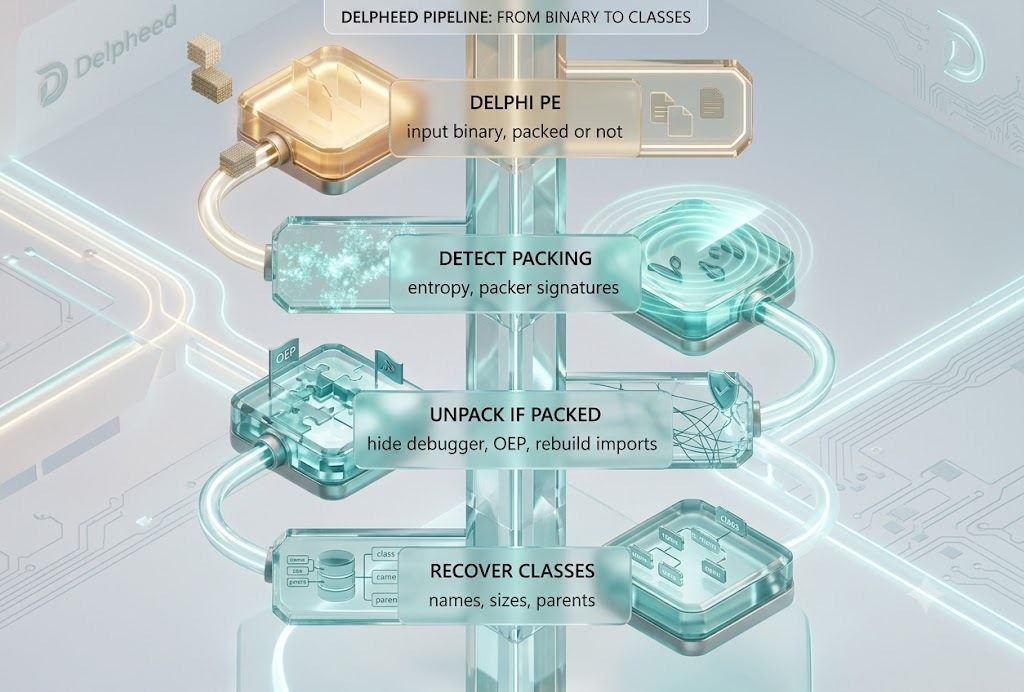
New here? See TUTORIAL.md for a hands-on, step-by-step walkthrough.
What it does
- Recover the class hierarchy of a Delphi binary — every class name, instance size, and parent — by locating VMTs through their self-pointer and validating them against Delphi's fixed VMT field layout (no disassembly required).
- Detect packing statically — per-section Shannon entropy, entry-point placement, import-table size, and known packer section-name signatures.
- Unpack common compressors two ways: the ESP trick (for
PUSHADstubs) and a guard-page OEP finder (for stubs that don't usePUSHAD). - Rebuild the import table of a dump so it loads again (Scylla-style).
- Hide the debugger from protectors that check for it (PEB/heap patching + ntdll inline hooks).
Pipeline
  target.exe
      |
      v
  [uPEFile]        parse headers, RVA<->offset<->VA, safe reads
      |
      v
  [uPackDetect]    packed?  -- no --> ---------------------------.
      |                                                          |
     yes                                                         |
      v                                                          |
  [uOEPFinder]     run under debug:                              |
    [uAntiAntiDebug]  hide the debugger (optional)               |
    strip execute from non-stub sections, catch OEP fault        |
    dump the unpacked image                                      |
    [uIATRebuild]     reconstruct imports -> *_fixed.exe         |
      |                                                          |
      v                                                          v
  [uDelphiVMT]     recover classes  <--------------------- (scan directly)
      |
      v
  class list (name, size, parent)
OEPScan / Delpheed wire these together; uUnpacker is the alternative ESP-trick
unpacker for PUSHAD stubs.
Files
| File | Role |
|---|---|
uPEFile.pas |
PE32/PE32+ parser: headers, sections, address translation, bounds-checked reads |
uDelphiVMT.pas |
VMT scanner: recovers classes + hierarchy from self-pointers and VMT layout |
uPackDetect.pas |
Packer detection: entropy, entry point, imports, known packer names |
uUnpacker.pas |
ESP-trick unpacker for PUSHAD stubs (Debug API + hardware breakpoint) |
uOEPFinder.pas |
Guard-page OEP finder; integrates anti-anti-debug + import rebuild |
uIATRebuild.pas |
Import-table reconstruction from the resolved IAT and live module exports |
uAntiAntiDebug.pas |
PEB/heap patching + ntdll inline hooks to hide the debugger |
uConsoleOut.pas |
Accessible console output (labelled text, word-based status, exit codes) |
VMTScan.dpr |
Driver: list classes in a PE |
Unpack.dpr |
Driver: ESP-trick unpack |
OEPScan.dpr |
Driver: guard-page unpack (/aad, /iat) |
Delpheed.dpr |
Driver: one-shot detect -> unpack -> analyse |
build.bat |
Build all four tools 32-bit with dcc32 |
Build
Everything builds 32-bit (the debugger, hooks, and offsets are x86-specific). With RAD Studio installed:
rsvars.bat            rem puts dcc32 on PATH  (or use a RAD Studio Command Prompt)
build.bat             rem builds VMTScan, Unpack, OEPScan, Delpheed into bin\
To build one by hand: dcc32 -B Delpheed.dpr. Requires Delphi 10.3+ (the code uses
inline variables and generics). Short RTL unit names (SysUtils, Classes) are used so
the static units also compile on older, pre-namespace Delphi.
Usage
VMTScan       <target.exe|dll>
Unpack        <packed.exe> [output.exe]
OEPScan       <packed.exe> [dump.exe] [/aad] [/iat]
Delpheed  <target.exe> [/aad]
Typical one-shot run:
Delpheed suspicious.exe /aadwhich detects packing, unpacks (hiding the debugger, rebuilding imports to
suspicious_unpacked_fixed.exe), and lists the recovered classes.
Manual, step by step:
OEPScan packed.exe packed_dump.exe /aad /iat
VMTScan packed_dump.exe
Exit codes
| Code | Meaning |
|---|---|
| 0 | success |
| 1 | bad or missing arguments |
| 2 | input could not be read / not a valid PE |
| 3 | ran, but the operation failed |
Accessibility
This is a command-line project, so "accessible" here means terminal/screen-reader
friendly, via uConsoleOut:
- status is carried by words (
OK:,ERROR:,WARNING:,INFO:), never colour; - output is linear and labelled (
Name: value), not aligned columns or tables; - no box-drawing, spinners, or cursor tricks;
- errors and warnings go to stderr, normal output to stdout;
- a quiet mode drops decorative output but keeps the result line;
- every tool returns a meaningful exit code.
Scope and limits
- 32-bit targets only for the dynamic tools. The
PUSHAD/ESP trick and syscall-stub hooks don't exist on x64; the guard-page finder needs the x86 layout. The static tools (uPEFile,uDelphiVMT,uPackDetect) handle both PE32 and PE32+. - Plain compressors (UPX, ASPack, MPRESS, older PECompact) unpack well. Strong protectors (Themida, VMProtect, Enigma) use anti-debug and virtualization that these methods do not defeat.
- The guard-page finder needs DEP enforced (the default for 32-bit processes on 64-bit Windows).
- Import reconstruction is heuristic (longest run of module-pointers) and flags any unresolved thunks rather than guessing them.
- Dumps assume the target sits at its preferred/actual image base; a stub that manages its own page protections or unpacks outside the image can defeat the finder.
Roadmap
- Disassembly-from-OEP IAT search — replace the heuristic IAT scan with a precise one
that follows
call/jmp [mem]from the OEP. Needs a small x86 length-disassembler; left out for now because a length decoder can't be validated without compiling, and a wrong one silently desyncs. - RTTI pass — walk the TypeInfo/Field/Method tables (already exposed per class) to recover published properties, methods, and enum names.
- x64 unpacking — a guard-page finder variant plus 64-bit import rebuild. Prototype in [Delpheed-64bit]