

Catalog · How the catalog works
MiniLLM

A tiny, fully explainable language model implemented in pure Delphi.
- ★ 18 on GitHub
Anyone may press Interesting, signed in or not. It helps others find this project.
README
MiniLLM
A tiny, fully explainable language model implemented in pure Delphi.
MiniLLM is an experimental project exploring how far we can push a micro-LLM architecture without any neural networks, using only:
- Pointwise Mutual Information (PMI) embeddings
- A weighted Markov transition graph
- A recurrent context vector
- Similarity-based scoring
- Multi-sample generation with reranking
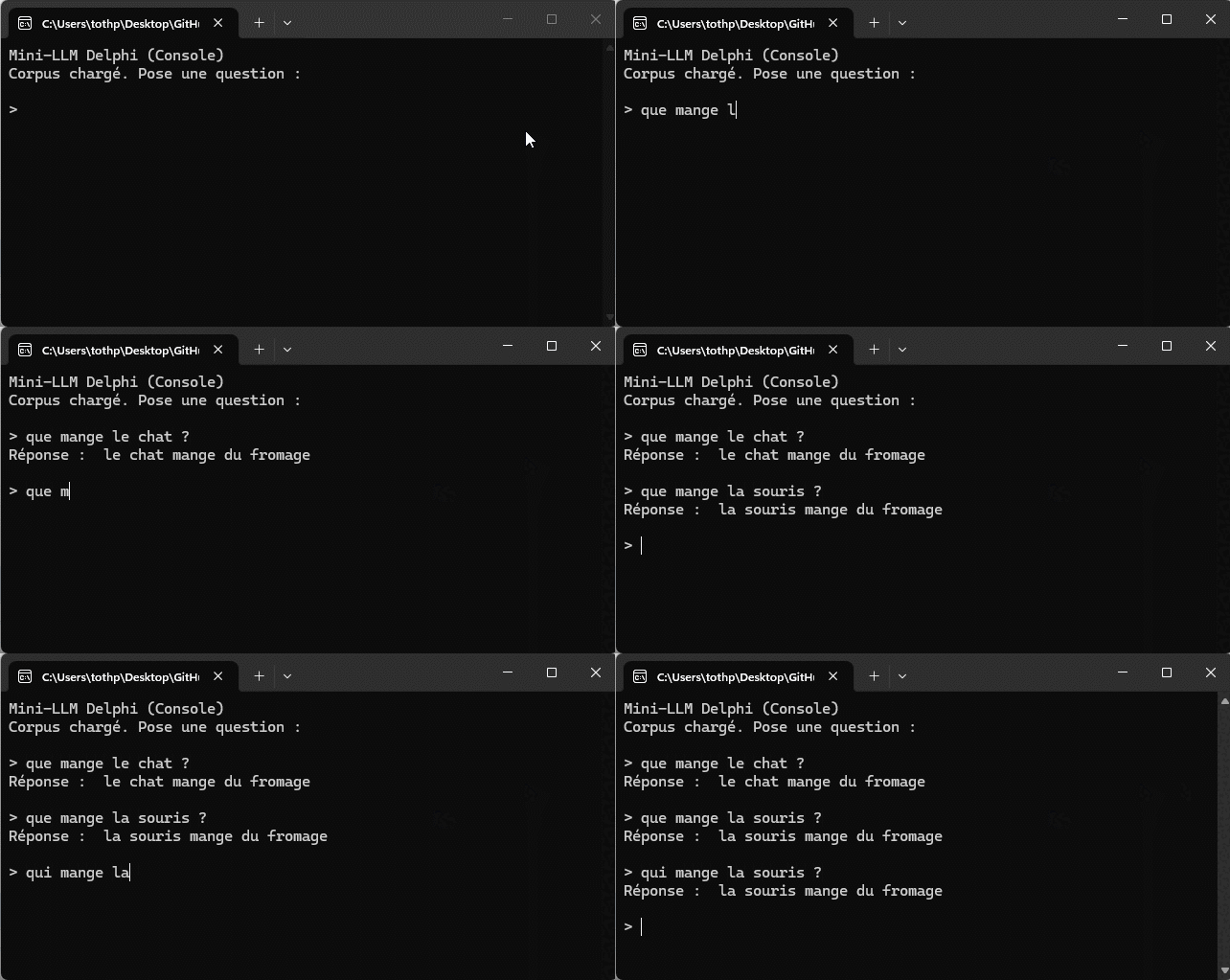
The goal is to build a small, transparent, hackable language model that can run anywhere, understand simple questions, and generate coherent answers from a very small corpus.
A large portion of the design originates from Copilot; I mainly streamlined and optimized the implementation. And for the record: this engine is not meant to compete with OpenAI — though it may occasionally surprise you with a sensible answer :)
✨ Features
🔹 Pure Delphi implementation
No external dependencies, no machine learning frameworks, no GPU.
Just clean, readable Delphi code.
🔹 PMI‑based word embeddings
Each token is represented by a PMI vector computed from the corpus.
This creates a lightweight semantic space similar to Word2Vec, but fully deterministic.
🔹 Markov transition model
Sentences are analyzed to build a weighted transition matrix between tokens.
Weights decrease with distance, giving a local contextual structure.
🔹 Recurrent context vector
During generation, each selected token updates the context vector, steering the model toward semantically relevant words.
🔹 N‑best generation with reranking
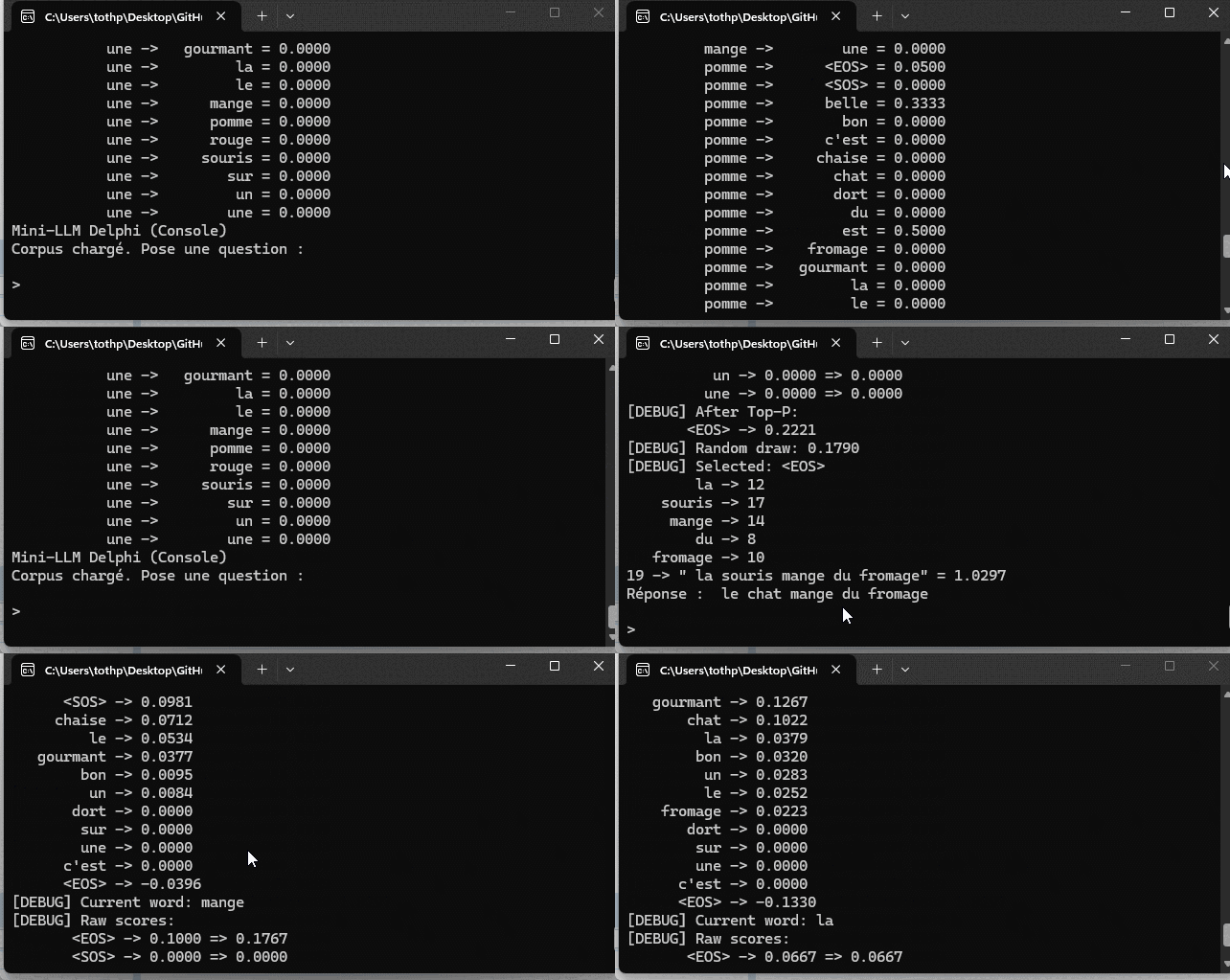
MiniLLM generates several candidate answers and selects the best one using:
- cosine similarity with the question
- Markov coherence
- penalties for repeated tokens
- structural anti‑loop heuristics
This avoids degenerate loops and produces stable, meaningful answers.
📁 Project Structure
MiniLLM/
????????? src/MiniLLM.Corpus.pas      # Tokenization, PMI vectors, sentence vectors
????????? src/MiniLLM.Markov.pas      # Transition matrix, next???token selection
????????? src/MiniLLM.Context.pas     # Recurrent context update logic
????????? src/MiniLLM.Engine.pas      # Generation, reranking, scoring
????????? README.md                   # You are here
🧠 How It Works (Short Overview)
MiniLLM combines three simple ideas:
- PMI embeddings Words that frequently appear together get similar vectors. This gives the model a notion of semantic proximity.
- Markov transitions The model learns which words tend to follow others. This gives it syntactic and local contextual structure.
- Recurrent scoring During generation, each candidate answer is scored using:
semantic similarity
transition coherence
repetition penalties
The best candidate is returned.
This architecture is small, transparent, and easy to extend.
🛠 Extending MiniLLM
You can easily add:
- larger corpora
- syntactic tags
- better distance weighting
- improved reranking
- multilingual support
- custom scoring functions
- export/import of trained models
The code is intentionally simple and hackable.