

Turn warnings and hints on or off: what changed
Revision 0 to 1. Removed lines have a minus sign; added lines have a plus sign.
Title: Turn warnings and hints on or off
| Old | New | Line | |
|---|---|---|---|
| 1 | + | There are several ways to control the behavior of warnings in both the Lazarus IDE and in the source code itself. Some warnings and hints are not very useful in a particular case so you want to hide them from view. On the other hand, if you would hide warnings or hints globally, you may want to turn a particular warning or hint explicitly on for a particular piece of your code. | |
| 2 | + | ||
| 3 | + | ``` pascal | |
| 4 | + | procedure TForm.Button1Click(sender:Tobject); | |
| 5 | + | begin | |
| 6 | + | // Do something that does not use sender | |
| 7 | + | Form1.Button1.Caption := 'Test'; | |
| 8 | + | end; | |
| 9 | + | ``` | |
| 10 | + | ||
| 11 | + | This will generate a hint that parameter sender is not used. Doh. I can see that! Problem is that this hint turns up all over the place and I know what it means. How do I hide them? | |
| 12 | + | ||
| 13 | + | # Lazarus IDE options | |
| 14 | + | ||
| 15 | + | The Lazarus IDE can control hints and warnings in two ways: | |
| 16 | + | ||
| 17 | + | - Globally through the Project Options menu | |
| 18 | + | - Using an IDE macro | |
| 19 | + | ||
| 20 | + | ## Global IDE option | |
| 21 | + | ||
| 22 | + | Go to the Project Options-\>Compiler Options-\>Messages and uncheck 'Hint:Paramater "\$1" not used'. | |
| 23 | + | ||
| 24 | + | This will turn of this particular hint for your whole project.\ | |
| 25 | + | If you would like to turn off this hint for all your projects, you can check the left bottom checkbox 'Set compiler options as default'. | |
| 26 | + | ||
| 27 | + | 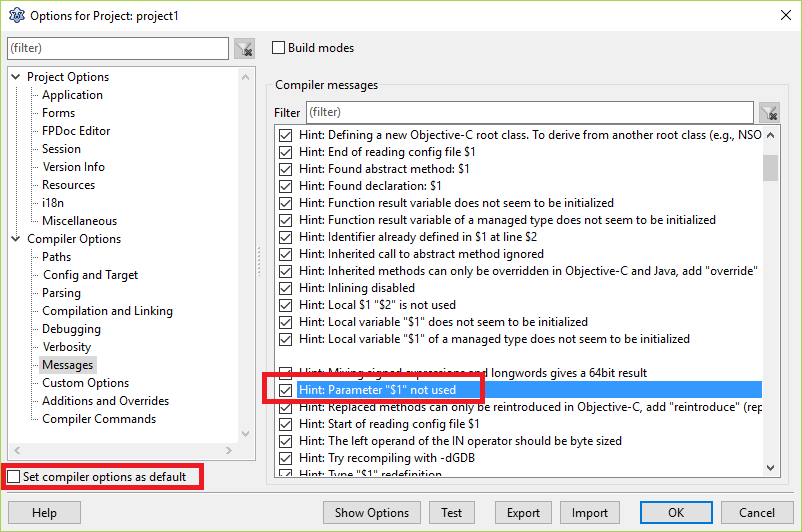 | |
| 28 | + | ||
| 29 | + | ## Local IDE option | |
| 30 | + | ||
| 31 | + | In the Lazarus IDE you can make use of the {%H-} IDE macro to turn hints off for a particular parameter.\ | |
| 32 | + | Of course {%H+} will turn hints on. | |
| 33 | + | ||
| 34 | + | ``` pascal | |
| 35 | + | procedure FormMouseDown(Sender: TObject; {%H-}Button: TMouseButton; | |
| 36 | + | {%H-}Shift: TShiftState; {%H-}X, {%H-}Y: Integer); | |
| 37 | + | ``` | |
| 38 | + | ||
| 39 | + | Note that this turns off ALL hints for that parameter, not just the 'is not used' hint, so be careful. | |
| 40 | + | ||
| 41 | + | # Source code and compiler options | |
| 42 | + | ||
| 43 | + | The options as described above will only work within the Lazarus IDE. | |
| 44 | + | ||
| 45 | + | It won't work in any other IDE, not even de FPC textmode IDE. The compiler output will still emit warnings and hints. | |
| 46 | + | ||
| 47 | + | Luckily there are several other options to control hints and warnings in the source code itself. | |
| 48 | + | ||
| 49 | + | ## Control all warnings per unit: | |
| 50 | + | ||
| 51 | + | Add | |
| 52 | + | ||
| 53 | + | ``` pascal | |
| 54 | + | {$warnings off} | |
| 55 | + | ``` | |
| 56 | + | ||
| 57 | + | or resp. | |
| 58 | + | ||
| 59 | + | ``` pascal | |
| 60 | + | {$warnings on} | |
| 61 | + | ``` | |
| 62 | + | ||
| 63 | + | just after the unit name. | |
| 64 | + | ||
| 65 | + | ## Control all hints per unit: | |
| 66 | + | ||
| 67 | + | Add | |
| 68 | + | ||
| 69 | + | ``` pascal | |
| 70 | + | {$hints off} | |
| 71 | + | ``` | |
| 72 | + | ||
| 73 | + | or resp. | |
| 74 | + | ||
| 75 | + | ``` pascal | |
| 76 | + | {$hints on} | |
| 77 | + | ``` | |
| 78 | + | ||
| 79 | + | just after the unit name. | |
| 80 | + | ||
| 81 | + | ## Control specific warnings: | |
| 82 | + | ||
| 83 | + | Add | |
| 84 | + | ||
| 85 | + | ``` pascal | |
| 86 | + | {$warn <number> off} | |
| 87 | + | ``` | |
| 88 | + | ||
| 89 | + | just after the unit name. See the example below. You can also use this construct if you want all warnings off but some specific warning(s) on: | |
| 90 | + | ||
| 91 | + | ``` pascal | |
| 92 | + | {$warnings off}{$warn <number> on} | |
| 93 | + | ``` | |
| 94 | + | ||
| 95 | + | ## Control Specific Warnings or hints per piece of code: | |
| 96 | + | ||
| 97 | + | You can control this very finely grained by using {\$push} and {\$pop} around a block of code. This does not have to be a method body as long it is a block, e.g. begin/end,repeat/until,/while do, try/finally etc. | |
| 98 | + | ||
| 99 | + | ``` pascal | |
| 100 | + | procedure withunusedparameter(const testme:integer); | |
| 101 | + | {$push}{$warn 5024 off} | |
| 102 | + | begin | |
| 103 | + | // | |
| 104 | + | end; | |
| 105 | + | {$pop} | |
| 106 | + | begin | |
| 107 | + | withunusedparameter(100); | |
| 108 | + | end. | |
| 109 | + | ``` | |
| 110 | + | ||
| 111 | + | # Obtaining the warnings and hints numbers to suppress | |
| 112 | + | ||
| 113 | + | You can obtain the needed numbers by compiling your code once with line info on and with -vwhilq | |
| 114 | + | ||
| 115 | + | This will show both the numbers and the messages and the line numbers where they are found. | |
| 116 | + | ||
| 117 | + | The other way to obtain hint, notice or warning number is to search inside FP repository for source of your current FPC version. | |
| 118 | + | ||
| 119 | + | All of the messages with its own description is stored in \<FPC source dir\>/msg/error\<language\>.msg | |
| 120 | + | ||
| 121 | + | This file is also have header, which provides explanation how error/notice/hint/warning constants are constructed. | |
| 122 | + | ||
| 123 | + | For the English language it's contains following: | |
| 124 | + | ||
| 125 | + | ``` pascal | |
| 126 | + | # CodePage 20127 | |
| 127 | + | ||
| 128 | + | # | |
| 129 | + | # The constants are build in the following order: | |
| 130 | + | # <part>_<type>_<txtidentifier> | |
| 131 | + | # | |
| 132 | + | # <part> is the part of the compiler the message is used | |
| 133 | + | # asmr_ assembler parsing | |
| 134 | + | # asmw_ assembler writing/binary writers | |
| 135 | + | # unit_ unit handling | |
| 136 | + | # option_ command line parameter parsing | |
| 137 | + | # scan_ scanner | |
| 138 | + | # parser_ parser | |
| 139 | + | # type_ type checking | |
| 140 | + | # general_ general info | |
| 141 | + | # exec_ calls to assembler, external linker, binder | |
| 142 | + | # link_ internal linker | |
| 143 | + | # package_ package handling | |
| 144 | + | # | |
| 145 | + | # <type> the type of the message it should normally used for | |
| 146 | + | # f_ fatal error | |
| 147 | + | # e_ error | |
| 148 | + | # w_ warning | |
| 149 | + | # n_ note | |
| 150 | + | # h_ hint | |
| 151 | + | # i_ info | |
| 152 | + | # l_ add linenumber | |
| 153 | + | # u_ used | |
| 154 | + | # t_ tried | |
| 155 | + | # c_ conditional | |
| 156 | + | # d_ debug message | |
| 157 | + | # x_ executable informations | |
| 158 | + | # o_ normal (e.g., "press enter to continue") | |
| 159 | + | # | |
| 160 | + | # <type> can contain a minus sign at the beginning to mark that | |
| 161 | + | # the message is off by default. Look at type_w_explicit_string_cast | |
| 162 | + | # for example. | |
| 163 | + | ``` | |
| 164 | + | ||
| 165 | + | So, to find your warning/notice/etc, you just need to search the message body. For the example, it can be \<unit "Pas2Js.pas" not used in main.pas\>, to find this warning, you need to replace all of the local data in message body with \$\< data number \>, | |
| 166 | + | ||
| 167 | + | `for this situation it will be: <Unit "$1" not used in $2>;` | |
| 168 | + | ||
| 169 | + | After that, you can find the required message just by finding its body in errors\<language\>.msg file, you will find the following: | |
| 170 | + | ||
| 171 | + | ``` pascal | |
| 172 | + | sym_n_unit_not_used=05023_H_Unit "$1" not used in $2 | |
| 173 | + | % The unit referenced in the \var{uses} clause is not used. | |
| 174 | + | ``` | |
| 175 | + | ||
| 176 | + | So, the actual notice number is 05023. | |
| 177 | + | ||
| 178 | + | Based on that number you can decide to suppress the warning or hint globally, per unit or per routine, depending on what you need. | |
| 179 | + | ||
| 180 | + | For example, if you want to suppress unused parameters you can subsequently compile with -vm5024. | |
| 181 | + | ||
| 182 | + | With the -vm compiler option you can use multiple warning and hint numbers separated by a comma. Or you can write: | |
| 183 | + | ||
| 184 | + | ``` pascal | |
| 185 | + | {$warn 5024 off} | |
| 186 | + | ``` | |
| 187 | + | ||
| 188 | + | This needs to be done for each number separately. | |
| 189 | + | ||
| 190 | + | See also: | |
| 191 | + | ||
| 192 | + | --- | |
| 193 | + | *From the Free Pascal wiki, page "Turn warnings and hints on or off", as it stood on 2020-03-02 after a change by Trev, out of the wiki's dump of 2024-05-26. Copyright stays with the author who wrote it, according to the old wiki's [[Licensing]] page. If you have concerns about this material, [message the admin](/wiki-contact).* |