

RunError
A RunError is a low-level error emitted by the Free Pascal Run Time Library.
#
Short description
Explanation
1
Invalid function number
An invalid operating system call was attempted.
2
File not found
Reported when trying to erase, rename or open a non-existent file.
3
Path not found
Reported by the directory handling routines when a path does not exist or is invalid. Also reported when trying to access a non-existent file.
4
Too many open files
The maximum number of files currently opened by your process has been reached. Certain operating systems limit the number of files which can be opened concurrently, and this error can occur when this limit has been reached.
5
File access denied
Permission to access the file is denied. This error might be caused by one of several reasons:
- Trying to open for writing a file which is read-only, or which is actually a directory.
- File is currently locked or used by another process.
- Trying to create a new file, or directory while a file or directory of the same name already exists.
- Trying to read from a file which was opened in write-only mode.
- Trying to write from a file which was opened in read-only mode.
- Trying to remove a directory or file while it is not possible.
- No permission to access the file or directory.
6
Invalid file handle
If this happens, the file variable you are using is trashed; it indicates that your memory is corrupted.
12
Invalid file access code
Reported when a reset or rewrite is called with an invalid FileMode value.
15
Invalid drive number
The number given to the Getdir or ChDir function specifies a non-existent disk.
16
Cannot remove current directory
Reported when trying to remove the currently active directory.
17
Cannot rename across drives
You cannot rename a file such that it would end up on another disk or partition.
100
Disk read error
An error occurred when reading from disk. Typically happens when you try to read past the end of a file.
101
Disk write error
Reported when the disk is full, and you’re trying to write to it.
102
File not assigned
This is reported by Reset, Rewrite, Append, Rename and Erase, if you call them with an unassigned file as a parameter.
103
File not open
Reported by the following functions : Close, Read, Write, Seek, EOf, FilePos, FileSize, Flush, BlockRead, and BlockWrite if the file is not open.
104
File not open for input
Reported by Read, BlockRead, Eof, Eoln, SeekEof or SeekEoln if the file is not opened with Reset.
105
File not open for output
Reported by write if a text file isn’t opened with Rewrite.
106
Invalid numeric format
Reported when a non-numeric value is read from a text file, and a numeric value was expected.
107
Invalid enumeration
Reported when a text representation of an enumerated constant cannot be created in a call to str or write(ln).
150
Disk is write-protected
(Critical error)
151
Bad drive request struct length
(Critical error)
152
Drive not ready
(Critical error)
154
CRC error in data
(Critical error)
156
Disk seek error
(Critical error)
157
Unknown media type
(Critical error)
158
Sector Not Found
(Critical error)
159
Printer out of paper
(Critical error)
160
Device write fault
(Critical error)
161
Device read fault
(Critical error)
162
Hardware failure
(Critical error)
200
Division by zero
The application attempted to divide a number by zero.
201
Range check error
If you compiled your program with range checking on, then you can get this error in the following cases:
- An array was accessed with an index outside its declared range.
- Trying to assign a value to a variable outside its range (for instance an enumerated type).
202
Stack overflow error
The stack has grown beyond its maximum size (in which case the size of local variables should be reduced to avoid this error), or the stack has become corrupt. This error is only reported when stack checking is enabled.
203
Heap overflow error
The heap has grown beyond its boundaries. This is caused when trying to allocate memory explicitly with New, GetMem or ReallocMem, or when a class or object instance is created and no memory is left. Please note that, by default, Free Pascal provides a growing heap, i.e. the heap will try to allocate more memory if needed. However, if the heap has reached the maximum size allowed by the operating system or hardware, then you will get this error.
204
Invalid pointer operation
You will get this in several cases:
- if you call Dispose or Freemem with an invalid pointer
- in case New or GetMem is called, and there is no more memory available. The behavior in this case depends on the setting of ReturnNilIfGrowHeapFails. If it is True, then Nil is returned. if False, then runerror 204 is raised.
205
Floating point overflow
You are trying to use or produce real numbers that are too large.
206
Floating point underflow
You are trying to use or produce real numbers that are too small.
207
Invalid floating point operation
Can occur if you try to calculate the square root or logarithm of a negative number.
210
Object not initialized
When compiled with range checking on, a program will report this error if you call a virtual method without having called its object’s constructor.
211
Call to abstract method
Your program tried to execute an abstract virtual method. Abstract methods should be overridden, and the overriding method should be called.
212
Stream registration error
This occurs when an invalid type is registered in the objects unit.
213
Collection index out of range
You are trying to access a collection item with an invalid index (objects unit).
214
Collection overflow error
The collection has reached its maximal size, and you are trying to add another element (objects unit).
215
Arithmetic overflow error
This error is reported when the result of an arithmetic operation is outside of its supported range. Contrary to Turbo Pascal, this error is only reported for 32-bit or 64-bit arithmetic overflows. This is due to the fact that everything is converted to 32-bit or 64-bit before doing the actual arithmetic operation.
216
The application tried to access invalid memory space. This can be caused by several problems:
- Dereferencing a nil pointer.
- Trying to access memory which is out of bounds (for example, calling move with an invalid length).
217
Unhandled exception occurred
An exception occurred, and there was no exception handler present. The sysutils unit installs a default exception handler which catches all exceptions and exits gracefully.
218
Invalid value specified
Error 218 occurs when an invalid value was specified to a system call, for instance when specifying a negative value to a seek() call.
219
Invalid typecast
Thrown when an invalid typecast is attempted on a class using the as operator. This error is also thrown when an object or class is typecast to an invalid class or object and a virtual method of that class or object is called. This last error is only detected if the -CR compiler option is used.
222
Variant dispatch error
No dispatch method to call from variant.
223
Variant array create
The variant array creation failed. Usually when there is not enough memory.
224
Variant is not an array
This error occurs when a variant array operation is attempted on a variant which is not an array.
225
Var Array Bounds check error
This error occurs when a variant array index is out of bounds.
227
Assertion failed error
An assertion failed, and no AssertErrorProc procedural variable was installed.
229
Safecall error check
This error occurs is a safecall check fails, and no handler routine is available.
231
Exception stack corrupted
This error occurs when the exception object is retrieved and none is available.
232
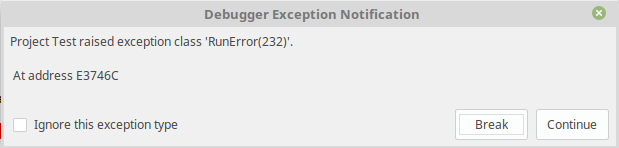
Threads not supported
Thread management relies on a separate driver on some operating systems (notably, Unixes). The unit with this driver needs to be specified on the uses clause of the program, preferably as the first unit (cthreads on unix).
Add {$define UseCThreads} in the top of the first Pascal unit (usually the project .lpr file)
See also
From the Free Pascal wiki, page "RunError", as it stood on 2023-11-11 after a change by Bart, out of the wiki's dump of 2024-05-26. Copyright stays with the author who wrote it, according to the old wiki's Licensing page. If you have concerns about this material, message the admin.
Talk about this page
Nobody has opened a bench for this page yet. Sign in to open one.