

LGenerics: what changed
Revision 3 to 4. Removed lines have a minus sign; added lines have a plus sign.
| Old | New | Line | |
|---|---|---|---|
| 1 | 1 | ## About | |
| 2 | 2 | ||
| 3 | 3 | Collection of generic algorithms and data structures for Free Pascal. | |
| 4 | 4 | ||
| 5 | 5 | Requires: FPC 3.2.2+, Lazarus 2.2+. | |
| 6 | 6 | ||
| 7 | 7 | Author: A.Koverdyaev (avk) | |
| 8 | 8 | ||
| 9 | 9 | License: Apache License 2.0 | |
| 10 | 10 | ||
| 11 | 11 | ## Download | |
| 12 | 12 | ||
| 13 | 13 | GitHub: <https://github.com/avk959/LGenerics> | |
| 14 | 14 | ||
| 15 | 15 | ## Features | |
| 16 | 16 | ||
| 17 | 17 | #### Implemented primitives | |
| 18 | 18 | ||
| 19 | 19 | - stack (unit lgStack) | |
| 20 | 20 | - queue (unit lgQueue) | |
| 21 | 21 | - deque (unit lgDeque) | |
| 22 | 22 | - vector (unit lgVector) | |
| 23 | 23 | - vector of bits (unit lgVector) | |
| 24 | 24 | - priority queue based on binary heap (unit lgPriorityQueue) | |
| 25 | 25 | - priority queue with key update and melding based on pairing heap (unit lgPriorityQueue) | |
| 26 | 26 | - sorted list (unit lgList) | |
| 27 | 27 | - hashed list - array based list with the ability to fast search by key (unit lgList) | |
| 28 | 28 | - hashset (unit lgHashSet) | |
| 29 | 29 | - fine-grained concurrent hashset (unit lgHashSet) | |
| 30 | 30 | - sorted set (unit lgTreeSet) | |
| 31 | 31 | - set of arbitrary size (unit lgUtil, TGSet) | |
| 32 | 32 | - hash multiset (unit lgHashMultiSet) | |
| 33 | 33 | - fine-grained concurrent hashmultiset (unit lgHashMultiSet) | |
| 34 | 34 | - sorted multiset (unit lgTreeMultiSet) | |
| 35 | 35 | - hashmap (unit lgHashMap) | |
| 36 | 36 | - fine-grained concurrent hashmap (unit lgHashMap) | |
| 37 | 37 | - sorted map (unit lgTreeMap) | |
| 38 | 38 | - hash multimap (unit lgMultiMap) | |
| 39 | 39 | - tree multimap (unit lgMultiMap) | |
| 40 | 40 | - list miltimap (unit lgMultiMap) | |
| 41 | 41 | - bijective map (unit lgBiMap) | |
| 42 | 42 | - sparse 2D table (unit lgTable2D) | |
| 43 | 43 | - disjoint set (unit lgHashSet) | |
| 44 | 44 | - AVL tree (unit lgAvlTree) | |
| 45 | 45 | - red-black tree (unit lgRbTree) | |
| 46 | 46 | - some treap variants (unit lgTreap) | |
| 47 | 47 | - general rooted tree (unit lgRootTree) | |
| 48 | 48 | - sparse labeled undirected graph (unit lgSimpleGraph) | |
| 49 | 49 | - sparse labeled directed graph (unit lgSimpleDigraph) | |
| 50 | 50 | - lite containers based on advanced records | |
| 51 | 51 | - extended IEnumearble interface - filtering, mapping, etc. | |
| 52 | 52 | ||
| 53 | 53 | #### Algorithms on graphs | |
| 54 | 54 | ||
| 55 | 55 | - core functions: | |
| 56 | 56 | - vertices/edges addition/removal/query/enumeration, edge contraction, degree | |
| 57 | 57 | - load/save to own binary format, primitive export to DOT format | |
| 58 | 58 | - connectivity: | |
| 59 | 59 | - connected/strongly connected components, bipartite detection, degeneracy, k-core | |
| 60 | 60 | - articulation points, bridges, biconnected components | |
| 61 | 61 | - edge-connectivity | |
| 62 | 62 | - traversals: | |
| 63 | 63 | - BFS/DFS traversals with visitors, | |
| 64 | 64 | - cycle/negative cycle detection, | |
| 65 | 65 | - topological sort | |
| 66 | 66 | - operations: | |
| 67 | 67 | - induced subgraphs, complement, reverse, union, intersect, symmetric difference, | |
| 68 | 68 | - chordality testing | |
| 69 | 69 | - planarity testing: FMR Left-Right Planarity algorithm | |
| 70 | 70 | - distance within graph: | |
| 71 | 71 | - eccentricity, radius, diameter, center, periphery | |
| 72 | 72 | - matching: | |
| 73 | 73 | - maximum cardinality matching on bipartite/arbitrary graphs | |
| 74 | 74 | - minimum/maximum weight matching on bipartite graphs | |
| 75 | 75 | - dominators in flowgraps: simple iterative and Semi-NCA algorithms | |
| 76 | 76 | - some suggestions for NP-hard problems: | |
| 77 | 77 | - maximum independent set, maximal independent sets enumeration | |
| 78 | 78 | - maximum clique, cliques enumeration | |
| 79 | 79 | - minimum vertex cover, minimal vertex covers enumeration | |
| 80 | 80 | - vertex coloring, approximations and exact | |
| 81 | 81 | - minimum dominating set | |
| 82 | 82 | - Hamiltonian cycles and paths | |
| 83 | 83 | - local search TSP approximations, BnB TSP solver | |
| 84 | 84 | - minimum spanning trees: Prims's and Kruskal's algorithms | |
| 85 | 85 | - single source shortest paths: | |
| 86 | 86 | - Dijkstra with pairing heap, Bellman-Ford-Moor with Tarjan's subtree disassembly(BFMT) | |
| 87 | 87 | - single pair shortest paths: | |
| 88 | 88 | - Dijkstra with binary heap, BFMT, bidirection Dijkstra, A*, NBA* | |
| 89 | 89 | - all pairs shortest paths: | |
| 90 | 90 | - Floyd–Warshall, Johnson, BFMT | |
| 91 | 91 | - networks: | |
| 92 | 92 | - maximum flow: push/relabel, capacity scaling Dinitz | |
| 93 | 93 | - minimum-cost flow: Busacker-Gowen, cost scaling push/relabel algorithm | |
| 94 | 94 | - global minimum cut: Stoer–Wagner, Nagamochi-Ibaraki | |
| 95 | 95 | ||
| 96 | 96 | #### Algorithms on arrays and vectors | |
| 97 | 97 | ||
| 98 | 98 | (mostly unit lgArrayHelpers) | |
| 99 | 99 | ||
| 100 | 100 | - reverse, right/left cyclic shifts | |
| 101 | 101 | - permutations | |
| 102 | 102 | - binary search | |
| 103 | 103 | - N-th order statistics | |
| 104 | 104 | - inversion counting | |
| 105 | 105 | - distinct values selection | |
| 106 | 106 | - quicksort | |
| 107 | 107 | - introsort | |
| 108 | 108 | - dual pivot quicksort | |
| 109 | 109 | - mergesort | |
| 110 | 110 | - timsort (unit lgMiscUtils) | |
| 111 | 111 | - counting sort | |
| 112 | 112 | - radix sort | |
| 113 | 113 | - translation of Orson Peters' PDQSort algorithm | |
| 114 | 114 | - static segment tree | |
| 115 | 115 | - longest increasing subsequence | |
| 116 | 116 | - ... | |
| 117 | 117 | ||
| 118 | 118 | #### Algorithms on strings and sequences | |
| 119 | 119 | ||
| 120 | 120 | (units lgStrHelpers, lgSeqUtils) | |
| 121 | 121 | ||
| 122 | 122 | - exact string matching | |
| 123 | 123 | - Boyer-Moore string matching algorithm(in Fast Search variant, unit lgStrHelpers) | |
| 124 | 124 | - Boyer-Moore-Horspool-Raita algorithm (unit lgStrHelpers) | |
| 125 | 125 | - Aho-Corasick automation for multiple string matching | |
| 126 | 126 | - longest common subsequence of two sequences: | |
| 127 | 127 | - reducing the LCS problem to LIS | |
| 128 | 128 | - Kumar-Rangan algorithm for LCS | |
| 129 | 129 | - Myers algorithm for LCS | |
| 130 | 130 | - the Levenshtein distance: | |
| 131 | 131 | - simple DP algorithm | |
| 132 | 132 | - modified Berghel-Roach algorithm | |
| 133 | 133 | - Myers bit-vector algorithm with cut-off heuristic | |
| 134 | 134 | - LCS distance: | |
| 135 | 135 | - Myers algorithm for LCS distance | |
| 136 | 136 | - fuzzy string matching(k differences) | |
| 137 | 137 | - Ukkonen EDP algorithm | |
| 138 | 138 | - fuzzy string matching with preprocessing(something similar to fuzzywuzzy) | |
| 139 | 139 | ||
| 140 | 140 | #### Other features | |
| 141 | 141 | ||
| 142 | 142 | - non-cryptogarphic hashes (unit lgHash): | |
| 143 | 143 | - Yann Collet's xxHash32, xxHash64 | |
| 144 | 144 | - Austin Appleby's MurmurHash2, MurmurHash2A, MurmurHash3_x86_32, MurmurHash64A | |
| 145 | 145 | - brief and dirty implementation of futures concept (unit lgAsync) | |
| 146 | 146 | - brief channel implementation (unit lgAsync) | |
| 147 | 147 | - brief implementation of thread pool (unit lgAsync) | |
| 148 | 148 | - 128-bit integers (unit lgInt128) | |
| 149 | 149 | - JSON validator/parser/generator (unit lgJson) | |
| 150 | 150 | - JSON Patch/Diff (unit lgJson) | |
| 151 | 151 | - JSON serialization/deserialization of native Pascal data structures using RTTI(unit lgPdo) | |
| 152 | 152 | - JSON Type Definition schemas(unit lgJsonTypeDef) | |
| 153 | 153 | - validating a JSON document against a JTD schema(unit lgJsonTypeDef) | |
| 154 | 154 | - generating Pascal code from a JTD schema(unit lgJtdCodegen) | |
| 155 | 155 | - inferring JTD schemas from example data(unit lgJtdInfer) | |
| 156 | 156 | - JSONPath implementation(unit LgJsonPath) | |
| 157 | 157 | - CSV document processing (unit lgCsvUtils) | |
| 158 | 158 | - Eisel-Lemire fast string-to-double conversion algorithm (unit lgJson) | |
| 159 | 159 | - Ryū double-to-string conversion algorithm (unit lgJson) | |
| 160 | 160 | ||
| 161 | 161 | ## Support for JSON Patch | |
| 162 | 162 | ||
| 163 | 163 | The TJsonPatch class from the lgJson unit implements the JSON Patch ([RFC 6902](https://datatracker.ietf.org/doc/html/rfc6902)) functionality. JSON Patch is a JSON document format (media type is application/json-patch+json) for expressing a sequence of operations applied to a target JSON document; it is always an array of objects, each representing a single operation, supported set of operations: ADD, REMOVE, REPLACE, MOVE, COPY, and TEST. | |
| 164 | 164 | ||
| 165 | 165 | For example, for this document: | |
| 166 | 166 | ||
| 167 | 167 | ``` json | |
| 168 | 168 | { | |
| 169 | 169 | "foo": [1, 3], | |
| 170 | 170 | "boo": ["bar", "baz"] | |
| 171 | 171 | } | |
| 172 | 172 | ``` | |
| 173 | 173 | ||
| 174 | 174 | applying this patch | |
| 175 | 175 | ||
| 176 | 176 | ``` json | |
| 177 | 177 | [ | |
| 178 | 178 | {"op": "add", "path": "/foo/1", "value": "fizz"}, | |
| 179 | 179 | {"op": "replace", "path": "/boo/1", "value": "qux"}, | |
| 180 | 180 | {"op": "add", "path": "/ozz", "value": "zoo"} | |
| 181 | 181 | ] | |
| 182 | 182 | ``` | |
| 183 | 183 | ||
| 184 | 184 | will have the following result: | |
| 185 | 185 | ||
| 186 | 186 | ``` json | |
| 187 | 187 | { | |
| 188 | 188 | "foo": [1, "fizz", 3], | |
| 189 | 189 | "boo": ["bar", "qux"], | |
| 190 | 190 | "ozz": "zoo" | |
| 191 | 191 | } | |
| 192 | 192 | ``` | |
| 193 | 193 | ||
| 194 | 194 | The TJsonPatch class also contains a POC implementation of the Diff utility, which generates a patch by comparing source and target documents. | |
| 195 | 195 | ||
| 196 | 196 | For example, for this source: | |
| 197 | 197 | ||
| 198 | 198 | ``` json | |
| 199 | 199 | { | |
| 200 | 200 | "a": 1, | |
| 201 | 201 | "b": null, | |
| 202 | 202 | "c": ["test", "plop"] | |
| 203 | 203 | } | |
| 204 | 204 | ``` | |
| 205 | 205 | ||
| 206 | 206 | and for this target: | |
| 207 | 207 | ||
| 208 | 208 | ``` json | |
| 209 | 209 | { | |
| 210 | 210 | "a": 6, | |
| 211 | 211 | "c": ["test", "flop"], | |
| 212 | 212 | "d": "baz" | |
| 213 | 213 | } | |
| 214 | 214 | ``` | |
| 215 | 215 | ||
| 216 | 216 | it will generate a patch like this: | |
| 217 | 217 | ||
| 218 | 218 | ``` json | |
| 219 | 219 | [ | |
| 220 | 220 | {"op": "replace", "path": "/a", "value": 6}, | |
| 221 | 221 | {"op": "remove", "path": "/b"}, | |
| 222 | 222 | {"op": "replace", "path": "/c/1", "value": "flop"}, | |
| 223 | 223 | {"op": "add", "path": "/d", "value": "baz"} | |
| 224 | 224 | ] | |
| 225 | 225 | ``` | |
| 226 | 226 | ||
| 227 | 227 | ## Exporting structures to JSON format | |
| 228 | 228 | ||
| 229 | 229 | A unit has been added to LGenerics for exporting Pascal data structures to JSON format and vice versa. The following types are currently supported (called PDOs for short): | |
| 230 | 230 | ||
| 231 | 231 | - numeric, boolean or string types, some limited support of variants; | |
| 232 | 232 | - enumerations (exported in string form as the name of the corresponding constant); | |
| 233 | 233 | - sets (exported as an array of its elements); | |
| 234 | 234 | - regular records, it is possible to register a list of field names or a custom serialization callback; | |
| 235 | 235 | - classes, using published properties or by registering a custom callback (TStrings and TCollection as a special case); | |
| 236 | 236 | - objects (only by registering a custom serialization callback); | |
| 237 | 237 | - static arrays of PDO (only one-dimensional, multidimensional arrays are written as one-dimensional); | |
| 238 | 238 | - dynamic arrays of PDO; | |
| 239 | 239 | - variant arrays (currently only one-dimensional); | |
| 240 | 240 | ||
| 241 | 241 | ### Serialization | |
| 242 | 242 | ||
| 243 | 243 | Function PdoToJson() saves native data structure to JSON format. | |
| 244 | 244 | ||
| 245 | 245 | For example, this code: | |
| 246 | 246 | ||
| 247 | 247 | ``` pascal | |
| 248 | 248 | program test; | |
| 249 | 249 | ||
| 250 | 250 | {$mode objfpc}{$h+}{$optimization noorderfields} | |
| 251 | 251 | ||
| 252 | 252 | uses | |
| 253 | 253 | SysUtils, lgUtils, lgJson, lgPdo; | |
| 254 | 254 | ||
| 255 | 255 | type | |
| 256 | 256 | TDayOfWeek = 1..7; | |
| 257 | 257 | TDaySet = set of TDayOfWeek; | |
| 258 | 258 | TMember = record | |
| 259 | 259 | Name: string; | |
| 260 | 260 | Age: Integer; | |
| 261 | 261 | VisitDays: TDaySet; | |
| 262 | 262 | end; | |
| 263 | 263 | ||
| 264 | 264 | const | |
| 265 | 265 | Members: array of TMember = ( | |
| 266 | 266 | (Name: 'Alice'; Age: 21; VisitDays: [1, 3, 5]), | |
| 267 | 267 | (Name: 'Bob'; Age: 25; VisitDays: [2, 5, 6])); | |
| 268 | 268 | var | |
| 269 | 269 | n: specialize TGAutoRef<TJsonNode>; | |
| 270 | 270 | s: string; | |
| 271 | 271 | ||
| 272 | 272 | begin | |
| 273 | 273 | RegisterRecordFields(TypeInfo(TMember), ['name', 'age', 'visitDays']); | |
| 274 | 274 | s := PdoToJson(TypeInfo(Members), Members); | |
| 275 | 275 | if not n.Instance.Parse(s) then | |
| 276 | 276 | WriteLn('Oops, something went wrong :(') | |
| 277 | 277 | else | |
| 278 | 278 | WriteLn(n.Instance.FormatJson([jfoEgyptBrace, jfoSingleLineArray])); | |
| 279 | 279 | end. | |
| 280 | 280 | ``` | |
| 281 | 281 | ||
| 282 | 282 | produces this JSON: | |
| 283 | 283 | ||
| 284 | 284 | ``` json | |
| 285 | 285 | [ | |
| 286 | 286 | { | |
| 287 | 287 | "name": "Alice", | |
| 288 | 288 | "age": 21, | |
| 289 | 289 | "visitDays": [1, 3, 5] | |
| 290 | 290 | }, | |
| 291 | 291 | { | |
| 292 | 292 | "name": "Bob", | |
| 293 | 293 | "age": 25, | |
| 294 | 294 | "visitDays": [2, 5, 6] | |
| 295 | 295 | } | |
| 296 | 296 | ] | |
| 297 | 297 | ``` | |
| 298 | 298 | ||
| 299 | 299 | ### Deserialization | |
| 300 | 300 | ||
| 301 | 301 | Procedure PdoLoadJson() is used to load JSON back to the native data structure. | |
| 302 | 302 | ||
| 303 | 303 | Let's change the previous example a bit: | |
| 304 | 304 | ||
| 305 | 305 | ``` pascal | |
| 306 | 306 | program test; | |
| 307 | 307 | ||
| 308 | 308 | {$mode objfpc}{$h+}{$optimization noorderfields} | |
| 309 | 309 | ||
| 310 | 310 | uses | |
| 311 | 311 | SysUtils, lgJson, lgPdo, lgMiscUtils; | |
| 312 | 312 | ||
| 313 | 313 | type | |
| 314 | 314 | TDayOfWeek = 1..7; | |
| 315 | 315 | TDaySet = set of TDayOfWeek; | |
| 316 | 316 | TMember = record | |
| 317 | 317 | Name: string; | |
| 318 | 318 | Age: Integer; | |
| 319 | 319 | VisitDays: TDaySet; | |
| 320 | 320 | end; | |
| 321 | 321 | ||
| 322 | 322 | const | |
| 323 | 323 | Members: array of TMember = ( | |
| 324 | 324 | (Name: 'Alice'; Age: 21; VisitDays: [1, 3, 5]), | |
| 325 | 325 | (Name: 'Bob'; Age: 25; VisitDays: [2, 5, 6])); | |
| 326 | 326 | var | |
| 327 | 327 | s: string; | |
| 328 | 328 | MemberList: array of TMember = nil; | |
| 329 | 329 | I: Integer; | |
| 330 | 330 | begin | |
| 331 | 331 | RegisterRecordFields(TypeInfo(TMember), ['name', 'age', 'visitDays']); | |
| 332 | 332 | s := PdoToJson(TypeInfo(Members), Members); | |
| 333 | 333 | //Let's try to read the resulting JSON back into the MemberList array | |
| 334 | 334 | PdoLoadJson(TypeInfo(MemberList), MemberList, s); | |
| 335 | 335 | for I := 0 to High(MemberList) do begin | |
| 336 | 336 | WriteLn('Member ', I); | |
| 337 | 337 | WriteLn(' Name: ', MemberList[I].Name); | |
| 338 | 338 | WriteLn(' Age: ', MemberList[I].Age); | |
| 339 | 339 | WriteLn(' VisitDays: ', Stringify(TypeInfo(TDaySet), MemberList[I].VisitDays)); | |
| 340 | 340 | end; | |
| 341 | 341 | end. | |
| 342 | 342 | ``` | |
| 343 | 343 | ||
| 344 | 344 | it prints | |
| 345 | 345 | ||
| 346 | 346 | Member 0 | |
| 347 | 347 | Name: Alice | |
| 348 | 348 | Age: 21 | |
| 349 | 349 | VisitDays: {1, 3, 5} | |
| 350 | 350 | Member 1 | |
| 351 | 351 | Name: Bob | |
| 352 | 352 | Age: 25 | |
| 353 | 353 | VisitDays: {2, 5, 6} | |
| 354 | 354 | ||
| 355 | 355 | ## Support for JSON Type Definition | |
| 356 | 356 | ||
| 357 | 357 | [JSON Type Definition (aka RFC 8927)](https://jsontypedef.com) is an easy-to-learn, standardized way to define a schema for JSON data. | |
| 358 | 358 | ||
| 359 | 359 | ##### Why a schema for JSON? | |
| 360 | 360 | ||
| 361 | 361 | The schema provides a way to describe the structure and to some extent the semantics of the document, with which: | |
| 362 | 362 | ||
| 363 | 363 | - it becomes possible to validate the document, i.e. to distinguish the "correct" document from the "incorrect" one; | |
| 364 | 364 | - a validated document can be safely deserialized into a native data structure; | |
| 365 | 365 | - and finally, it becomes possible to automatically generate this particular native data structure; | |
| 366 | 366 | ||
| 367 | 367 | ##### Why JSON Typedef? | |
| 368 | 368 | ||
| 369 | 369 | It is simple, standardized, well documented, and there are a fair number of implementations for various programming languages(of course, Pascal is not among them). | |
| 370 | 370 | ||
| 371 | 371 | Strictly speaking, JSON Typedef is a subset of JSON Schema. According to the author, the expressiveness of the JTD was intentionally limited to be no more powerful than what can be expressed in the type systems of of major programming languages. | |
| 372 | 372 | ||
| 373 | 373 | In short, for most projects this may be exactly what you need. | |
| 374 | 374 | ||
| 375 | 375 | TL;DR | |
| 376 | 376 | ||
| 377 | 377 | There is not much point in describing the features of the JTD schemas, it is well explained in the documentation. | |
| 378 | 378 | ||
| 379 | 379 | ##### Validation | |
| 380 | 380 | ||
| 381 | 381 | Suppose we should to receive JSON messages like | |
| 382 | 382 | ||
| 383 | 383 | ``` json | |
| 384 | 384 | { | |
| 385 | 385 | "firstName": "John", | |
| 386 | 386 | "lastName": "Doe", | |
| 387 | 387 | "age": 42 | |
| 388 | 388 | } | |
| 389 | 389 | ``` | |
| 390 | 390 | ||
| 391 | 391 | such JSON can be described by the JTD scheme | |
| 392 | 392 | ||
| 393 | 393 | ``` json | |
| 394 | 394 | { | |
| 395 | 395 | "properties": { | |
| 396 | 396 | "firstName": {"type": "string"}, | |
| 397 | 397 | "lastName": {"type": "string"}, | |
| 398 | 398 | "age": {"type": "uint8"} | |
| 399 | 399 | } | |
| 400 | 400 | } | |
| 401 | 401 | ``` | |
| 402 | 402 | ||
| 403 | 403 | And let us get the message | |
| 404 | 404 | ||
| 405 | 405 | ``` json | |
| 406 | 406 | { | |
| 407 | 407 | "firstName": "Bill", | |
| 408 | 408 | "lastName": "Smith", | |
| 409 | 409 | "age": -5 | |
| 410 | 410 | } | |
| 411 | 411 | ``` | |
| 412 | 412 | ||
| 413 | 413 | which we need to check for consistency with the scheme. | |
| 414 | 414 | ||
| 415 | 415 | First we need to load the JSON representation of the schema into the corresponding Pascal structure - TJtdSchema class. For example, let our schema be located in the file PersonSchema.json, code | |
| 416 | 416 | ||
| 417 | 417 | ``` pascal | |
| 418 | 418 | Schema := TJtdSchema.Create; | |
| 419 | 419 | try | |
| 420 | 420 | Schema.LoadFromFile('PersonSchema.json') | |
| 421 | 421 | except | |
| 422 | 422 | //something to do in case of an exception | |
| 423 | 423 | end; | |
| 424 | 424 | ``` | |
| 425 | 425 | ||
| 426 | 426 | will load the schema and then it can be used repeatedly. In turn, the received JSON(let it be the string S) should be loaded into TJsonNode class, for example like this: | |
| 427 | 427 | ||
| 428 | 428 | ``` pascal | |
| 429 | 429 | Person := TJsonNode.Create; | |
| 430 | 430 | Person.AsJson := S; | |
| 431 | 431 | ``` | |
| 432 | 432 | ||
| 433 | 433 | The Validate(yep!) function is used to validate against the schema; its main parameters are the loaded JSON sample, the loaded schema, and the (out) list of errors found. The error list is an array of InstancePath/SchemaPath pairs, which are JSON pointers. The first one points to the part of the document(instance) that is invalid, and the second one points to the part of the schema that rejected that input. The purpose of the other parameters is described in detail in the lgJsonTypeDef source. | |
| 434 | 434 | ||
| 435 | 435 | So this code | |
| 436 | 436 | ||
| 437 | 437 | ``` pascal | |
| 438 | 438 | var | |
| 439 | 439 | ErrList: TJtdErrorList; | |
| 440 | 440 | e: TValidateError; | |
| 441 | 441 | ... | |
| 442 | 442 | case Validate(Person, Schema, ErrList) of | |
| 443 | 443 | jvrOk: {It's okay, the document is correct}; | |
| 444 | 444 | jvrErrors: | |
| 445 | 445 | for e in ErrList do | |
| 446 | 446 | WriteLn('Error: instance path = ', e.InstancePath, ', schema path = ', e.SchemaPath); | |
| 447 | 447 | else | |
| 448 | 448 | //dealing with the remaining cases | |
| 449 | 449 | end; | |
| 450 | 450 | ``` | |
| 451 | 451 | ||
| 452 | 452 | will print | |
| 453 | 453 | ||
| 454 | 454 | ||
| 455 | 455 | Error: instance path = /age, schema path = /properties/age/type | |
| 456 | 456 | ||
| 457 | 457 | ##### Code generation from schemas | |
| 458 | 458 | ||
| 459 | 459 | Because of RTTI's limited capabilities, it was decided to create a separate hierarchy of classes(see lgJtdTypes unit) to generate the Pascal code according to the given JTD scheme. | |
| 460 | 460 | ||
| 461 | 461 | This hierarchy would have to reflect the JSON Typedef type system and be able to load/save itself from/to different JSON representations. | |
| 462 | 462 | ||
| 463 | 463 | The part of the implementation responsible for code generation, specifically the TJtdPasCodegen class, can be found in the lgJtdCodegen unit. | |
| 464 | 464 | ||
| 465 | 465 | To generate a Pascal unit, the TJtdPasCodegen class needs the schema itself (mandatory), the name of the unit (desirable), the name of the root class (optional), and if the code is to be saved to a file, the name of the file. | |
| 466 | 466 | ||
| 467 | 467 | For example, suppose we have the following scheme: | |
| 468 | 468 | ||
| 469 | 469 | ``` json | |
| 470 | 470 | { | |
| 471 | 471 | "definitions": { | |
| 472 | 472 | "fruits": {"enum": ["apple", "banana", "strawberry"], | |
| 473 | 473 | "metadata": { | |
| 474 | 474 | "description": "this is fruits enumeration description", | |
| 475 | 475 | "enumDescription": { | |
| 476 | 476 | "apple": "this is apple description", | |
| 477 | 477 | "banana": "this is banana description", | |
| 478 | 478 | "strawberry": "this is strawberry description" | |
| 479 | 479 | } | |
| 480 | 480 | } | |
| 481 | 481 | }, | |
| 482 | 482 | "nameList": {"elements": {"type": "string"}} | |
| 483 | 483 | }, | |
| 484 | 484 | "properties": { | |
| 485 | 485 | "firstName": {"type": "string"}, | |
| 486 | 486 | "lastName": {"type": "string"}, | |
| 487 | 487 | "age": {"type": "uint8"}, | |
| 488 | 488 | "friends": {"ref": "nameList", "nullable": true}, | |
| 489 | 489 | "favoriteFruit": {"ref": "fruits", "nullable": true} | |
| 490 | 490 | }, | |
| 491 | 491 | "metadata": { | |
| 492 | 492 | "description": "this is Person description", | |
| 493 | 493 | "preferredName": "person" | |
| 494 | 494 | } | |
| 495 | 495 | } | |
| 496 | 496 | ``` | |
| 497 | 497 | ||
| 498 | 498 | and we have loaded it into a TJtdSchema instance named PersonSchema, code | |
| 499 | 499 | ||
| 500 | 500 | ``` pascal | |
| 501 | 501 | with TJtdPasCodegen.Create(PersonSchema) do | |
| 502 | 502 | try | |
| 503 | 503 | UnitName := 'Person'; | |
| 504 | 504 | SaveToFile('person.pas'); | |
| 505 | 505 | finally | |
| 506 | 506 | Free; | |
| 507 | 507 | end; | |
| 508 | 508 | ``` | |
| 509 | 509 | ||
| 510 | 510 | will create a (nice-looking :)) unit in the application folder, whose root class will be able to load/save JSONs compliant to the schema. | |
| 511 | 511 | ||
| 512 | 512 | ``` pascal | |
| 513 | 513 | { | |
| 514 | 514 | This unit was automatically created by JtdPasCodegen, do not edit. | |
| 515 | 515 | } | |
| 516 | 516 | unit Person; | |
| 517 | 517 | ||
| 518 | 518 | {$MODE OBJFPC}{$H+}{$B-} | |
| 519 | 519 | ||
| 520 | 520 | interface | |
| 521 | 521 | ||
| 522 | 522 | uses | |
| 523 | 523 | SysUtils, lgJson, lgJtdTypes; | |
| 524 | 524 | ||
| 525 | 525 | type | |
| 526 | 526 | ||
| 527 | 527 | TNameList = class sealed(specialize TJtdList<TJtdString>) | |
| 528 | 528 | class function GetJtdClass: TJtdEntityClass; override; | |
| 529 | 529 | end; | |
| 530 | 530 | ||
| 531 | 531 | { this is fruits enumeration description } | |
| 532 | 532 | TFruits = ( | |
| 533 | 533 | apple, // this is apple description | |
| 534 | 534 | banana, // this is banana description | |
| 535 | 535 | strawberry // this is strawberry description | |
| 536 | 536 | ); | |
| 537 | 537 | ||
| 538 | 538 | { Container for some TFruits enumeration element } | |
| 539 | 539 | TFruitsElem = class sealed(specialize TJtdEnum<TFruits>) | |
| 540 | 540 | class function GetJtdClass: TJtdEntityClass; override; | |
| 541 | 541 | end; | |
| 542 | 542 | ||
| 543 | 543 | { this is Person description } | |
| 544 | 544 | TPerson = class sealed(TJtdObject) | |
| 545 | 545 | private | |
| 546 | 546 | FFirstName: TJtdString; | |
| 547 | 547 | FLastName: TJtdString; | |
| 548 | 548 | FAge: TJtdUInt8; | |
| 549 | 549 | FFriends: TNameList; | |
| 550 | 550 | FFavoriteFruit: TFruitsElem; | |
| 551 | 551 | procedure SetFirstName(aValue: TJtdString); | |
| 552 | 552 | procedure SetLastName(aValue: TJtdString); | |
| 553 | 553 | procedure SetAge(aValue: TJtdUInt8); | |
| 554 | 554 | procedure SetFriends(aValue: TNameList); | |
| 555 | 555 | procedure SetFavoriteFruit(aValue: TFruitsElem); | |
| 556 | 556 | protected | |
| 557 | 557 | procedure DoReadJson(aNode: TJsonNode); override; | |
| 558 | 558 | procedure DoReadJson(aReader: TJsonReader); override; | |
| 559 | 559 | procedure DoWriteJson(aWriter: TJsonStrWriter); override; | |
| 560 | 560 | public | |
| 561 | 561 | class function GetJtdClass: TJtdEntityClass; override; | |
| 562 | 562 | procedure Clear; override; | |
| 563 | 563 | { refers to "firstName" JSON property } | |
| 564 | 564 | property FirstName: TJtdString read FFirstName write SetFirstName; | |
| 565 | 565 | { refers to "lastName" JSON property } | |
| 566 | 566 | property LastName: TJtdString read FLastName write SetLastName; | |
| 567 | 567 | { refers to "age" JSON property } | |
| 568 | 568 | property Age: TJtdUInt8 read FAge write SetAge; | |
| 569 | 569 | { refers to "friends" JSON property; is nullable } | |
| 570 | 570 | property Friends: TNameList read FFriends write SetFriends; | |
| 571 | 571 | { refers to "favoriteFruit" JSON property; is nullable } | |
| 572 | 572 | property FavoriteFruit: TFruitsElem read FFavoriteFruit write SetFavoriteFruit; | |
| 573 | 573 | end; | |
| 574 | 574 | ||
| 575 | 575 | implementation | |
| 576 | 576 | ||
| 577 | 577 | { TNameList } | |
| 578 | 578 | ||
| 579 | 579 | class function TNameList.GetJtdClass: TJtdEntityClass; | |
| 580 | 580 | begin | |
| 581 | 581 | Result := TNameList; | |
| 582 | 582 | end; | |
| 583 | 583 | ||
| 584 | 584 | { TFruitsElem } | |
| 585 | 585 | ||
| 586 | 586 | class function TFruitsElem.GetJtdClass: TJtdEntityClass; | |
| 587 | 587 | begin | |
| 588 | 588 | Result := TFruitsElem; | |
| 589 | 589 | end; | |
| 590 | 590 | ||
| 591 | 591 | { TPerson } | |
| 592 | 592 | ||
| 593 | 593 | class function TPerson.GetJtdClass: TJtdEntityClass; | |
| 594 | 594 | begin | |
| 595 | 595 | Result := TPerson; | |
| 596 | 596 | end; | |
| 597 | 597 | ||
| 598 | 598 | procedure TPerson.Clear; | |
| 599 | 599 | begin | |
| 600 | 600 | FreeAndNil(FFirstName); | |
| 601 | 601 | FreeAndNil(FLastName); | |
| 602 | 602 | FreeAndNil(FAge); | |
| 603 | 603 | FreeAndNil(FFriends); | |
| 604 | 604 | FreeAndNil(FFavoriteFruit); | |
| 605 | 605 | end; | |
| 606 | 606 | ||
| 607 | 607 | procedure TPerson.SetFirstName(aValue: TJtdString); | |
| 608 | 608 | begin | |
| 609 | 609 | if aValue = FFirstName then exit; | |
| 610 | 610 | FFirstName.Free; | |
| 611 | 611 | FFirstName := aValue; | |
| 612 | 612 | end; | |
| 613 | 613 | ||
| 614 | 614 | procedure TPerson.SetLastName(aValue: TJtdString); | |
| 615 | 615 | begin | |
| 616 | 616 | if aValue = FLastName then exit; | |
| 617 | 617 | FLastName.Free; | |
| 618 | 618 | FLastName := aValue; | |
| 619 | 619 | end; | |
| 620 | 620 | ||
| 621 | 621 | procedure TPerson.SetAge(aValue: TJtdUInt8); | |
| 622 | 622 | begin | |
| 623 | 623 | if aValue = FAge then exit; | |
| 624 | 624 | FAge.Free; | |
| 625 | 625 | FAge := aValue; | |
| 626 | 626 | end; | |
| 627 | 627 | ||
| 628 | 628 | procedure TPerson.SetFriends(aValue: TNameList); | |
| 629 | 629 | begin | |
| 630 | 630 | if aValue = FFriends then exit; | |
| 631 | 631 | FFriends.Free; | |
| 632 | 632 | FFriends := aValue; | |
| 633 | 633 | end; | |
| 634 | 634 | ||
| 635 | 635 | procedure TPerson.SetFavoriteFruit(aValue: TFruitsElem); | |
| 636 | 636 | begin | |
| 637 | 637 | if aValue = FFavoriteFruit then exit; | |
| 638 | 638 | FFavoriteFruit.Free; | |
| 639 | 639 | FFavoriteFruit := aValue; | |
| 640 | 640 | end; | |
| 641 | 641 | ||
| 642 | 642 | {$PUSH}{$WARN 5057 OFF} | |
| 643 | 643 | procedure TPerson.DoReadJson(aNode: TJsonNode); | |
| 644 | 644 | var | |
| 645 | 645 | p: TJsonNode.TPair; | |
| 646 | 646 | Flags: array[0..4] of Boolean; | |
| 647 | 647 | I: Integer; | |
| 648 | 648 | begin | |
| 649 | 649 | if not aNode.IsObject then ReadError; | |
| 650 | 650 | Clear; | |
| 651 | 651 | System.FillChar(Flags, SizeOf(Flags), 0); | |
| 652 | 652 | for p in aNode.Entries do | |
| 653 | 653 | case p.Key of | |
| 654 | 654 | 'firstName': | |
| 655 | 655 | begin | |
| 656 | 656 | FFirstName := TJtdString(TJtdString.ReadJson(p.Value)); | |
| 657 | 657 | Flags[0] := True; | |
| 658 | 658 | end; | |
| 659 | 659 | 'lastName': | |
| 660 | 660 | begin | |
| 661 | 661 | FLastName := TJtdString(TJtdString.ReadJson(p.Value)); | |
| 662 | 662 | Flags[1] := True; | |
| 663 | 663 | end; | |
| 664 | 664 | 'age': | |
| 665 | 665 | begin | |
| 666 | 666 | FAge := TJtdUInt8(TJtdUInt8.ReadJson(p.Value)); | |
| 667 | 667 | Flags[2] := True; | |
| 668 | 668 | end; | |
| 669 | 669 | 'friends': | |
| 670 | 670 | begin | |
| 671 | 671 | FFriends := TNameList(TNameList.ReadJson(p.Value)); | |
| 672 | 672 | Flags[3] := True; | |
| 673 | 673 | end; | |
| 674 | 674 | 'favoriteFruit': | |
| 675 | 675 | begin | |
| 676 | 676 | FFavoriteFruit := TFruitsElem(TFruitsElem.ReadJson(p.Value)); | |
| 677 | 677 | Flags[4] := True; | |
| 678 | 678 | end; | |
| 679 | 679 | else | |
| 680 | 680 | UnknownProp(p.Key); | |
| 681 | 681 | end; | |
| 682 | 682 | for I := 0 to System.High(Flags) do | |
| 683 | 683 | if not Flags[I] then | |
| 684 | 684 | case I of | |
| 685 | 685 | 0: PropNotFound('firstName'); | |
| 686 | 686 | 1: PropNotFound('lastName'); | |
| 687 | 687 | 2: PropNotFound('age'); | |
| 688 | 688 | 3: PropNotFound('friends'); | |
| 689 | 689 | 4: PropNotFound('favoriteFruit'); | |
| 690 | 690 | else | |
| 691 | 691 | end; | |
| 692 | 692 | end; | |
| 693 | 693 | {$POP} | |
| 694 | 694 | ||
| 695 | 695 | {$PUSH}{$WARN 5057 OFF} | |
| 696 | 696 | procedure TPerson.DoReadJson(aReader: TJsonReader); | |
| 697 | 697 | var | |
| 698 | 698 | Flags: array[0..4] of Boolean; | |
| 699 | 699 | I: Integer; | |
| 700 | 700 | begin | |
| 701 | 701 | if aReader.TokenKind <> tkObjectBegin then ReadError; | |
| 702 | 702 | Clear; | |
| 703 | 703 | System.FillChar(Flags, SizeOf(Flags), 0); | |
| 704 | 704 | repeat | |
| 705 | 705 | if not aReader.Read then ReadError; | |
| 706 | 706 | if aReader.TokenKind = tkObjectEnd then break; | |
| 707 | 707 | case aReader.Name of | |
| 708 | 708 | 'firstName': | |
| 709 | 709 | begin | |
| 710 | 710 | FFirstName := TJtdString(TJtdString.ReadJson(aReader)); | |
| 711 | 711 | Flags[0] := True; | |
| 712 | 712 | end; | |
| 713 | 713 | 'lastName': | |
| 714 | 714 | begin | |
| 715 | 715 | FLastName := TJtdString(TJtdString.ReadJson(aReader)); | |
| 716 | 716 | Flags[1] := True; | |
| 717 | 717 | end; | |
| 718 | 718 | 'age': | |
| 719 | 719 | begin | |
| 720 | 720 | FAge := TJtdUInt8(TJtdUInt8.ReadJson(aReader)); | |
| 721 | 721 | Flags[2] := True; | |
| 722 | 722 | end; | |
| 723 | 723 | 'friends': | |
| 724 | 724 | begin | |
| 725 | 725 | FFriends := TNameList(TNameList.ReadJson(aReader)); | |
| 726 | 726 | Flags[3] := True; | |
| 727 | 727 | end; | |
| 728 | 728 | 'favoriteFruit': | |
| 729 | 729 | begin | |
| 730 | 730 | FFavoriteFruit := TFruitsElem(TFruitsElem.ReadJson(aReader)); | |
| 731 | 731 | Flags[4] := True; | |
| 732 | 732 | end; | |
| 733 | 733 | else | |
| 734 | 734 | UnknownProp(aReader.Name); | |
| 735 | 735 | end; | |
| 736 | 736 | until False; | |
| 737 | 737 | for I := 0 to System.High(Flags) do | |
| 738 | 738 | if not Flags[I] then | |
| 739 | 739 | case I of | |
| 740 | 740 | 0: PropNotFound('firstName'); | |
| 741 | 741 | 1: PropNotFound('lastName'); | |
| 742 | 742 | 2: PropNotFound('age'); | |
| 743 | 743 | 3: PropNotFound('friends'); | |
| 744 | 744 | 4: PropNotFound('favoriteFruit'); | |
| 745 | 745 | else | |
| 746 | 746 | end; | |
| 747 | 747 | end; | |
| 748 | 748 | {$POP} | |
| 749 | 749 | ||
| 750 | 750 | procedure TPerson.DoWriteJson(aWriter: TJsonStrWriter); | |
| 751 | 751 | begin | |
| 752 | 752 | aWriter.BeginObject; | |
| 753 | 753 | aWriter.AddName('firstName'); | |
| 754 | 754 | FirstName.WriteJson(aWriter); | |
| 755 | 755 | aWriter.AddName('lastName'); | |
| 756 | 756 | LastName.WriteJson(aWriter); | |
| 757 | 757 | aWriter.AddName('age'); | |
| 758 | 758 | Age.WriteJson(aWriter); | |
| 759 | 759 | aWriter.AddName('friends'); | |
| 760 | 760 | Friends.WriteJson(aWriter); | |
| 761 | 761 | aWriter.AddName('favoriteFruit'); | |
| 762 | 762 | FavoriteFruit.WriteJson(aWriter); | |
| 763 | 763 | aWriter.EndObject; | |
| 764 | 764 | end; | |
| 765 | 765 | ||
| 766 | 766 | end. | |
| 767 | 767 | ``` | |
| 768 | 768 | ||
| 769 | 769 | ##### Schema inference | |
| 770 | 770 | ||
| 771 | 771 | Also added support for inferring JTD schemas from JSON samples. | |
| 772 | 772 | ||
| 773 | 773 | At least the examples from [this article](https://jsontypedef.com/docs/jtd-infer/) run as expected. | |
| 774 | 774 | ||
| 775 | 775 | For example, this simple program: | |
| 776 | 776 | ||
| 777 | 777 | ``` pascal | |
| 778 | 778 | program infer_test; | |
| 779 | 779 | ||
| 780 | 780 | {$mode objfpc}{$H+} | |
| 781 | 781 | ||
| 782 | 782 | uses | |
| 783 | 783 | SysUtils, lgUtils, lgJson, lgJtdInfer; | |
| 784 | 784 | ||
| 785 | 785 | var | |
| 786 | 786 | Schema: specialize TGUniqRef<TJsonNode>; | |
| 787 | 787 | ||
| 788 | 788 | const | |
| 789 | 789 | Lincoln = '{"name":"Abraham Lincoln","isAdmin": true}'; | |
| 790 | 790 | Sherman = '{"name":"William Sherman","isAdmin": false,"middleName": "Tecumseh"}'; | |
| 791 | 791 | ||
| 792 | 792 | begin | |
| 793 | 793 | Schema.Instance := TJtdInferrer.Infer([Lincoln, Sherman], []); | |
| 794 | 794 | WriteLn(Schema.Instance.FormatJson(DefaultJsonFmtStyle)); | |
| 795 | 795 | end. | |
| 796 | 796 | ``` | |
| 797 | 797 | ||
| 798 | 798 | generates such a schema: | |
| 799 | 799 | ||
| 800 | 800 | ``` json | |
| 801 | 801 | { | |
| 802 | 802 | "properties": { | |
| 803 | 803 | "name": {"type": "string"}, | |
| 804 | 804 | "isAdmin": {"type": "boolean"} | |
| 805 | 805 | }, | |
| 806 | 806 | "optionalProperties": { | |
| 807 | 807 | "middleName": {"type": "string"} | |
| 808 | 808 | } | |
| 809 | 809 | } | |
| 810 | 810 | ``` | |
| 811 | 811 | ||
| 812 | 812 | The /example/json/jtd folder contains a small schema editor to demonstrate the functionality of JSON Typedef. | |
| 813 | 813 | ||
| 814 | 814 | ## Support for JSONPath | |
| 815 | 815 | ||
| 816 | 816 | #### About JSONPath | |
| 817 | 817 | ||
| 818 | 818 | ||
| 819 | 819 | JSONPath enables you to search for particular data in a JSON document using a simple query syntax somewhat similar to XPath. | |
| 820 | 820 | ||
| 821 | 821 | It is based on Stefan Gessner's popular proposal( [2007-02-21](https://goessner.net/articles/JsonPath/)), and now finally achieved Proposed Standard status: [RFC 9535](https://www.rfc-editor.org/rfc/rfc9535) . | |
| 822 | 822 | ||
| 823 | 823 | A JSONPath query might look like this: | |
| 824 | 824 | ||
| 825 | - | ||
| 825 | + | ```text | |
| 826 | + | $.store.book[?@.price < 10].title | |
| 827 | + | ``` | |
| 826 | 828 | ||
| 827 | 829 | or | |
| 828 | 830 | ||
| 829 | - | ||
| 831 | + | ```text | |
| 832 | + | $['store']['book'][?@['price'] < 10]['title'] | |
| 833 | + | ``` | |
| 830 | 834 | ||
| 831 | 835 | or | |
| 832 | 836 | ||
| 833 | - | ||
| 837 | + | ```text | |
| 838 | + | $["store"]["book"][?@["price"] < 10]["title"] | |
| 839 | + | ``` | |
| 834 | 840 | ||
| 835 | 841 | These are just different ways of writing a query to select book titles which price is less than 10. | |
| 836 | 842 | ||
| 837 | 843 | #### Syntax | |
| 838 | 844 | ||
| 839 | 845 | The implementation of JSONPath in LGenerics tries to follow the syntax described in the [RFC 9535](https://www.rfc-editor.org/rfc/rfc9535). | |
| 840 | 846 | ||
| 841 | 847 | Any query starts with \$ sign followed by some (possibly zero) number of segments, leading and trailing spaces are not allowed. | |
| 842 | 848 | ||
| 843 | 849 | The whole process can be depicted as a pipe, where each step selects some number of child nodes ( possibly zero), which are then passed to the next step. The result of this is a list of Nodes, Nodelist in terms of specifications. | |
| 844 | 850 | ||
| 845 | 851 | It is worth noting that in specs terminology, a JSONPath Node represents a pair, the JSON value along with its location within the query argument. | |
| 846 | 852 | ||
| 847 | 853 | | Element | Descrition | | |
| 848 | 854 | |----|----| | |
| 849 | 855 | | \$ | root node identifier (query argument) | | |
| 850 | 856 | | @ | current node identifier | | |
| 851 | 857 | | \[\<selectors\>\] | child segment: selects zero or more children of a node; contains one or more selectors, separated by commas | | |
| 852 | 858 | | .name | shorthand for \['name'\] or \["name"\] | | |
| 853 | 859 | | .* | shorthand for \[*\] | | |
| 854 | 860 | | ..\[\<selectors\>\] | descendant segment: selects zero or more descendants of a node; contains one or more selectors, separated by commas | | |
| 855 | 861 | | ..name | shorthand for ..\['name'\] | | |
| 856 | 862 | | ..* | shorthand for ..\[*\] | | |
| 857 | 863 | | 'name' | name selector: selects a named child of an object | | |
| 858 | 864 | | * | wildcard selector: selects all children of a node | | |
| 859 | 865 | | 7 | index selector: selects an indexed child of an array (0-based) | | |
| 860 | 866 | | 0:42:5 | array slice selector: start:end:step for arrays | | |
| 861 | 867 | | ?\<logical-expr\> | filter selector: selects particular children using a logical expression | | |
| 862 | 868 | | length(@.foo) | function extension: invokes a function in a filter expression | | |
| 863 | 869 | ||
| 864 | 870 | Basic syntax elements | |
| 865 | 871 | ||
| 866 | 872 | Index and slice selectors have certain peculiarities: | |
| 867 | 873 | ||
| 868 | 874 | :* `$.book[1]` matches the second book | |
| 869 | 875 | ||
| 870 | 876 | :* `$.book[-1]` matches the last book | |
| 871 | 877 | ||
| 872 | 878 | :* `$.book[2:]` matches the third and all following books | |
| 873 | 879 | ||
| 874 | 880 | :* `$.book[-2:]` matches the last two books | |
| 875 | 881 | ||
| 876 | 882 | :* `$.book[:2]` matches the first two books | |
| 877 | 883 | ||
| 878 | 884 | :* `$.book[::]` matches all books | |
| 879 | 885 | ||
| 880 | 886 | :* `$.book[::-1]` matches all books in reverse order | |
| 881 | 887 | ||
| 882 | 888 | The filter selector is a logical expression containing logical operators, comparison operators, and function calls. | |
| 883 | 889 | ||
| 884 | 890 | | Precedence | Operator type | Syntax | | |
| 885 | 891 | |------------|---------------|--------------------------| | |
| 886 | 892 | | 5 | Grouping | ( ... ) | | |
| 887 | 893 | | 4 | Logical NOT | ! | | |
| 888 | 894 | | 3 | Relations | ==, !=, \>, \<, \>=, \<= | | |
| 889 | 895 | | 2 | Logical AND | && | | |
| 890 | 896 | | 1 | Logical OR | \<nowiki\> | | |
| 891 | 897 | ||
| 892 | 898 | Filter expressions operator precedence | |
| 893 | 899 | ||
| 894 | 900 | It is also highly recommended to implement 5 functions whose syntax and semantics are predefined in the specifications: | |
| 895 | 901 | ||
| 896 | 902 | - `length()` | |
| 897 | 903 | - `count()` | |
| 898 | 904 | - `match()` | |
| 899 | 905 | - `search()` | |
| 900 | 906 | - `value()` | |
| 901 | 907 | ||
| 902 | 908 | The match() and search() functions use a special flavor of regular expression (I-Regexp, [RFC 9485](https://www.rfc-editor.org/rfc/rfc9485)) for interoperability purposes. | |
| 903 | 909 | ||
| 904 | 910 | #### Implementation | |
| 905 | 911 | ||
| 906 | 912 | In LGenerics, the JSONPath implementation can be found in the LgJsonPath unit. | |
| 907 | 913 | ||
| 908 | 914 | JSONPath functionality is represented by the IJsonPath COM interface, which currently (end of February 2024) contains 12 basic matching methods for different types of input and output data and an additional Params\[\] property for setting parameters in parametric queries. | |
| 909 | 915 | ||
| 910 | 916 | To get a reference to the IJsonPath interface, one can use an overloaded version of the JpParseQuery() function with the required set of parameters. | |
| 911 | 917 | ||
| 912 | 918 | In addition to the built-in functions defined in the specification, some extra functions of greater or lesser utility have been added; a list and description can be found in the unit header. | |
| 913 | 919 | ||
| 914 | 920 | It is also possible to register user-defined functions, which, however, requires some caution. | |
| 915 | 921 | ||
| 916 | 922 | The specs seems to be realized in its entirety and the implementation is successfully passing the current compliance tests. | |
| 917 | 923 | ||
| 918 | 924 | A small example, JSON document taken from the specifications: | |
| 919 | 925 | ||
| 920 | 926 | ``` pascal | |
| 921 | 927 | program test_jp; | |
| 922 | 928 | {$mode objfpc}{$h+} | |
| 923 | 929 | uses | |
| 924 | 930 | SysUtils, LgUtils, LgJson, lgJsonPath; | |
| 925 | 931 | ||
| 926 | 932 | const | |
| 927 | 933 | Json: string = | |
| 928 | 934 | '{ "store": { ' + | |
| 929 | 935 | ' "book": [ ' + | |
| 930 | 936 | ' { "category": "reference", ' + | |
| 931 | 937 | ' "author": "Nigel Rees", ' + | |
| 932 | 938 | ' "title": "Sayings of the Century",' + | |
| 933 | 939 | ' "price": 8.95 ' + | |
| 934 | 940 | ' }, ' + | |
| 935 | 941 | ' { "category": "fiction", ' + | |
| 936 | 942 | ' "author": "Evelyn Waugh", ' + | |
| 937 | 943 | ' "title": "Sword of Honour", ' + | |
| 938 | 944 | ' "price": 12.99 ' + | |
| 939 | 945 | ' }, ' + | |
| 940 | 946 | ' { "category": "fiction", ' + | |
| 941 | 947 | ' "author": "Herman Melville", ' + | |
| 942 | 948 | ' "title": "Moby Dick", ' + | |
| 943 | 949 | ' "isbn": "0-553-21311-3", ' + | |
| 944 | 950 | ' "price": 8.99 ' + | |
| 945 | 951 | ' }, ' + | |
| 946 | 952 | ' { "category": "fiction", ' + | |
| 947 | 953 | ' "author": "J. R. R. Tolkien", ' + | |
| 948 | 954 | ' "title": "The Lord of the Rings", ' + | |
| 949 | 955 | ' "isbn": "0-395-19395-8", ' + | |
| 950 | 956 | ' "price": 22.99 ' + | |
| 951 | 957 | ' } ' + | |
| 952 | 958 | ' ], ' + | |
| 953 | 959 | ' "bicycle": { ' + | |
| 954 | 960 | ' "color": "red", ' + | |
| 955 | 961 | ' "price": 399 ' + | |
| 956 | 962 | ' } ' + | |
| 957 | 963 | ' } ' + | |
| 958 | 964 | '} '; | |
| 959 | 965 | ||
| 960 | 966 | var | |
| 961 | 967 | Doc, CurrNode: specialize TGAutoRef<TJsonNode>; | |
| 962 | 968 | Path: IJsonPath; | |
| 963 | 969 | List: TJpNodeList; | |
| 964 | 970 | Node: TJpNode; | |
| 965 | 971 | begin | |
| 966 | 972 | if not Doc.Instance.Parse(Json) then begin | |
| 967 | 973 | WriteLn('Oops, failed to parse document'); | |
| 968 | 974 | Halt; | |
| 969 | 975 | end; | |
| 970 | 976 | ||
| 971 | 977 | if JpParseQuery('$..author', Path) then begin | |
| 972 | 978 | WriteLn('All authors: '); | |
| 973 | 979 | List := Path.Match(Doc.Instance); | |
| 974 | 980 | for Node in List do begin | |
| 975 | 981 | CurrNode.Instance.Parse(Node.AsJson); | |
| 976 | 982 | WriteLn(CurrNode.Instance.FormatJson(DefaultJsonFmtStyle, 2)); | |
| 977 | 983 | end; | |
| 978 | 984 | WriteLn; | |
| 979 | 985 | end; | |
| 980 | 986 | ||
| 981 | 987 | if JpParseQuery('$..[?@.isbn]', Path) then begin | |
| 982 | 988 | WriteLn('Anything that has an ISBN:'); | |
| 983 | 989 | List := Path.Match(Doc.Instance); | |
| 984 | 990 | for Node in List do begin | |
| 985 | 991 | CurrNode.Instance.Parse(Node.AsJson); | |
| 986 | 992 | WriteLn(CurrNode.Instance.FormatJson(DefaultJsonFmtStyle, 2)); | |
| 987 | 993 | end; | |
| 988 | 994 | WriteLn; | |
| 989 | 995 | end; | |
| 990 | 996 | ||
| 991 | 997 | if JpParseQuery('$..[?@.color == "red"]', Path) then begin | |
| 992 | 998 | WriteLn('Anything that is red: '); | |
| 993 | 999 | List := Path.Match(Doc.Instance); | |
| 994 | 1000 | for Node in List do begin | |
| 995 | 1001 | CurrNode.Instance.Parse(Node.AsJson); | |
| 996 | 1002 | WriteLn(CurrNode.Instance.FormatJson(DefaultJsonFmtStyle, 2)); | |
| 997 | 1003 | end; | |
| 998 | 1004 | WriteLn; | |
| 999 | 1005 | end; | |
| 1000 | 1006 | ||
| 1001 | 1007 | if JpParseQuery('$..[?search(@.title, "[Hh]ono")]', Path) then begin | |
| 1002 | 1008 | WriteLn('Anything that contains "Hono" or "hono" in the title: '); | |
| 1003 | 1009 | List := Path.Match(Doc.Instance); | |
| 1004 | 1010 | for Node in List do begin | |
| 1005 | 1011 | CurrNode.Instance.Parse(Node.AsJson); | |
| 1006 | 1012 | WriteLn(CurrNode.Instance.FormatJson(DefaultJsonFmtStyle, 2)); | |
| 1007 | 1013 | end; | |
| 1008 | 1014 | end; | |
| 1009 | 1015 | end. | |
| 1010 | 1016 | ``` | |
| 1011 | 1017 | ||
| 1012 | 1018 | It prints: | |
| 1013 | 1019 | ||
| 1014 | - | ||
| 1015 | - | ||
| 1016 | - | ||
| 1017 | - | ||
| 1018 | - | ||
| 1019 | - | ||
| 1020 | - | ||
| 1021 | - | ||
| 1022 | - | ||
| 1023 | - | ||
| 1024 | - | ||
| 1025 | - | ||
| 1026 | - | ||
| 1027 | - | ||
| 1028 | - | ||
| 1029 | - | ||
| 1030 | - | ||
| 1031 | - | ||
| 1032 | - | ||
| 1033 | - | ||
| 1034 | - | ||
| 1035 | - | ||
| 1036 | - | ||
| 1037 | - | ||
| 1038 | - | ||
| 1039 | - | ||
| 1040 | - | ||
| 1041 | - | ||
| 1042 | - | ||
| 1043 | - | ||
| 1044 | - | ||
| 1045 | - | ||
| 1046 | - | ||
| 1047 | - | ||
| 1048 | - | ||
| 1049 | - | ||
| 1050 | - | ||
| 1051 | - | ||
| 1052 | - | ||
| 1053 | - | ||
| 1054 | - | ||
| 1055 | - | ||
| 1056 | - | ||
| 1057 | - | ||
| 1020 | + | ```text | |
| 1021 | + | All authors: | |
| 1022 | + | {"location": "$['store']['book'][0]['author']", "value": "Nigel Rees"} | |
| 1023 | + | {"location": "$['store']['book'][1]['author']", "value": "Evelyn Waugh"} | |
| 1024 | + | {"location": "$['store']['book'][2]['author']", "value": "Herman Melville"} | |
| 1025 | + | {"location": "$['store']['book'][3]['author']", "value": "J. R. R. Tolkien"} | |
| 1026 | + | ||
| 1027 | + | Anything that has an ISBN: | |
| 1028 | + | { | |
| 1029 | + | "location": "$['store']['book'][2]", | |
| 1030 | + | "value": { | |
| 1031 | + | "category": "fiction", | |
| 1032 | + | "author": "Herman Melville", | |
| 1033 | + | "title": "Moby Dick", | |
| 1034 | + | "isbn": "0-553-21311-3", | |
| 1035 | + | "price": 8.99 | |
| 1036 | + | } | |
| 1037 | + | } | |
| 1038 | + | { | |
| 1039 | + | "location": "$['store']['book'][3]", | |
| 1040 | + | "value": { | |
| 1041 | + | "category": "fiction", | |
| 1042 | + | "author": "J. R. R. Tolkien", | |
| 1043 | + | "title": "The Lord of the Rings", | |
| 1044 | + | "isbn": "0-395-19395-8", | |
| 1045 | + | "price": 22.99 | |
| 1046 | + | } | |
| 1047 | + | } | |
| 1048 | + | ||
| 1049 | + | Anything that is red: | |
| 1050 | + | { | |
| 1051 | + | "location": "$['store']['bicycle']", | |
| 1052 | + | "value": {"color": "red", "price": 399} | |
| 1053 | + | } | |
| 1054 | + | ||
| 1055 | + | Anything that contains "Hono" or "hono" in the title: | |
| 1056 | + | { | |
| 1057 | + | "location": "$['store']['book'][1]", | |
| 1058 | + | "value": { | |
| 1059 | + | "category": "fiction", | |
| 1060 | + | "author": "Evelyn Waugh", | |
| 1061 | + | "title": "Sword of Honour", | |
| 1062 | + | "price": 12.99 | |
| 1063 | + | } | |
| 1064 | + | } | |
| 1065 | + | ``` | |
| 1058 | 1066 | ||
| 1059 | 1067 | ## Performance | |
| 1060 | 1068 | ||
| 1061 | 1069 | ### Containers | |
| 1062 | 1070 | ||
| 1063 | 1071 | #### Performance of hash maps | |
| 1064 | 1072 | ||
| 1065 | 1073 | There is a [wonderful benchmark](https://www.benibela.de/fpc-map-benchmark_en.html) from *BeniBela*, which also covers hashmaps from LGenerics. | |
| 1066 | 1074 | ||
| 1067 | 1075 | ### Algorithms on arrays/vectors | |
| 1068 | 1076 | ||
| 1069 | 1077 | #### Sorting | |
| 1070 | 1078 | ||
| 1071 | 1079 | (This section is outdated.) | |
| 1072 | 1080 | ||
| 1073 | 1081 | The benchmark sorts 1000000 integers and calculates the number of CPU cycles spent on one element and involves: | |
| 1074 | 1082 | ||
| 1075 | 1083 | - QuickSort_ItemList_Context from unit SortBase (Rtl/SortBase) | |
| 1076 | 1084 | - TOrderingArrayUtils.Sort from Fcl-Stl.GArrayUtils (Fcl-Stl) | |
| 1077 | 1085 | - TArrayHelper.Sort from Rtl-Generics.Generics.Collections (Rtl-Generics) | |
| 1078 | 1086 | - std::sort from libstdc++ (std::sort) | |
| 1079 | 1087 | - std::stable_sort from libstdc++ (std::stable_sort) | |
| 1080 | 1088 | - TGOrdinalArrayHelper.QuickSort (LG/QuickSort) | |
| 1081 | 1089 | - TGOrdinalArrayHelper.IntroSort (LG/IntroSort) | |
| 1082 | 1090 | - TGOrdinalArrayHelper.DualPivotQuickSort (LG/DualPivotQuickSort) | |
| 1083 | 1091 | - TGOrdinalArrayHelper.PDQSort (LG/PDQSort) | |
| 1084 | 1092 | - TGComparableArrayHelper.MergeSort (LG/MergeSort) | |
| 1085 | 1093 | - TGComparableTimSort.Sort (LG/TimSort) | |
| 1086 | 1094 | - TGOrdinalArrayHelper.Sort (LG/Sort) | |
| 1087 | 1095 | - A negative value indicates that the algorithm exhibits quadratic behavior. | |
| 1088 | 1096 | ||
| 1089 | 1097 | 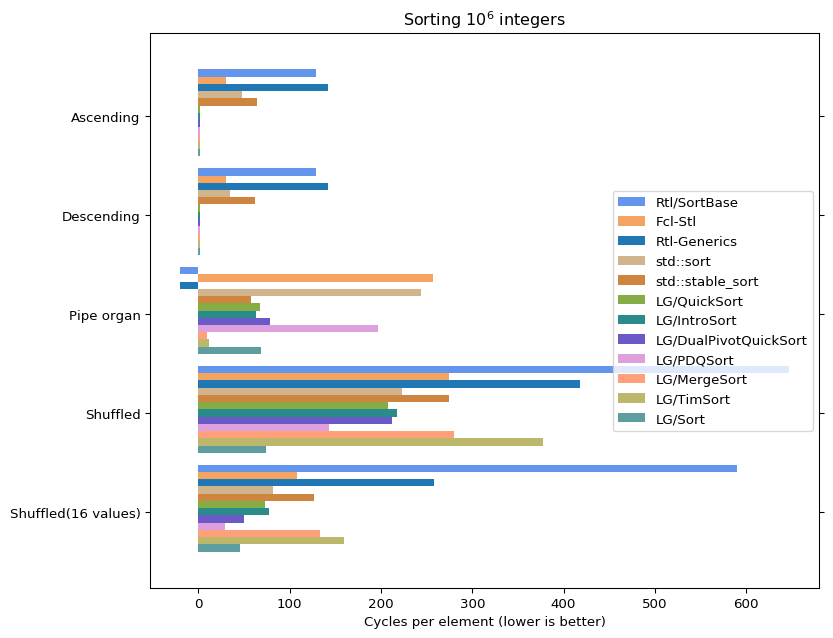 | |
| 1090 | 1098 | ||
| 1091 | 1099 | ### Algorithms on graphs | |
| 1092 | 1100 | ||
| 1093 | 1101 | For performance comparison the AGraph library (taken from [here](https://github.com/zamtmn/agraphlaz)) was chosen as a reference implementation. All tests were compiled for x86 and run on win64 machine (unfortunately the 64-bit version of AGraph crashes on these tests). | |
| 1094 | 1102 | ||
| 1095 | 1103 | So, AGraph vs LGenerics: | |
| 1096 | 1104 | ||
| 1097 | 1105 | | problem | graph | AGraph time(ms) | LGenerics time(ms) | notes | | |
| 1098 | 1106 | |----|----|----|----|----| | |
| 1099 | 1107 | | BFS traversal | undirected, V=500000, E=4000000 | 640 | 109 | | | |
| 1100 | 1108 | | BFS traversal | directed, V=500000, E=4000000 | 484 | 94 | | | |
| 1101 | 1109 | | Connected components | undirected, V=500000, E=4000000 | 764 | 0 | If no edges were removed, TGSimpleGraph always knows the number and ownership of connected components | | |
| 1102 | 1110 | | Strongly connected components | directed, V=500000, E=4000000 | 1060 | 265 | | | |
| 1103 | 1111 | | Single-source shortest path | undirected, V=500000, E=4000000 | 3011 | 842 | | | |
| 1104 | 1112 | | Single-source shortest path | directed, V=500000, E=4000000 | 2153 | 718 | | | |
| 1105 | 1113 | | Single-pair shortest path | undirected, V=500000, E=4000000 | 2777 | 31 | | | |
| 1106 | 1114 | | Single-pair shortest path | directed, V=500000, E=4000000 | 1825 | 47 | | | |
| 1107 | 1115 | | Minimum spanning tree | undirected, V=500000, E=4000000 | 5974 | 640 | | | |
| 1108 | 1116 | | Maximum flow | dense, V=1000, E=499500 | 29499 | 47 | | | |
| 1109 | 1117 | | Maximum flow | sparse, V=64000, E=512000 | 3339 | 63 | | | |
| 1110 | 1118 | | Planarity test | undirected, V=219086, E=657252 | 1419 | 172 | | | |
| 1111 | 1119 | | Maximum clique | DIMACS brock200_2.clq, V=200, E=9876 | 84210 | 16 | | | |
| 1112 | 1120 | | Maximum clique | DIMACS brock200_4.clq, V=200, E=13089 | Cancelled(timeout 1 h) | 312 | | | |
| 1113 | 1121 | ||
| 1114 | 1122 | ### Algorithms on strings/sequences | |
| 1115 | 1123 | ||
| 1116 | 1124 | It was curious to compare the performance of the SimRatioLevEx() function (which is inspired by FuzzyWuzzy) with some incarnations of the FuzzyWuzzy ([listed here](https://pypi.org/project/fuzzywuzzy/)) on benchmark datasets. Disclamer: SimRatioLevEx() does not reproduce FuzzyWuzzy, but it does some things in a similar way, in particular, SimRatioLevEx() in smTokenSetEx mode and token_set_ratio() do roughly the same job. | |
| 1117 | 1125 | ||
| 1118 | 1126 | It seems the C++ version only supports single-byte strings, so only compared to the single-byte version of SimRatioLevEx(): | |
| 1119 | 1127 | ||
| 1120 | 1128 | Dataset SimRatioLevEx() token_set_ratio() | |
| 1121 | 1129 | ||
| 1122 | 1130 | Short/big_dist 1154 6440 | |
| 1123 | 1131 | Short/small_dist 967 3020 | |
| 1124 | 1132 | Medium/big_dist 811 3450 | |
| 1125 | 1133 | Medium/small_dist 702 1470 | |
| 1126 | 1134 | Long/big_dist 1966 15000 | |
| 1127 | 1135 | Long/small_dist 1061 2250 | |
| 1128 | 1136 | ||
| 1129 | 1137 | The numbers indicate the run time in milliseconds; the C++ version was compiled with gcc-8.1.0 with options -O3 -m64; the Pascal version was compiled with FPC-3.3.1-9941-g8e6e9bbf33, -O3. The benchmark was run on a Windows x64 machine. | |
| 1130 | 1138 | ||
| 1131 | 1139 | The Go version, on the contrary, always works with Unicode strings: | |
| 1132 | 1140 | ||
| 1133 | 1141 | Dataset SimRatioLevExUtf8() TokenSetRatio() | |
| 1134 | 1142 | ||
| 1135 | 1143 | Short/big_dist 2143 18705 | |
| 1136 | 1144 | Short/small_dist 1593 2224 | |
| 1137 | 1145 | Medium/big_dist 1266 15062 | |
| 1138 | 1146 | Medium/small_dist 853 1742 | |
| 1139 | 1147 | Long/big_dist 3853 79851 | |
| 1140 | 1148 | Long/small_dist 1269 3126 | |
| 1141 | 1149 | ||
| 1142 | 1150 | Go version: go1.10.4 linux/amd64; FPC-3.3.1-10683-g2a19e152b7 -O3. The benchmark was run on a virtual Linux machine. | |
| 1143 | 1151 | ||
| 1144 | 1152 | ### Performance of JSON operations | |
| 1145 | 1153 | ||
| 1146 | 1154 | A small performance comparison of the lgJson. TJsonNode class with some other implementations, the benchmark was compiled for x86_64 and run on a win64 machine. | |
| 1147 | 1155 | ||
| 1148 | 1156 | | description | FpJson | JsonTools | lgJson | notes | | |
| 1149 | 1157 | |----|----|----|----|----| | |
| 1150 | 1158 | | Average parsing speed on a set of JSON samples from the example/json/parse_bench folder, MB/s | 34,45 | 46,11 | 68,12 | | | |
| 1151 | 1159 | | Average validating speed on a set of JSON samples from the example/json/parse_bench folder, MB/s | 34,4 | 46,02 | 349,48 | FpJson does not provide any function to validate JSON, so a parser was used | | |
| 1152 | 1160 | | Recursive traversal (using the built-in enumerator) of the document of moderate size (34 KB) with all values read (50000 repeats), milliseconds | 8315 | 6802 | 639 | | | |
| 1153 | 1161 | | Search in a moderately sized document using path (750000 repeats), milliseconds | 8549 | 5398 | 873 | | | |
| 1154 | 1162 | | Dynamic creation of a small document and reading it as formatted JSON (150000 repeats), milliseconds | 7597 | 4150 | 1903 | | | |
| 1155 | 1163 | | Saving a moderate size document to a stream (10000 repeats), milliseconds | 4820 | 4587 | 827 | | | |
| 1156 | 1164 | | RFC 8259 compliance test, 295 test files from test/json_testset/testset | 5 failed | 23 failed | all passed | | | |
| 1157 | 1165 | ||
| 1158 | 1166 | #### Performance of export to JSON | |
| 1159 | 1167 | ||
| 1160 | 1168 | Datasets used: a collection of simple items (with three string properties and one integer property) and an array of records whose fields contain values that coincide with the values of the collection's item properties (i.e. the resulting JSONs should be the same). The number of elements in the datasets was chosen so that the size of the resulting JSON approximately corresponded to the values (20KB, 100KB, 1MB, 10MB, 50MB). | |
| 1161 | 1169 | ||
| 1162 | 1170 | TJSONStreamer.CollectionToJSON() was taken as a reference implementation (FpJsonStreamer for short), other members: | |
| 1163 | 1171 | ||
| 1164 | 1172 | - PdoToJson() with a collection as parameter (PdoCollection); | |
| 1165 | 1173 | - PdoToJson() with array as parameter and field name list registration (PdoRecordFieldMap); | |
| 1166 | 1174 | - PdoToJson() with array as parameter and custom callback registration (PdoRecordCallback); | |
| 1167 | 1175 | ||
| 1168 | 1176 | Each member exports the data several times (number of attempts is pre-defined), the best time is taken as the result. | |
| 1169 | 1177 | ||
| 1170 | 1178 | The full benchmark code can be found in the folder LGenerics/example/json/json_export_bench. | |
| 1171 | 1179 | ||
| 1172 | 1180 | Results on author's machine: | |
| 1173 | 1181 | ||
| 1174 | 1182 | -------<JSON size 20 KB>------- | |
| 1175 | 1183 | FpJsonStreamer......1,045 ms. | |
| 1176 | 1184 | Rating: 22,23 MB/s. | |
| 1177 | 1185 | PdoCollection.......0,123 ms. | |
| 1178 | 1186 | Rating: 164,36 MB/s. | |
| 1179 | 1187 | PdoRecordFieldMap...0,089 ms. | |
| 1180 | 1188 | Rating: 226,76 MB/s. | |
| 1181 | 1189 | PdoRecordCallback...0,057 ms. | |
| 1182 | 1190 | Rating: 356,65 MB/s. | |
| 1183 | 1191 | -------<JSON size 100 KB>------- | |
| 1184 | 1192 | FpJsonStreamer......5,647 ms. | |
| 1185 | 1193 | Rating: 20,51 MB/s. | |
| 1186 | 1194 | PdoCollection.......0,626 ms. | |
| 1187 | 1195 | Rating: 160,7 MB/s. | |
| 1188 | 1196 | PdoRecordFieldMap...0,443 ms. | |
| 1189 | 1197 | Rating: 226,72 MB/s. | |
| 1190 | 1198 | PdoRecordCallback...0,285 ms. | |
| 1191 | 1199 | Rating: 352,29 MB/s. | |
| 1192 | 1200 | -------<JSON size 1 MB>------- | |
| 1193 | 1201 | FpJsonStreamer......80,298 ms. | |
| 1194 | 1202 | Rating: 14,34 MB/s. | |
| 1195 | 1203 | PdoCollection.......6,552 ms. | |
| 1196 | 1204 | Rating: 152,63 MB/s. | |
| 1197 | 1205 | PdoRecordFieldMap...4,701 ms. | |
| 1198 | 1206 | Rating: 212,71 MB/s. | |
| 1199 | 1207 | PdoRecordCallback...3,107 ms. | |
| 1200 | 1208 | Rating: 321,85 MB/s. | |
| 1201 | 1209 | -------<JSON size 10 MB>------- | |
| 1202 | 1210 | FpJsonStreamer......3554,483 ms. | |
| 1203 | 1211 | Rating: 3,24 MB/s. | |
| 1204 | 1212 | PdoCollection.......71,202 ms. | |
| 1205 | 1213 | Rating: 140,57 MB/s. | |
| 1206 | 1214 | PdoRecordFieldMap...53,309 ms. | |
| 1207 | 1215 | Rating: 187,75 MB/s. | |
| 1208 | 1216 | PdoRecordCallback...37,39 ms. | |
| 1209 | 1217 | Rating: 267,69 MB/s. | |
| 1210 | 1218 | -------<JSON size 50 MB>------- | |
| 1211 | 1219 | FpJsonStreamer......84343,47 ms. | |
| 1212 | 1220 | Rating: 0,68 MB/s. | |
| 1213 | 1221 | PdoCollection.......350,224 ms. | |
| 1214 | 1222 | Rating: 142,99 MB/s. | |
| 1215 | 1223 | PdoRecordFieldMap...260,963 ms. | |
| 1216 | 1224 | Rating: 191,89 MB/s. | |
| 1217 | 1225 | PdoRecordCallback...183,328 ms. | |
| 1218 | 1226 | Rating: 273,16 MB/s. | |
| 1219 | 1227 | ||
| 1220 | 1228 | #### Performance of JSON Type Definition | |
| 1221 | 1229 | ||
| 1222 | 1230 | Test schema: | |
| 1223 | 1231 | ||
| 1224 | 1232 | ``` json | |
| 1225 | 1233 | { | |
| 1226 | 1234 | "definitions": { | |
| 1227 | 1235 | "point": { | |
| 1228 | 1236 | "properties": { | |
| 1229 | 1237 | "x": {"type": "int32"}, | |
| 1230 | 1238 | "y": {"type": "int32"} | |
| 1231 | 1239 | } | |
| 1232 | 1240 | }, | |
| 1233 | 1241 | "shape": {"enum": ["circle", "ellipce", "rectangle", "rhombus", "triangle"]}, | |
| 1234 | 1242 | "figure": { | |
| 1235 | 1243 | "properties": { | |
| 1236 | 1244 | "name": {"type": "string"}, | |
| 1237 | 1245 | "shape": {"ref": "shape"}, | |
| 1238 | 1246 | "area": {"type": "float64"}, | |
| 1239 | 1247 | "center": {"ref": "point"} | |
| 1240 | 1248 | } | |
| 1241 | 1249 | } | |
| 1242 | 1250 | }, | |
| 1243 | 1251 | "elements": {"ref": "figure"} | |
| 1244 | 1252 | } | |
| 1245 | 1253 | ``` | |
| 1246 | 1254 | ||
| 1247 | 1255 | The TJSONDeStreamer loading a collection of figures was taken as a reference implementation. To create more or less extreme conditions, a test JSON of size 62267256 bytes was generated, JTD class(unit Figures) was generated using TJtdPasCodegen. | |
| 1248 | 1256 | ||
| 1249 | 1257 | Full source code of the test application: | |
| 1250 | 1258 | ||
| 1251 | 1259 | ``` pascal | |
| 1252 | 1260 | program jtd_test; | |
| 1253 | 1261 | ||
| 1254 | 1262 | {$mode objfpc}{$H+} | |
| 1255 | 1263 | ||
| 1256 | 1264 | uses | |
| 1257 | 1265 | Classes, SysUtils, fpJsonRtti, lgJson, lgJsonTypeDef, Figures; | |
| 1258 | 1266 | ||
| 1259 | 1267 | type | |
| 1260 | 1268 | {$PUSH}{$M+} | |
| 1261 | 1269 | TMyPoint = class | |
| 1262 | 1270 | private | |
| 1263 | 1271 | FX, | |
| 1264 | 1272 | FY: Integer; | |
| 1265 | 1273 | published | |
| 1266 | 1274 | property x: Integer read FX write FX; | |
| 1267 | 1275 | property y: Integer read FY write FY; | |
| 1268 | 1276 | end; | |
| 1269 | 1277 | {$POP} | |
| 1270 | 1278 | ||
| 1271 | 1279 | TMyFigure = class(TCollectionItem) | |
| 1272 | 1280 | private | |
| 1273 | 1281 | FArea: Double; | |
| 1274 | 1282 | FCenter: TMyPoint; | |
| 1275 | 1283 | FName: string; | |
| 1276 | 1284 | FShape: TShape; | |
| 1277 | 1285 | public | |
| 1278 | 1286 | constructor Create(ACollection: TCollection); override; | |
| 1279 | 1287 | destructor Destroy; override; | |
| 1280 | 1288 | published | |
| 1281 | 1289 | property name: string read FName write FName; | |
| 1282 | 1290 | property shape: TShape read FShape write FShape; | |
| 1283 | 1291 | property area: Double read FArea write FArea; | |
| 1284 | 1292 | property center: TMyPoint read FCenter; | |
| 1285 | 1293 | end; | |
| 1286 | 1294 | ||
| 1287 | 1295 | constructor TMyFigure.Create(ACollection: TCollection); | |
| 1288 | 1296 | begin | |
| 1289 | 1297 | inherited Create(ACollection); | |
| 1290 | 1298 | FCenter := TMyPoint.Create; | |
| 1291 | 1299 | end; | |
| 1292 | 1300 | ||
| 1293 | 1301 | destructor TMyFigure.Destroy; | |
| 1294 | 1302 | begin | |
| 1295 | 1303 | FCenter.Free; | |
| 1296 | 1304 | inherited; | |
| 1297 | 1305 | end; | |
| 1298 | 1306 | ||
| 1299 | 1307 | var | |
| 1300 | 1308 | s: string; | |
| 1301 | 1309 | ||
| 1302 | 1310 | procedure TestCollection; | |
| 1303 | 1311 | var | |
| 1304 | 1312 | c: TCollection; | |
| 1305 | 1313 | Start, Stop: QWord; | |
| 1306 | 1314 | begin | |
| 1307 | 1315 | c := TCollection.Create(TMyFigure); | |
| 1308 | 1316 | Start := GetTickCount64; | |
| 1309 | 1317 | with TJSONDeStreamer.Create(nil) do | |
| 1310 | 1318 | try | |
| 1311 | 1319 | JSONToCollection(s, c); | |
| 1312 | 1320 | finally | |
| 1313 | 1321 | Free; | |
| 1314 | 1322 | end; | |
| 1315 | 1323 | Stop := GetTickCount64; | |
| 1316 | 1324 | c.Free; | |
| 1317 | 1325 | WriteLn('TJSONDeStreamer.JSONToCollection: ', Stop - Start); | |
| 1318 | 1326 | end; | |
| 1319 | 1327 | ||
| 1320 | 1328 | procedure TestJtd; | |
| 1321 | 1329 | var | |
| 1322 | 1330 | Node: TJsonNode; | |
| 1323 | 1331 | Schema: TJtdSchema; | |
| 1324 | 1332 | eList: TJtdErrorList; | |
| 1325 | 1333 | Figures: TFigureList; | |
| 1326 | 1334 | Start, Stop: QWord; | |
| 1327 | 1335 | begin | |
| 1328 | 1336 | Start := GetTickCount64; | |
| 1329 | 1337 | if not TJsonNode.TryParse(s, Node) then begin | |
| 1330 | 1338 | WriteLn('Failed to load data'); | |
| 1331 | 1339 | exit; | |
| 1332 | 1340 | end; | |
| 1333 | 1341 | Stop := GetTickCount64; | |
| 1334 | 1342 | WriteLn('Loading data into TJsonNode: ', Stop - Start); | |
| 1335 | 1343 | ||
| 1336 | 1344 | if not TJtdSchema.TryLoadFromFile('schema.json', Schema) then begin | |
| 1337 | 1345 | WriteLn('Failed to load schema'); | |
| 1338 | 1346 | exit; | |
| 1339 | 1347 | end; | |
| 1340 | 1348 | ||
| 1341 | 1349 | Start := GetTickCount64; | |
| 1342 | 1350 | if Validate(Node, Schema, eList) <> jvrOk then begin | |
| 1343 | 1351 | WriteLn('Failed to validate data'); | |
| 1344 | 1352 | exit; | |
| 1345 | 1353 | end; | |
| 1346 | 1354 | Stop := GetTickCount64; | |
| 1347 | 1355 | Schema.Free; | |
| 1348 | 1356 | WriteLn('TJsonNode data validation: ', Stop - Start); | |
| 1349 | 1357 | ||
| 1350 | 1358 | Start := GetTickCount64; | |
| 1351 | 1359 | Figures := TFigureList.ReadJson(Node) as TFigureList; | |
| 1352 | 1360 | Stop := GetTickCount64; | |
| 1353 | 1361 | Figures.Free; | |
| 1354 | 1362 | Node.Free; | |
| 1355 | 1363 | WriteLn('Loadind JTD class from TJsonNode: ', Stop - Start); | |
| 1356 | 1364 | ||
| 1357 | 1365 | Start := GetTickCount64; | |
| 1358 | 1366 | Figures := TFigureList.ReadJson(s) as TFigureList; | |
| 1359 | 1367 | Stop := GetTickCount64; | |
| 1360 | 1368 | Figures.Free; | |
| 1361 | 1369 | WriteLn('Direct loading of JTD class: ', Stop - Start); | |
| 1362 | 1370 | end; | |
| 1363 | 1371 | ||
| 1364 | 1372 | procedure LoadData; | |
| 1365 | 1373 | begin | |
| 1366 | 1374 | with TStringStream.Create do | |
| 1367 | 1375 | try | |
| 1368 | 1376 | LoadFromFile('data.json'); | |
| 1369 | 1377 | s := DataString; | |
| 1370 | 1378 | finally | |
| 1371 | 1379 | Free; | |
| 1372 | 1380 | end; | |
| 1373 | 1381 | end; | |
| 1374 | 1382 | ||
| 1375 | 1383 | begin | |
| 1376 | 1384 | LoadData; | |
| 1377 | 1385 | ||
| 1378 | 1386 | TestCollection; | |
| 1379 | 1387 | TestJtd; | |
| 1380 | 1388 | ||
| 1381 | 1389 | end. | |
| 1382 | 1390 | ``` | |
| 1383 | 1391 | ||
| 1384 | 1392 | On my machine, it prints results like this: | |
| 1385 | 1393 | ||
| 1386 | 1394 | TJSONDeStreamer.JSONToCollection: 5304 | |
| 1387 | 1395 | Loading data into TJsonNode: 1513 | |
| 1388 | 1396 | TJsonNode data validation: 1732 | |
| 1389 | 1397 | Loadind JTD class from TJsonNode: 515 | |
| 1390 | 1398 | Direct loading of JTD class: 1560 | |
| 1391 | 1399 | ||
| 1392 | 1400 | Conclusion: the total validation and loading time of the JTD class is still noticeably better than the TCollection load time (3760 vs 5304). | |
| 1393 | 1401 | ||
| 1394 | 1402 | The direct load time of the JTD class is better than the load time of the TCollection by more than three times. | |
| 1395 | 1403 | ||
| 1396 | 1404 | --- | |
| 1397 | 1405 | *From the Free Pascal wiki, page "LGenerics", as it stood on 2024-05-14 after a change by Avk, out of the wiki's dump of 2024-05-26. Copyright stays with the author who wrote it, according to the old wiki's [[Licensing]] page. If you have concerns about this material, [message the admin](/wiki-contact).* | |
| 1398 | 1406 | Category: JSON | |
| 1399 | 1407 | Category: Libraries |