Sign in Join

Live chat for Free Pascal, Lazarus, Delphi and every Pascal programmer.

Mailing lists / lazarus / 2019-08

Tests results of several pascal based JSON parsers

47 messages · 11 people · –

Reply by email Subscribe to this list Your subscription

Read-only archive. Use j and k to move between messages.

Anthony Walter

I've posted a new page that tests the speed and correctness of several pascal based JSON parsers.

https://www.getlazarus.org/json/tests/

In full disclosure I am the author of the new open source JsonTools library, and even though my parser seems to a big improvement over the other alternatives, my tests were not biased.

If anyone would like help in replication the tests, let me know and I'll see what I can do.

Also, to be thorough, you should read through both the article I posted at the top this message, and my original page <https://www.getlazarus.org/json> which has been updated with more information. Both pages took some time to write, and I promise if you read through them some of your questions will be answered without having to ask others for help or insight.

Thanks,
Anthony
-------------- next part --------------
An HTML attachment was scrubbed...
URL: <http://lists.lazarus-ide.org/pipermail/lazarus/attachments/20190830/33f5673f/attachment.html>

Reply by email

Alexey Tor.
to Anthony Walter

This is very good news, that we have JsonTools parser now. I may think of using it in CudaText - ie replacing fpJSON to JsonTools.

About lib. 1) Pls add an option to handle //.... comments in json. yes, json don't allow this but CudaText and SublimeText and many programs have json configs with comments. They use libs which allow comments. fpJSON allows comments by option.

2) Pls add an option which allows "," after final dict node: { "a":1, "b":2, }

so my app can read json file with final (bad) comma after "b":2.

3) Lib must support "true", "false", "none" or "nil"(?), values like list [], with empty list, values like dict {}, with empty dict. And list inside dict etc.

Alexey Torgashin

Reply by email

Anthony Walter
to Alexey Tor.

Alexey,

Currently JsonTools anything that is valid JSON as described on this page:

https://www.json.org/

The only valid constants are: null, true, false
Arrays can contain other arrays and object to any reasonable level [[[]]] // is a valid array
[{}{}[{}{}]] // is a valid array
Objects can contain other objects and arrays to any reasonable level {"a":{"a":{"a":[[]]}}} // is a valid object

I will look into you request for comment support, even though comments are not allowed in the official specification.
-------------- next part --------------
An HTML attachment was scrubbed...
URL: <http://lists.lazarus-ide.org/pipermail/lazarus/attachments/20190830/dd76d70a/attachment.html>

Reply by email

Michael Van Canneyt
to Anthony Walter: I've posted a new page that tests the speed and correctness of several pascal based JSON…
Anthony Walter wrote 8 lines
I've posted a new page that tests the speed and correctness of several pascal based JSON parsers. https://www.getlazarus.org/json/tests/ In full disclosure I am the author of the new open source JsonTools library, and even though my parser seems to a big improvement over the other alternatives, my tests were not biased.

Test are always biased in the sense that they depend on the proficiency of the coder. you must ask someone with sufficient knowledge to write the code.

The shootout benchmarks for example are dismally coded for FPC with as a result that they perform badly.

So it could well be that the fpJSON results for example can be improved a lot by changing the method used to a more efficient one.

Also, not every library is designed with the same goals. fpjson could probably be made smaller if the goal was more focused. it has a factory pattern, added on behalf of users who asked for this. jsontools does not have this.
You can format the output. JSONTools does not have this. fpJSON was designed to be pluggable wrt. parsing. JSONTools is not.

In short fpjson can do a lot more than JSONtools.
Some things come at a price, others not.

In that sense, tests like this compare apples with pears.

Show quoted text 8 lines
If anyone would like help in replication the tests, let me know and I'll see what I can do. Also, to be thorough, you should read through both the article I posted at the top this message, and my original page <https://www.getlazarus.org/json> which has been updated with more information. Both pages took some time to write, and I promise if you read through them some of your questions will be answered without having to ask others for help or insight.

Can you please send me the testcode you used for your speed & correctness tests ?

I'm a bit surprised to see fpJSON fail in unicode correctness. It's been tested extensively, maybe your code contains errors (or maybe fpjson does, I'll need to check).

Also please explain what 'Handling duplicate key names correctly' means to you. Saying that a library fails a test without specifying what the test is, is strange.

Michael.

Reply by email

Michael Van Canneyt
to Anthony Walter: Currently JsonTools anything that is valid JSON as described on this page:…
Anthony Walter wrote 15 lines
Alexey, Currently JsonTools anything that is valid JSON as described on this page: https://www.json.org/ The only valid constants are: null, true, false Arrays can contain other arrays and object to any reasonable level [[[]]] // is a valid array [{}{}[{}{}]] // is a valid array Objects can contain other objects and arrays to any reasonable level {"a":{"a":{"a":[[]]}}} // is a valid object I will look into you request for comment support, even though comments are not allowed in the official specification.

And so your tool will also become more bulky and slower :)

Michael.

Reply by email

Anthony Walter
to Alexey Tor.

With regards to duplicate key names, some libraries allow for the same key to be parsed resulting in multiple child nodes of the same name. Others throw an exception when parsing an object with a duplicate key name.

The correct way to handle duplicate keys is to overwrite the existing key when a duplicate is encountered.

My library does have Save/Load To/From /File/Stream. Please see the articles I posted. They are listed there.

Unicode support exists in both allowing unicode to be in the JSON, and escape inotpced e.g. \u00ae becomes ® a two byte utf8 encoding char when parsed by my parser. It also saves/load that utf8 encoding to steams or files.

Regarding indentation and formatted, I support two options as noted in my original article. The AsJson property create spaceless compact JSON suitable for network traffic, while the Vale property allows for friendly human readable formatting and indentation. Currently the friendly indentation is fixed and I doesn't see a reason use case reason to allow for custom indentation beyond what I already provide.

And finally regarding the unicode failure of FPJson, I am parsing a small bit of JSON ...

{ "name": "Joe\u00aeSchmoe"}

And compare it to the value of 'name' to the string constant 'Joe®Schmoe' in pascal code. If fails the first iteration, but if I run it a second time it works, so there is something amiss.

And finally with regards to plugins and extensiblity, that's great to have, but I am just trying to write something that handles the JSON spec and only that. If I want something to stream a form layout or settings to JSON it would be a separate wholly independent library that depends ona parser, but isn't part of the parser library.
-------------- next part --------------
An HTML attachment was scrubbed...
URL: <http://lists.lazarus-ide.org/pipermail/lazarus/attachments/20190830/378a96b9/attachment-0001.html>

Reply by email

Anthony Walter
to Anthony Walter

Michael,

I have a hurricane headed my way, but when I'm done evacuating I'll send you a copy of my test. If you want to make improvements to the test program to be sure the manner in which I am using the FPJson functions and classes is correct and send me a revised test program, then that would be awesome.

Thanks
-------------- next part --------------
An HTML attachment was scrubbed...
URL: <http://lists.lazarus-ide.org/pipermail/lazarus/attachments/20190830/e573a80c/attachment.html>

Reply by email

Michael Van Canneyt
to Anthony Walter: With regards to duplicate key names, some libraries allow for the same key to be parsed…
Anthony Walter wrote 6 lines
With regards to duplicate key names, some libraries allow for the same key to be parsed resulting in multiple child nodes of the same name. Others throw an exception when parsing an object with a duplicate key name. The correct way to handle duplicate keys is to overwrite the existing key when a duplicate is encountered.
There you go. I think the "correct way" is to raise an error;
not to override and thus inadvertently lose previous data.

I won't argue on who is correct, since it is a matter of opinion.

But this is a prime example of 'biased' tests.
You're testing an opinion, not actual functionality.

so IMHO it would be only fair to remove it from your comparison.

For speed & correctness, I repeat my request:
please provide your test code.

Michael.

Reply by email

Michael Van Canneyt
to Anthony Walter: I have a hurricane headed my way, but when I'm done evacuating I'll send you a copy of my…
Anthony Walter wrote 6 lines
Michael, I have a hurricane headed my way, but when I'm done evacuating I'll send you a copy of my test. If you want to make improvements to the test program to be sure the manner in which I am using the FPJson functions and classes is correct and send me a revised test program, then that would be awesome.

Just make sure you don't get caught in the hurricane. I wish you a quickk hiding place ! :-)

Michael.

Reply by email

Anthony Walter
to Michael Van Canneyt

Michael,

Can you tell me why the second half (N.Items[1].AsUnicodeString) this test fails? This is the part that decodes "bank teller \u00Ae ".

function VerifyUnicodeChars: Boolean;
const
  UnicodeChars = '{ "name": "Joe®Schmoe", "occupation": "bank teller \u00Ae
" }';
var
  N: TJSONData;
begin
  N := GetJSON(UnicodeChars);
  Result := (N.Items[0].AsUnicodeString = 'Joe®Schmoe') and
(N.Items[1].AsUnicodeString = 'bank teller ® ');
  N.Free;
end;
begin
  WriteLn('Handles unicode chars correctly: ', VerifyUnicodeChars);
end.
-------------- next part --------------
An HTML attachment was scrubbed...
URL: <http://lists.lazarus-ide.org/pipermail/lazarus/attachments/20190830/2c156bdf/attachment.html>

Reply by email

Michael Van Canneyt
to Anthony Walter
Anthony Walter wrote
Michael, Can you tell me why the second half (N.Items[1].AsUnicodeString) this test fails? This is the part that decodes "bank teller \u00Ae ".

The test fails on "Joe®Schmoe", not on "bank teller \u00Ae ".

If you WriteLn the UnicodeChars string to console, it shows:

{ "name": "Joe®Schmoe", "occupation": "bank teller \u00Ae " }

(notice the  in front of ®)

This is because your string is encoded wrong in the binary.

Adding

{$codepage UTF8}

Before the uses clause makes your test print 'TRUE'.

Because I work on Linux, I also had to add the "cwstring" unit to the uses clause.

Michael.

Reply by email

Michael Van Canneyt
to Anthony Walter
Anthony Walter wrote
On my system with FPJson the test is failing it failing on "bank teller \u00Ae ", but on when using approximately the same code with JSONTools it passes on both "name" and "occupation" always. What do you think is going on?

No idea. I tested with both 3.0.4 and trunk. Both give the same result.

Here are the sources I used:

home:~/fpc/packages/fcl-json/tests> cat twalter.pas
program twalter;
{$codepage UTF8}
uses cwstring, fpjson, jsonparser;
function VerifyUnicodeChars: Boolean;
const
   UnicodeChars =  '{ "name": "Joe®Schmoe", "occupation": "bank teller \u00Ae " }';
var
   N: TJSONData;
begin
   N := GetJSON(UnicodeChars);
   Writeln('>',UnicodeChars,'<');
   Result := (N.Items[0].AsUnicodeString = 'Joe®Schmoe') and
             (N.Items[1].AsUnicodeString = 'bank teller ® ');
   N.Free;
end;
begin
   WriteLn('Handles unicode chars correctly: ', VerifyUnicodeChars);
end.

I test on linux, but could try windows.

Michael.

Reply by email

Anthony Walter

Alan, oh that's a good idea. I will do that as well as add a few more parser libraries as requested by a few people in other non mailing lists threads. I will also try to find out what's going on the unicode strings as it might be a problem with the compiler.

Michael,

I am on Linux as well, but I will test under Windows and Mac too. -------------- next part --------------
An HTML attachment was scrubbed...
URL: <http://lists.lazarus-ide.org/pipermail/lazarus/attachments/20190830/3fe0f2e8/attachment.html>

Reply by email

Michael Van Canneyt
to Anthony Walter
Anthony Walter wrote 8 lines
Alan, oh that's a good idea. I will do that as well as add a few more parser libraries as requested by a few people in other non mailing lists threads. I will also try to find out what's going on the unicode strings as it might be a problem with the compiler. Michael, I am on Linux as well, but I will test under Windows and Mac too.

To show that my argument of 'coding proficiency' influence on algorithm speed is not complete nonsense, I quickly cooked up the following test:

{$mode objfpc}
{$h+}
uses DateUtils, Sysutils,Classes, fpjson, jsonparser;
var
   FN : String;
   i,aCount : Integer;
   S : TJSONStringType;
   T : TMemoryStream;
   N : TDateTime;
procedure ReadJSON;
begin
   T:=TMemoryStream.Create;
   T.LoadFromFile(FN);
   SetLength(S,T.Size);
   T.ReadBuffer(S[1],T.Size);
   T.Position:=0;
end;
begin
   if ParamCount2 then Halt(1);
   aCount:=StrToInt(Paramstr(1));
   FN:=ParamStr(2);
   ReadJSON;
   try
     Writeln('Reading string ',aCount,' times');
     N:=Now;
     for I:=1 to aCount do
       GetJSON(S).Free;
     Writeln('Msecs : ',MillisecondsBetween(Now,N));
     Writeln('Reading stream ',aCount,' times');
     N:=Now;
     for I:=1 to aCount do
       begin
       GetJSON(T).Free;
       T.Position:=0;
       end;
     Writeln('Msecs : ',MillisecondsBetween(Now,N));
   finally
     T.Free;
   end;
end.

When you run this:

home:~/fpc/packages/fcl-json/tests> ./testjsonspeedread 100 ./testdata.json Reading string 100 times
Msecs : 2972
Reading stream 100 times
Msecs : 1203

(file of 260Kb, 500 lines)

Not using a string (as you do) but a stream already gives a factor of 2.x faster. The speed gain is there both for trunk as for 3.0.4.

So, I'm fairly confident that I can probably speed up your test results as well, when you send me the sources.

That said, this is not to say that there is no room for speed improvements in fpjson.

I've already identified 2 places where speed gains can be made in the fpJSON codebase, I'll improve the codebase this weekend and post results.

Michael.

Reply by email

Anthony Walter
to Anthony Walter: Can you tell me why the second half (N.Items[1].AsUnicodeString) this test fails? This is…

Okay, so I turned on my Windows VM with a different version of FPC and ran VerifyUnicodeChars with both FPJson and JsonTools. The resutls are the same. JsonTools sees the unicode correctly, and something is wrong when using FPJson. I don't know what the problem is, but other people are noticing similar issues, so it would seem there is definitely a problem resulting in a failure for FPJson.

Michael, you have all the information needed to find out what's wrong and I'd be curious to learn why it's not working.
-------------- next part --------------
An HTML attachment was scrubbed...
URL: <http://lists.lazarus-ide.org/pipermail/lazarus/attachments/20190830/f72267f0/attachment.html>

Reply by email

Anthony Walter
to Michael Van Canneyt: To show that my argument of 'coding proficiency' influence on algorithm speed is not…

I am not sure how under any situation parsing a JSON from a stream source would be any faster than parsing a string. Also with regards to timing I am not sure how accurate Now is. For this purpose I've written:

{ Return a time based on system performance counters }
function TimeQuery: Double;

Implemented as:

const
{$ifdef linux}
  libc = 'libc.so';
{$endif}
{$ifdef darwin}
  libc = 'libSystem.dylib';
{$endif}
function gettimeofday(out TimeVal: TTimeVal; TimeZone: PTimeVal): Integer;
apicall; external libc;
var
  TimeSec: SysInt;
function TimeQuery: Double;
var
  TimeVal: TTimeVal;
begin
  gettimeofday(TimeVal, nil);
  if TimeSec = 0 then
    TimeSec := TimeVal.Sec;
  TimeVal.Sec := TimeVal.Sec - TimeSec;
  Result := TimeVal.Sec + TimeVal.MSec / 1000000;
end;
{$endif}
{$ifdef windows}
const
  kernel32  = 'kernel32.dll';
function QueryPerformanceCounter(var Counter: Int64): LongBool; apicall;
external kernel32;
function QueryPerformanceFrequency(var Frequency: Int64): LongBool;
apicall; external kernel32;
function TimeQuery: Double;
var
  C, F: Int64;
begin
  F := 0;
  C := 0;
  if QueryPerformanceFrequency(F) and QueryPerformanceCounter(C) then
    Result := C / F
  else
    Result := 0;
end;
{$endif}
-------------- next part --------------
An HTML attachment was scrubbed...
URL: <http://lists.lazarus-ide.org/pipermail/lazarus/attachments/20190830/3c5a24a3/attachment.html>

Reply by email

Bart
to Bart
PM Bart wrote
On Windows it prints FALSE, both with 3.0.4 and trunk r42348

It fails on both comparisons (hexadecimal representation of the returned unicodestrings):

Name : 004A 006F 0065 003F 0053 0063 0068 006D 006F 0065 Expected: 004A 006F 0065 00AE 0053 0063 0068 006D 006F 0065 00AE is replaced by 003F (a questionmark IIRC)

Occupation: 0062 0061 006E 006B 0020 0074 0065 006C 006C 0065 0072 0020 003F 0020
Expected: 0062 0061 006E 006B 0020 0074 0065 006C 006C 0065 0072 0020 00AE 0020

Same replacement there.

fpc trunk r42348.

Bart

Reply by email

Anthony Walter
to Bart

For those tracking the unicode issue, could you please verify the problem does not present in my JsonTools library on compiler revisions and platforms? I always get true (passed) with my library, but not with any other library. Here is the relevant test:

function VerifyUnicodeChars: Boolean;
const
  UnicodeChars = '{ "name": "Joe®Schmoe", "occupation": "bank teller \u00Ae
" }';
var
  N: TJsonNode;
begin
  N := TJsonNode.Create;
  N.Parse(UnicodeChars);
  Result := (N.Child(0).AsString = 'Joe®Schmoe') and (N.Child(1).AsString =
'bank teller ® ');
  N.Free;
end;
begin
  WriteLn('Handles unicode characters correctly: ', VerifyUnicodeChars);
end.
-------------- next part --------------
An HTML attachment was scrubbed...
URL: <http://lists.lazarus-ide.org/pipermail/lazarus/attachments/20190830/12faeb70/attachment.html>

Reply by email

Michael Van Canneyt
to Anthony Walter: I am not sure how under any situation parsing a JSON from a stream source would be any…
Anthony Walter wrote
I am not sure how under any situation parsing a JSON from a stream source would be any faster than parsing a string.

If you would check the fpjson code, you'd see why. You'd also see why there is plenty of room for improvement.

Also with regards to timing I am not sure how accurate Now is. For this purpose I've written:

I agree that for time measurements of 10ms or less, you should not use Now for measurements.

But over a total timespan of 2.9 seconds, now is plenty accurate.

Michael.

Reply by email

Michael Van Canneyt
to Bart: It fails on both comparisons (hexadecimal representation of the returned unicodestrings):…
Bart wrote 16 lines
On Fri, Aug 30, 2019 at 9:09 PM Bart wrote: > On Windows it prints FALSE, both with 3.0.4 and trunk r42348 It fails on both comparisons (hexadecimal representation of the returned unicodestrings): Name : 004A 006F 0065 003F 0053 0063 0068 006D 006F 0065 Expected: 004A 006F 0065 00AE 0053 0063 0068 006D 006F 0065 00AE is replaced by 003F (a questionmark IIRC) Occupation: 0062 0061 006E 006B 0020 0074 0065 006C 006C 0065 0072 0020 003F 0020 Expected: 0062 0061 006E 006B 0020 0074 0065 006C 006C 0065 0072 0020 00AE 0020 Same replacement there.

Can you try setting defaultsystemcodepage to UTF8 ?

Michael.

Reply by email

Michael Van Canneyt
to Anthony Walter: Okay, so I turned on my Windows VM with a different version of FPC and ran…
Anthony Walter wrote 9 lines
Okay, so I turned on my Windows VM with a different version of FPC and ran VerifyUnicodeChars with both FPJson and JsonTools. The resutls are the same. JsonTools sees the unicode correctly, and something is wrong when using FPJson. I don't know what the problem is, but other people are noticing similar issues, so it would seem there is definitely a problem resulting in a failure for FPJson. Michael, you have all the information needed to find out what's wrong and I'd be curious to learn why it's not working.

Allow me to correct you, I don't have all information:

1. Did you run my provided test program on linux ? (the first one I sent, not the one for the speed test)

If my test program also shows different results on your machine, indeed something strange is going on.

The reason I insist on the us of my test program and not yours, is that the result can be influenced by some unknown units or whatnot in yours, and my program is "bare bones".

On the assumption my private computer can be somehow 'compromised' by years of FPC development I even copied my program to 2 other linux machines, used for production work, and the result is 'True' on both. (see log below for one of them, this is with standard ubuntu installed compiler)

I can believe the program would output something different on Windows, but not on another linux box.

2. Where is the source code of your test program(s) ? At least the ones for fpjson and jsontools.

Without your actual source code, I cannot give advice or investigate properly.

I'd like to see this cleared up. fpjson has been in use in many REST services in large production sites for at least 8 years, these services definitely use UTF8 content outside the basic ASCII or even ANSI codepages.

So the failures you see are highly surprising to me, to say the least.

Michael.

Copy&paste from a quick sompile session.
----
Welcome to Ubuntu 18.04.1 LTS (GNU/Linux 4.15.0-34-generic x86_64)

* Documentation: https://help.ubuntu.com
* Management: https://landscape.canonical.com
* Support: https://ubuntu.com/advantage

* Keen to learn Istio? It's included in the single-package MicroK8s.

https://snapcraft.io/microk8s

* Canonical Livepatch is available for installation.
- Reduce system reboots and improve kernel security. Activate at: https://ubuntu.com/livepatch
_____
/ ___/___ _ _ _____ _ ___ ___
| | / _ \| \| |_ _/ \ | _ )/ _ \
| |__| (_) | .` | | |/ _ \| _ \ (_) |
\____\___/|_|\_| |_/_/ \_|___/\___/

Welcome!

This server is hosted by Contabo. If you have any questions or need help, please don't hesitate to contact us at login: Tue Aug 20 14:23:39 2019 from 81.82.199.218 root at vmi203569:~# fpc twalter.pas -S2
Free Pascal Compiler version 3.0.4+dfsg-18ubuntu1 [2018/07/02] for x86_64 Copyright (c) 1993-2017 by Florian Klaempfl and others Target OS: Linux for x86-64
Compiling twalter.pas
Linking twalter
/usr/bin/ld.bfd: warning: link.res contains output sections; did you forget -T? 26 lines compiled, 0.4 sec
root at vmi203569:~# ./twalter
Handles unicode chars correctly: >{ "name": "Joe®Schmoe", "occupation": "bank teller \u00Ae " }< TRUE

Reply by email

Anthony Walter
to Michael Van Canneyt

Michael, regarding this unicode problem, all the code has already been posted in this thread.

program Test;
uses
  FPJson, JsonParser, JsonTools;
const
  UnicodeChars = '{ "name": "Joe®Schmoe", "occupation": "bank teller \u00Ae
" }';
function VerifyUnicodeCharsFPJson: Boolean;
var
  N: TJSONData;
begin
  N := GetJSON(UnicodeChars);
  Result := (N.Items[0].AsUnicodeString = 'Joe®Schmoe') and
(N.Items[1].AsUnicodeString = 'bank teller ® ');
  N.Free;
end;
function VerifyUnicodeCharsJsonTools: Boolean;
const
  UnicodeChars = '{ "name": "Joe®Schmoe", "occupation": "bank teller \u00Ae
" }';
var
  N: TJsonNode;
begin
  N := TJsonNode.Create;
  N.Parse(UnicodeChars);
  Result := (N.Child(0).AsString = 'Joe®Schmoe') and (N.Child(1).AsString =
'bank teller ® ');
  N.Free;
end;
begin
  WriteLn('FPJson Handles unicode chars correctly: ',
VerifyUnicodeCharsFPJson);
  WriteLn('JsonTools Handles unicode chars correctly: ',
VerifyUnicodeCharsJsonTools);
end.

Output:

FPJson Handles unicode chars correctly: FALSE
JsonTools Handles unicode chars correctly: TRUE

Tested on both Linux and Windows with the same results. Differing versions of FPC on differing platforms and other people have verified the same result. Try the tests yourself. Maybe you can figure out what's going wrong. -------------- next part --------------
An HTML attachment was scrubbed...
URL: <http://lists.lazarus-ide.org/pipermail/lazarus/attachments/20190831/5ab1e3f8/attachment.html>

Reply by email

Anthony Walter
to Anthony Walter

Michael, I hadn't tried your example code yet as I thought the discussion was on the topic of the unicode failure, and your example was about parsing speed. I'll be happy to take a look at speed improvements, but like you I am interested to find our what's failing with VerifyUnicodeCharsFPJson. -------------- next part --------------
An HTML attachment was scrubbed...
URL: <http://lists.lazarus-ide.org/pipermail/lazarus/attachments/20190831/4632cc8f/attachment.html>

Reply by email

Michael Van Canneyt
to Anthony Walter: Michael, regarding this unicode problem, all the code has already been posted in this…
Anthony Walter wrote
Michael, regarding this unicode problem, all the code has already been posted in this thread.
Show quoted text 5 lines
program Test; uses FPJson, JsonParser, JsonTools;

There you are. You're missing the cwstring unit and the codepage directive.

Change the above code to

{$mode objfpc}
{$h+}
{$codepage utf8}
uses
   {$IFDEF UNIX}cwstring, {$ENDIF} FPJson, JsonParser, JsonTools;

and it will work correctly.
(The objpas and $h+ are probably in your fpc.cfg or lazarus setup)

Your program will only work correctly in a utf8-only environment. (see also below)

But fpJSON relies on the fpc infrastructure to handle all codepages, as a consequence this infrastructure also must be set up properly.

Now you can see why I insisted on using my program, it was known to work correctly: it sets up things properly. If you look at my initial mail, you'll also see that I explicitly mentioned including cwstring. You probably failed to pick up on that important piece of info.

So, mystery solved.

That said :

Unfortunately JSONTools is also not without problems.

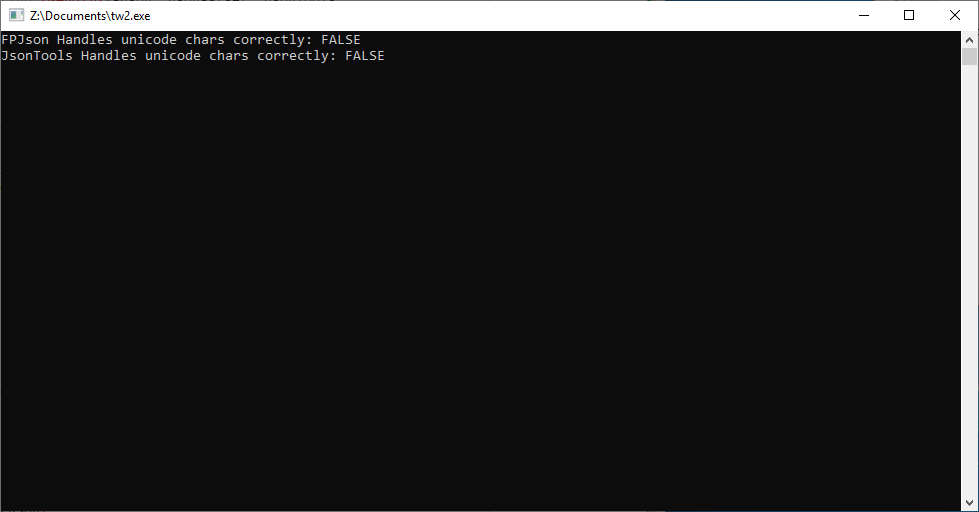
I copied the program to a windows VM.

Attached screenshot of the output.

As you can see, jsontools also does not work correctly.

It's no mystery why not. I had to add

   DefaultSystemCodePage:=CP_UTF8;

as the first line in the program, then it does show TRUE for both tests. Now, if you work in lazarus, it does this for you, so you don't notice/know it.

Codepages & strings require careful setup. Contrary to popular belief, it does not 'just work'.

All this is documented:

https://www.freepascal.org/docs-html/current/ref/refsu9.html#x32-390003.2.4

Many people tend to ignore this, because Lazarus does a lot behind the scenes (which is a good thing).

But if people use your JSONTools in a 'mixed' environment, you might get strange results, if you ignore the correct and careful setup.

You control your environment, and jsontools will function correctly in your environment. But it's a big world out there, where things might be happening that you didn't foresee but which do influence jsontools.

I hope with my explanations, you are now well equipped/informed to strengthen jsontools and help people should problems nevertheless pop up.

Now that we've hopefully established that fpjson does work correctly, I would appreciate it if you could correct the JSON test comparison page you created.

Michael.
-------------- next part --------------
A non-text attachment was scrubbed...
Name: jsontools.png
Type: image/png
Size: 8535 bytes
Desc:
URL: <http://lists.lazarus-ide.org/pipermail/lazarus/attachments/20190831/9e88b4fa/attachment-0001.png>

Reply by email

Anthony Walter
to Anthony Walter: Michael, I hadn't tried your example code yet as I thought the discussion was on the…

Okay, going back and looking through the messages I see you did post a test with:

{$codepage UTF8} and uses cwstring

Here are the results with that added:

On Linux using {$codepage UTF8} by itself causes both tests to fail. Adding cwstring causes both tests to work. On Windows trying to use cwstring causes the compilation to fail, but with {$codepage UTF8} added the tests work. I will try a few more tests, but there should be an "out of the box" option to get FPJson working without the need to add ifdefs along with extra directives added outside of the FPJson units themselves.

I will write a few more unicode tests, perhaps with 4 byte character strings, and some other potential unicode problems to be sure both are working before we come to a final resolution.
-------------- next part --------------
An HTML attachment was scrubbed...
URL: <http://lists.lazarus-ide.org/pipermail/lazarus/attachments/20190831/f8a25762/attachment.html>

Reply by email

Michael Van Canneyt
to Anthony Walter
Anthony Walter wrote 13 lines
Okay, going back and looking through the messages I see you did post a test with: {$codepage UTF8} and uses cwstring Here are the results with that added: On Linux using {$codepage UTF8} by itself causes both tests to fail. Adding cwstring causes both tests to work. On Windows trying to use cwstring causes the compilation to fail, but with {$codepage UTF8} added the tests work. I will try a few more tests, but there should be an "out of the box" option to get FPJson working without the need to add ifdefs along with extra directives added outside of the FPJson units themselves.

Glad you picked it up.

See my other mail for more details.

Bottom line:
You simply cannot ignore this. Doing so is asking for problems.

It may work for you, but fail for someone else, and then you'll be scratching your head as to "why on earth doesn't it work?"

Michael.

Reply by email

Michael Van Canneyt
to Michael Van Canneyt
Michael Van Canneyt wrote 27 lines
On Sat, 31 Aug 2019, Anthony Walter via lazarus wrote: > Okay, going back and looking through the messages I see you did post a test > with: > > {$codepage UTF8} and uses cwstring > > Here are the results with that added: > > On Linux using {$codepage UTF8} by itself causes both tests to fail. Adding > cwstring causes both tests to work. On Windows trying to use cwstring > causes the compilation to fail, but with {$codepage UTF8} added the tests > work. I will try a few more tests, but there should be an "out of the box" > option to get FPJson working without the need to add ifdefs along with > extra directives added outside of the FPJson units themselves. Glad you picked it up. See my other mail for more details. Bottom line: You simply cannot ignore this. Doing so is asking for problems. It may work for you, but fail for someone else, and then you'll be scratching your head as to "why on earth doesn't it work?"

One last thing.

Lazarus includes cwstring by default:

interfaces/carbon/interfaces.pas: {$IFNDEF DisableCWString}cwstring,{$ENDIF} interfaces/cocoa/interfaces.pas: {$IFNDEF DisableCWString}cwstring,{$ENDIF} interfaces/gtk2/interfaces.pas:{$IFDEF UNIX}{$IFNDEF DisableCWString}uses cwstring;{$ENDIF}{$ENDIF} interfaces/gtk3/interfaces.pp: {$IFDEF UNIX}{$IFNDEF DisableCWString}cwstring,{$ENDIF}{$ENDIF} interfaces/qt5/interfaces.pp: {$IFDEF UNIX}{$IFNDEF DisableCWString}cwstring,{$ENDIF}{$ENDIF} interfaces/qt/interfaces.pp: {$IFDEF UNIX}{$IFNDEF DisableCWString}cwstring,{$ENDIF}{$ENDIF}

If you look in the code, you'll see that it handles codepages explicitly in many places.

Just to corroborate that ignoring this is not an option, and that lazarus goes to great lengths to make it easier on people.

Michael.

Reply by email

Sven Barth
to Michael Van Canneyt: There you are. You're missing the cwstring unit and the codepage directive. Change the…
Michael Van Canneyt wrote 10 lines
Codepages & strings require careful setup. Contrary to popular belief, it does not 'just work'. All this is documented: https://www.freepascal.org/docs-html/current/ref/refsu9.html#x32-390003.2.4 Many people tend to ignore this, because Lazarus does a lot behind the scenes (which is a good thing).

Looking at the text of the "Code page conversions" section: what do these mean: (CODE_CP ¡¿ CP_ACP) ? Or should it have been (CODE_CP CP_ACP)?

Regards,
Sven
-------------- next part --------------
An HTML attachment was scrubbed...
URL: <http://lists.lazarus-ide.org/pipermail/lazarus/attachments/20190831/bf7a36a4/attachment.html>

Reply by email

Sven Barth
to Sven Barth
Sven Barth wrote 14 lines
Am 31.08.2019 um 09:45 schrieb Michael Van Canneyt via lazarus: > Codepages & strings require careful setup. Contrary to popular > belief, it does not 'just work'. > > All this is documented: > > https://www.freepascal.org/docs-html/current/ref/refsu9.html#x32-390003.2.4 > > > Many people tend to ignore this, because Lazarus does a lot behind > the scenes (which is a good thing). Looking at the text of the "Code page conversions" section: what do these mean: (CODE_CP ¡¿ CP_ACP) ? Or should it have been (CODE_CP CP_ACP)?

And there's another one in the section "UTF8String" at the bottom: (ordinal value ¡128) Should this have been (ordinal value < 128)?

Regards,
Sven
-------------- next part --------------
An HTML attachment was scrubbed...
URL: <http://lists.lazarus-ide.org/pipermail/lazarus/attachments/20190831/e320523b/attachment-0001.html>

Reply by email

Michael Van Canneyt
to Sven Barth: Looking at the text of the "Code page conversions" section: what do these mean: (CODE_CP…
Sven Barth wrote 12 lines
Am 31.08.2019 um 09:45 schrieb Michael Van Canneyt via lazarus: > Codepages & strings require careful setup. Contrary to popular belief, it > does not 'just work'. > > All this is documented: > > https://www.freepascal.org/docs-html/current/ref/refsu9.html#x32-390003.2.4 > > Many people tend to ignore this, because Lazarus does a lot behind the > scenes (which is a good thing). Looking at the text of the "Code page conversions" section: what do these mean: (CODE_CP ¡¿ CP_ACP) ? Or should it have been (CODE_CP CP_ACP)?

Latex->html conversion errors, I suppose. Using $\lt$ or so should fix it.

Michael.

Reply by email

Benjamin Rosseaux
to Anthony Walter: Alan, oh that's a good idea. I will do that as well as add a few more parser libraries as…

Could you include https://github.com/BeRo1985/pasjson in the comparison?

On Fri, Aug 30, 2019 at 4:22 PM Anthony Walter via lazarus <

Show quoted text 16 lines
wrote: Alan, oh that's a good idea. I will do that as well as add a few more parser libraries as requested by a few people in other non mailing lists threads. I will also try to find out what's going on the unicode strings as it might be a problem with the compiler. Michael, I am on Linux as well, but I will test under Windows and Mac too. -- _______________________________________________ lazarus mailing list https://lists.lazarus-ide.org/listinfo/lazarus

-------------- next part --------------
An HTML attachment was scrubbed...
URL: <http://lists.lazarus-ide.org/pipermail/lazarus/attachments/20190831/c86410b6/attachment.html>

Reply by email

Bart
to Michael Van Canneyt: Can you try setting defaultsystemcodepage to UTF8 ? Michael.
PM Michael Van Canneyt wrote
Can you try setting defaultsystemcodepage to UTF8 ?

Feeling a little bit embarrassed now (I'm used to Lazarus which defaults to that).
With DefaultSystemCodePage := CP_UTF8 it works:

Handles unicode chars correctly: >{ "name": "Joe®Schmoe", "occupation": "bank teller \u00Ae " }<
Name : 004A 006F 0065 00AE 0053 0063 0068 006D 006F 0065 [Joe®Schmoe] Expected: 004A 006F 0065 00AE 0053 0063 0068 006D 006F 0065 [Joe®Schmoe] Occupation: 0062 0061 006E 006B 0020 0074 0065 006C 006C 0065 0072 0020 00AE 0020 [bank teller ® ]
Expected: 0062 0061 006E 006B 0020 0074 0065 006C 006C 0065 0072 0020 00AE 0020 [bank teller ® ]
TRUE

Bart

Reply by email

Anthony Walter
to Benjamin Rosseaux: Could you include https://github.com/BeRo1985/pasjson in the comparison? On Fri, Aug 30,…
Could you include https://github.com/BeRo1985/pasjson in the comparison?

Sure. I also have a few other people have requested. I will also list the license of each in the first table.

Regarding a huge gigabytes of JSON in a file, I know a small portion of programmers of people might be inclined use it as an offline database format much like CSV. Even though by far most JSON is used with XMLHttpRequest, REST APIS, or storing settings and configurations, there are bound to be endless requests for use cases with JSON.

For example to accommodate the reading a huge files as indoividual records a helper class operating outside the definition of a JSON parser could accomplish this goal. For example, it would be relatively easy to write in a separate file:

type
  TJsonStreamReader = class
  public
    constructor Create(Stream: TStream; OwnsStream: Boolean = False);
    constructor CreateFromFile(const FileName: string);
    destructor Destroy;
    function Read(out Parser: TSomeJsonParser): Boolean;
  end;

Then use as ...

var
  R: TJsonStreamReader;
  P: TSomeJsonParser;
begin
  R := TJsonStreamReader.Create(InputStreamOrFileName);
  try
    while R.Read(P) do
      // Read JSON record here
  finally
    R.Free;
  end;
end;

And in this way a large file could be read in small blocks and given back to the user as a parser to allow for processing of individual records. The benefit of breaking this into its own class is that you do not need to mix in every possible use case into the parser. You can simply write separate use cases into their own independent units, rather than trying to make a super class which handles every possible concern.

For example if wanted to store object state using RTTI in a JSON file, create a separate TJsonObjectState class to handle this for you. Or if you wanted to create a database table from a JSON file, or create a JSON file from a database table, then again write this into its own class.

The point is, saying this JSON class does lots of these things is the wrong approach (IMO), as these use case scenarios as likely endless and would add unnecessary cruft to a parser. Even designing a plug in or other extensible seems unnecessary, when simple separate classes to add functionality works as well without all the complexity.
-------------- next part --------------
An HTML attachment was scrubbed...
URL: <http://lists.lazarus-ide.org/pipermail/lazarus/attachments/20190831/0769d0e2/attachment.html>

Reply by email

Michael Van Canneyt
to Anthony Walter
Anthony Walter wrote 5 lines
> Could you include https://github.com/BeRo1985/pasjson in the comparison? Sure. I also have a few other people have requested. I will also list the license of each in the first table.

[snip]

For example if wanted to store object state using RTTI in a JSON file, create a separate TJsonObjectState class to handle this for you. Or if you wanted to create a database table from a JSON file, or create a JSON file from a database table, then again write this into its own class.

Not sure I understand what you mean.

It seems to me that in that case you will repeat your scanner/parser code all over the place. in case of an error, you need to fix it in as many places.

I can of course be wrong.

The current fpjson scanner/parser can be used anywhere. You don't need to use fpjson data structures to be able to use the scanner or reader: It's perfectly possible to use the scanner/parser to create TJSONNode from JSONTools.

But general usability comes indeed at the price of some speed loss.

That said, your classes are markedly slower when it comes to data manipulation.

The following is 100 (!) times slower than fpjson code:

{$mode objfpc}
{$h+}
uses dateutils,sysutils, jsontools;
Var
   I,N : Integer;
   D,E : TJSONNode;
   B : double;
   NT : TDateTime;
begin
   N:=10000000;
   D:=TJSONNode.Create;
   D.Parse('{ "d": 12345678.3 }');
   E:=D.Child(0);
   NT:=Now;
   B:=1;
   for i:=0 to N  do
     B:=E.AsNumber * 2;
   Writeln('Time ',MillisecondsBetween(Now,NT));
   D.Free;
end.

home:~> ./tb
Time 3888

Same program in fpJSON:

home:~> ./tb2
Time 32

This is because when accessing the value, you must do the conversion to float. Every time.

This is true for JSON string values as well: you must re-decode the JSON on every access. And you do it over and over again, each time the data is accessed.

No doubt you can easily fix this by storing the value in the proper type, but this will slow down your parser.

So:
if you use the resulting JSON a lot, code will run faster in fpJSON.

It thus boils down to a choice: do you need fast processing or fast parsing ?

In the end it will probably not matter: most likely all the nodes will be traversed in a typical use case, and the overall time for your and my approach will be similar.

This is the danger of benchmarks. They focus on 1 aspect. In real life, all aspects are usually present.

Anyway.

While coding this small test, I noticed that this also does not work in jsontools:

D : TJSONNode;
begin
   D.Parse('true'); // or D.Parse('12345678.3');
end.

An unhandled exception occurred at $00000000004730B0: EJsonException: Root node must be an array or object

if you look at browser specs, this is supposed to work as well:

https://developer.mozilla.org/en-US/docs/Web/JavaScript/Reference/Global_Objects/JSON/parse

Also frequently encountered is omitting "" around property names. JSON is a subset of Javascript:

D.Parse('{ d: 12345678.3 }');

Results in:

An unhandled exception occurred at $0000000000473075: EJsonException: Error while parsing text

Both are things which are supported in fpJSON. No doubt you can fix this easily.

So you see, with some extra study, the picture of what is "better", jsontool or fpjson is not so clear as it may seem. In the end it all boils down to some choices.

Michael.

PS.
With 2 relatively simple changes, I took 40% off the parsing time of fpJSON. No doubt more gain can be achieved, for example I didn't do the suggestion by Benito yet.

Reply by email

Luca Olivetti
to Michael Van Canneyt

El 31/8/19 a les 16:22, Michael Van Canneyt via lazarus ha escrit:

Show quoted text 8 lines
https://developer.mozilla.org/en-US/docs/Web/JavaScript/Reference/Global_Objects/JSON/parse Also frequently encountered is omitting "" around property names. JSON is a subset of Javascript: D.Parse('{ d: 12345678.3 }');

The parser at mozilla says: "Error: JSON.parse: expected property name or '}' at line 1 column 3 of the JSON data"

Bye

Luca Olivetti Wetron Automation Technology http://www.wetron.es/ Tel. +34 93 5883004 (Ext.3010) Fax +34 93 5883007

Reply by email

Michael Van Canneyt
to Luca Olivetti
Luca Olivetti wrote 14 lines
El 31/8/19 a les 16:22, Michael Van Canneyt via lazarus ha escrit: > > https://developer.mozilla.org/en-US/docs/Web/JavaScript/Reference/Global_Objects/JSON/parse > > > Also frequently encountered is omitting "" around property names. JSON is a > subset of Javascript: > > D.Parse('{ d: 12345678.3 }'); The parser at mozilla says: "Error: JSON.parse: expected property name or '}' at line 1 column 3 of the JSON data"

I know. But if you treat it as Javascript e.g.
b = eval('{ d: 12345678.3 }');
it does work. JSON is a subset of Javascript.

That is why I said "frequently encountered". Not all parsers handle & allow it. But ExtJS for instance handles&produces it. (I used ExtJS and had to add it for that)

On large JSON files this shaves off quite some bytes off the result, I guess that is why they did it. (not that it helped, an ExtJS JSON Store is dead slow.)

Michael.

Reply by email

Anthony Walter
to Michael Van Canneyt: [snip] Not sure I understand what you mean. It seems to me that in that case you will…

Michael,

Internally JsonTools just stores the document as JSON fragments or text, in the case of object, array, or null, the text is empty, but in the case of number or bool, it converts the text to a number or bool when you ask AsNumber or AsBoolean. Now normally this wont be a problem because as you read a document you'll read a particular node possibly once as you hand it off to some other system, be it a database insert, a subroutine, or other use.

In practice what's happening is I am delaying the conversion until it's needed, which makes my parser faster when just parsing a document. If you need to use the node value as a number or a bool, then the cost of the conversion happens at that time, but if you don't need to use a particular field there is no conversion cost. This is one of the reasons my parser is faster. I still validate the number, bool, and other fields but I don't convert until needed. The downside, as you've seen is that converting the same value over and over again results in longer execution time. That said, if a user request every field as a number or bool once when processing an incoming request (say you are writing a REST service) then the performance would equal out and the speed difference would favor the faster parser.

A side benefit of storing JSON fragments is that the node kind can be changed easily without the need to remove an item from an internal list, destroy the class, create a new one of a different class, apply a copy of the original name, and reinsert.

Of course this lazy evaluation of numbers and boolean scould be improved by caching the conversion once calculated (e.g. StrToFloat) and reusing the conversion in any subsequent calls. For now I will keep it simple as is as I feel for most cases the user will either not need the conversion, or need it once, and the performance lost in invoking it many times wills be made up for in all the times the conversion is never used.

Real world examples of never used JSON fields:

Calling most web REST methods which return JSON as a web result where the caller is only interested in success or failure with a message. Acting as a RESTful service where many JSON request bodies use optional values that are meant to be skipped.
Retrieving settings where and option is never used, yet stored, such as a dockable or floating pallet position that is always left closed.

And so on...
-------------- next part --------------
An HTML attachment was scrubbed...
URL: <http://lists.lazarus-ide.org/pipermail/lazarus/attachments/20190831/acd376ba/attachment-0001.html>

Reply by email

Michael Van Canneyt
to Anthony Walter
Anthony Walter wrote 11 lines
Michael, Real world examples of never used JSON fields: Calling most web REST methods which return JSON as a web result where the caller is only interested in success or failure with a message. Acting as a RESTful service where many JSON request bodies use optional values that are meant to be skipped. Retrieving settings where and option is never used, yet stored, such as a dockable or floating pallet position that is always left closed.

In my experience these are a minority of the scenarios. They look to me also as the scenarios where speed is largely irrelevant since the structures will be small.

Most of the time I see code getting a result of a REST server and displaying the result in a grid or inserting in a database. In these scenarios, all values are always evaluated. lazy evaluation will not give you performance improvements in such scenarios.

So use cases clearly vary, and as usual you should pick the technology that is best suited for the me the result of the whole discussion is that we've managed to establish that fpjson is functioning correct (it triggered the discussion in the first place), and I did some long-due speed improvements on fpjson. The speed difference between a stream or string as a JSON source has also been eliminated.

All in all a positive result.

Michael.

Reply by email

Marco van de Voort
to Anthony Walter: I've posted a new page that tests the speed and correctness of several pascal based JSON…

Op 2019-08-30 om 10:18 schreef Anthony Walter via lazarus:

Show quoted text 19 lines
I've posted a new page that tests the speed and correctness of several pascal based JSON parsers. https://www.getlazarus.org/json/tests/ In full disclosure I am the author of the new open source JsonTools library, and even though my parser seems to a big improvement over the other alternatives, my tests were not biased. If anyone would like help in replication the tests, let me know and I'll see what I can do. Also, to be thorough, you should read through both the article I posted at the top this message, and my original page <https://www.getlazarus.org/json> which has been updated with more information. Both pages took some time to write, and I promise if you read through them some of your questions will be answered without having to ask others for help or insight.

I only looked superficially, but I miss a test on a large files, only files of a few kb repeated 100000 times.

The large file case is a good test for scaling of internal datastructures.

Reply by email

Sergey Bodrov
to Anthony Walter: I've posted a new page that tests the speed and correctness of several pascal based JSON…

пт, 30 авг. 2019 г. в 11:18, Anthony Walter via lazarus <

Show quoted text 6 lines
: I've posted a new page that tests the speed and correctness of several pascal based JSON parsers.

Thanks for testing! My JsonStorage seems to be outsider. =)

Actually, my work requires more effective serializers, such as Protobuffers, ASN.1 or Thrift. But I shoose Bencode, it simple and almost human-readable text, but fast and compact as binary.

Most serialization protocols use same data structures - numbers, literals, lists and records. Pascal type Variant suitable for any data, except records (dictionary, name-value pairs). So, if we add records to Variant, it will become serializable/deserializabe to many protocols. Also, it can be used to store publushed properties and used to transfer data between different objects/classes/records, that supports RTTI.

Even without RTTI, Variants can be used to store name-value pairs as name-indexed array, it very handy, and present in many modern programming languages. "Variant record" can be static, initialized once, like VarArrayCreate(), don't allow appending new name-values.

*Bodrov Sergey* software development, IT consulting http://www.serbod.com *Phone (Belarus):* +375(25)794-21-58 *Skype:* sergey.bodrov1 *e-mail:* , -------------- next part -------------- An HTML attachment was scrubbed... URL: <http://lists.lazarus-ide.org/pipermail/lazarus/attachments/20190902/ef8b025b/attachment.html>

Reply by email

Luiz Americo Pereira Camara
to Marco van de Voort: Op 2019-08-30 om 10:18 schreef Anthony Walter via lazarus: I only looked superficially,…

Em dom, 1 de set de 2019 às 12:37, Marco van de Voort via lazarus <

Show quoted text 9 lines
escreveu: I only looked superficially, but I miss a test on a large files, only files of a few kb repeated 100000 times. The large file case is a good test for scaling of internal datastructures.

Here you can find some real use json for testing, including a big one (1.6MB)

Luiz
-------------- next part --------------
An HTML attachment was scrubbed...
URL: <http://lists.lazarus-ide.org/pipermail/lazarus/attachments/20190902/4ae17843/attachment.html>

Reply by email

Luiz Americo Pereira Camara
to Luiz Americo Pereira Camara

Em seg, 2 de set de 2019 às 13:24, Luiz Americo Pereira Camara <

Show quoted text 18 lines
escreveu: Em dom, 1 de set de 2019 às 12:37, Marco van de Voort via lazarus < > escreveu: > > I only looked superficially, but I miss a test on a large files, only > files of a few kb repeated 100000 times. > > The large file case is a good test for scaling of internal datastructures. > > Here you can find some real use json for testing, including a big one (1.6MB)

https://github.com/RichardHightower/json-parsers-benchmark/tree/master/data

Luiz

-------------- next part --------------
An HTML attachment was scrubbed...
URL: <http://lists.lazarus-ide.org/pipermail/lazarus/attachments/20190902/6a95acb0/attachment.html>

Reply by email