Sign in Join

Live chat for Free Pascal, Lazarus, Delphi and every Pascal programmer.

Mailing lists / fpc-devel / 2012-01

Bounty for MIPS

43 messages · 13 people · –

Reply by email Subscribe to this list Your subscription

Read-only archive. Use j and k to move between messages.

Jy V

Hello to all possible interested MIPS hackers,

as I read the wiki page
http://wiki.lazarus.freepascal.org/Native_MIPS_Systems it looks like actual status of FPC for MIPS is a little behind the head development and stalled at some point as described by Mark,

I do plan to use FPC for MIPS with OpenWRT on MIPS embedded devices such as NetGear WNDR3800,
and "hack for the poor" the low end 20 euros device TPLINK TL-WR703N,

I am ready to offer a reasonable bounty to get motivated anyone that would help to catchup the MIPS support as of current state of FPC (2.6), for each of the following item:
1. compiling a program for OpenWRT MIPS from a PC Linux x64 (or Windows x64, up to your choice to simplify) (command line as a first step if this is easier)
2. compiling a program for OpenWRT MIPS from Lazarus IDE on a PC Linux x64 (or Windows x64, up to your choice to simplify)
3. remote debugging in a QEMU MIPS VM running on the host Linux x64 (or Windows x64, up to your choice to simplify)
4. remote debugging of the target embedded device from the development PC Linux x64 (or Windows x64, up to your choice to simplify)

I would provide WNDR3800 hardware for development/testing, or any other MIPS device of your choice that would make sense to build the toolchain required,

by the way, I will be at Fosdem during next week-end, if anyone would like to discuss the options and details about porting FPC to MIPS,

Cordially, Jerome.

PS: I am following the FPC and Lazarus development for multiple years, maintaining XMLRAD application server compiling for FPC on Win x86/x64 and Linux X86/x64 (a 500KLOC),
and my feeling about FPC which is targeting multiple architectures, despite the huge improvement of Lazarus
is that it lacks integrated toolchain for cross-compile environment and debugging from a single IDE.
Reply by email

Florian Klämpfl
to Jy V

Main problem with MIPS is to get hands on a reasonable development system (full fledged unix like Debian Linux, *BSD, CPU in the range of 1 GHz, 128 MB or more RAM, at least 1 GB of HD/SSD). Cross compiling is possible of course, but it makes testing and bug fixing very tedious. If ssh to such a system is available, I'll look into fixing the MIPS port without any bounty.

Reply by email

Jy V
to Florian Klämpfl

Thank you Florian to have jumped a fast answer on my email, the device I have tested at this time is NetGear WNDR3800, which is a 680MHz MIPS Atheros, 128MB RAM, with a USB port (possible to plug the latest quad channel Patriot Supersonic to obtain best Disk IOPS possible on the market with large disk space),
this device is running OpenWRT (Linux 2.6.32.27 as far I can figure out), http://wiki.openwrt.org/toh/netgear/wndr3800
I have been able to install on it Asterisk 1.8 (VoIP PBX) through a SSH Putty session,

if you know any other MIPS device which is more beefy, I will be very pleased to send it to your place,

Jerome.

Reply by email

Mark Morgan Lloyd
to Florian Klämpfl: Main problem with MIPS is to get hands on a reasonable development system (full fledged…
Florian Klämpfl wrote 6 lines
Main problem with MIPS is to get hands on a reasonable development system (full fledged unix like Debian Linux, *BSD, CPU in the range of 1 GHz, 128 MB or more RAM, at least 1 GB of HD/SSD). Cross compiling is possible of course, but it makes testing and bug fixing very tedious. If ssh to such a system is available, I'll look into fixing the MIPS port without any bounty.

My experience is that Qemu's support of a MIPS target isn't bad, although what I've done so far has been cross-hosted which was certainly good enough for compilation of e.g. the compiler in isolation.

Didn't somebody already have loan hardware for this?

I'd certainly be happy to continue chugging away at testing once the assembler reader issue was sorted out- at least until the next insurmountable problem :-)

Mark Morgan Lloyd markMLl .AT. telemetry.co .DOT. uk [Opinions above are the author's, not those of his employers or colleagues]

Reply by email

Pierre Free Pascal
to Mark Morgan Lloyd
Show quoted text 24 lines
-----Message d'origine----- De : [mailto:fpc-devel- De la part de Mark Morgan Lloyd Envoyé : dimanche 29 janvier 2012 15:19 À : Objet : Re: [fpc-devel] Bounty for MIPS Florian Klämpfl wrote: > Main problem with MIPS is to get hands on a reasonable development > system (full fledged unix like Debian Linux, *BSD, CPU in the range of 1 > GHz, 128 MB or more RAM, at least 1 GB of HD/SSD). Cross compiling is > possible of course, but it makes testing and bug fixing very tedious. If > ssh to such a system is available, I'll look into fixing the MIPS port > without any bounty. My experience is that Qemu's support of a MIPS target isn't bad, although what I've done so far has been cross-hosted which was certainly good enough for compilation of e.g. the compiler in isolation. Didn't somebody already have loan hardware for this? I'd certainly be happy to continue chugging away at testing once the assembler reader issue was sorted out- at least until the next insurmountable problem :-)

It seems that David Zhang's compiler already had such a reader, I will try to adapt it if I find the time.

Questions:
It seems like GNU AS has a different MUPS syntax as traditional MIPS assembler, but I didn't find precise information about this; Could someone give me some pointers?

Pierre

PS: I do have access to a GCC Compile farm machine running on gcc42 160G 0.8 GHz ICT Loongson 2F / 512 MB RAM / Lemote Fuloong 6004 Linux mini PC / Debian mipsel
uname -a
Linux gcc42 2.6.27.1 #476 Tue Oct 20 14:25:23 CST 2009 mips64 GNU/Linux No idea how that machine would compare to the one
we were talking about here.

Reply by email

Jy V
to Pierre Free Pascal

Pierre,

uname -a

Linux gcc42 2.6.27.1 #476 Tue Oct 20 14:25:23 CST 2009 mips64 GNU/Linux No idea how that machine would compare to the one we were talking about here.

on the WNDR3800 the OpenWRT installed gives
uname -a
Linux OpenWrt 2.6.32.27 #5 Wed Dec 21 01:59:33 CET 2011 mips GNU/Linux

cat /proc/cpuinfo
system type : Atheros AR7161 rev 2
machine : NETGEAR WNDR3700v2
processor : 0
cpu model : MIPS 24Kc V7.4
BogoMIPS : 452.19
wait instruction : yes
microsecond timers : yes
tlb_entries : 16
extra interrupt vector : yes
hardware watchpoint : yes, count: 4, address/irw mask: [0x0000, 0x0ff8, 0x0f f8, 0x0ff8]
ASEs implemented : mips16
shadow register sets : 1
core : 0
VCED exceptions : not available
VCEI exceptions : not available

the router devices are almost all the same, using the MIPS Atheros the 20 euros target device http://wiki.openwrt.org/toh/tp-link/tl-wr703n is using similar MIPS from Atheros

Jerome.

Reply by email

Pierre Free Pascal
to Jy V

Anyhow, I just discovered that

the /home directory is 99% full on that GCC compile farm machine,

meaning that only remote tests will be possible L

It seems that lots of developers have the same issue about finding

MIPS machines for testing ….

Pierre

De :
De la part de Jy V
Envoyé : dimanche 29 janvier 2012 16:32
À : FPC developers' list
Objet : Re: [fpc-devel] Bounty for MIPS

Pierre,

uname -a
Linux gcc42 2.6.27.1 #476 Tue Oct 20 14:25:23 CST 2009 mips64 GNU/Linux No idea how that machine would compare to the one
we were talking about here.

on the WNDR3800 the OpenWRT installed gives
uname -a
Linux OpenWrt 2.6.32.27 #5 Wed Dec 21 01:59:33 CET 2011 mips GNU/Linux

cat /proc/cpuinfo
system type : Atheros AR7161 rev 2
machine : NETGEAR WNDR3700v2
processor : 0
cpu model : MIPS 24Kc V7.4
BogoMIPS : 452.19
wait instruction : yes
microsecond timers : yes
tlb_entries : 16
extra interrupt vector : yes
hardware watchpoint : yes, count: 4, address/irw mask: [0x0000, 0x0ff8, 0x0f f8, 0x0ff8]
ASEs implemented : mips16
shadow register sets : 1
core : 0
VCED exceptions : not available
VCEI exceptions : not available

the router devices are almost all the same, using the MIPS Atheros the 20 euros target device http://wiki.openwrt.org/toh/tp-link/tl-wr703n is using similar MIPS from Atheros

Jerome.

Reply by email

Jy V
to Pierre Free Pascal
Show quoted text 12 lines
Anyhow, I just discovered that **** the /home directory is 99% full on that GCC compile farm machine,**** meaning that only remote tests will be possible L**** ** ** It seems that lots of developers have the same issue about finding **** MIPS machines for testing ….

Would you consider the NetGear WNDR3800 680Mhz, 128MB RAM with a USB Flash drive of 32GB to be good enough for the development of the FPC toolchain ? (in this case, I can purchase and ship such device to your place),

or would you consider that only a qemu virtual MIPS machine which can handle more memory and more disk space to be suitable for the development ?

Reply by email

Mark Morgan Lloyd
to Pierre Free Pascal: It seems that David Zhang's compiler already had such a reader, I will try to adapt it if…
Pierre Free Pascal wrote 30 lines
> -----Message d'origine----- > De : [mailto:fpc-devel- > De la part de Mark Morgan Lloyd > Envoyé : dimanche 29 janvier 2012 15:19 > À : > Objet : Re: [fpc-devel] Bounty for MIPS > > Florian Klämpfl wrote: >> Main problem with MIPS is to get hands on a reasonable development >> system (full fledged unix like Debian Linux, *BSD, CPU in the range of 1 >> GHz, 128 MB or more RAM, at least 1 GB of HD/SSD). Cross compiling is >> possible of course, but it makes testing and bug fixing very tedious. If >> ssh to such a system is available, I'll look into fixing the MIPS port >> without any bounty. > My experience is that Qemu's support of a MIPS target isn't bad, > although what I've done so far has been cross-hosted which was certainly > good enough for compilation of e.g. the compiler in isolation. > > Didn't somebody already have loan hardware for this? > > I'd certainly be happy to continue chugging away at testing once the > assembler reader issue was sorted out- at least until the next > insurmountable problem :-) It seems that David Zhang's compiler already had such a reader, I will try to adapt it if I find the time. Questions: It seems like GNU AS has a different MUPS syntax as traditional MIPS assembler, but I didn't find precise information about this; Could someone give me some pointers?

I don't think I've got access to any MIPS as other than gas, but if necessary I could put the disc that came with my problematic SGI system into a PC server and investigate whether it has any development software (it's a fairly minimal IRIX).

What differences did you have in mind?

Mark Morgan Lloyd markMLl .AT. telemetry.co .DOT. uk [Opinions above are the author's, not those of his employers or colleagues]

Reply by email

Pierre Free Pascal
to Mark Morgan Lloyd
Show quoted text 11 lines
> Questions: > It seems like GNU AS has a different MUPS syntax as traditional MIPS > assembler, but I didn't find precise information about this; > Could someone give me some pointers? I don't think I've got access to any MIPS as other than gas, but if necessary I could put the disc that came with my problematic SGI system into a PC server and investigate whether it has any development software (it's a fairly minimal IRIX). What differences did you have in mind?

Take a look at trunk/rtl/linux/mips/prt0.as
This file is non-functional, but it seems to contain some disassembly of a start code (probably from some other compiler...) This disassembly syntax seems quite different from the other assembler code (below in same file and in other sources seem more like gnu as generated by GCC if using --save-temps.

Well, at least register naming is different (using a4 or s7 instead of $sp and $X
where X is a number...)

Anyway, maybe the content of rtl/mips/prt0.as isn't really MIPS assembler at all :(

Pierre

Reply by email

Mark Morgan Lloyd
to Pierre Free Pascal
Pierre Free Pascal wrote 20 lines
>> Questions: >> It seems like GNU AS has a different MUPS syntax as traditional MIPS >> assembler, but I didn't find precise information about this; >> Could someone give me some pointers? > I don't think I've got access to any MIPS as other than gas, but if > necessary I could put the disc that came with my problematic SGI system > into a PC server and investigate whether it has any development software > (it's a fairly minimal IRIX). > > What differences did you have in mind? Take a look at trunk/rtl/linux/mips/prt0.as This file is non-functional, but it seems to contain some disassembly of a start code (probably from some other compiler...) This disassembly syntax seems quite different from the other assembler code (below in same file and in other sources seem more like gnu as generated by GCC if using --save-temps. Well, at least register naming is different (using a4 or s7 instead of $sp and $X where X is a number...)

I agree that there's something odd with that, but I was working against the rtl/linux/mipsel one. Also:

"Note that register names are 0, 1 etc. with $ as a mandatory sigil, and that register assignment is right-to-left; versions of GNU as from 2.18 onwards also support symbolic register names a0, a1 etc. There is a delay slot after branch etc. instructions."
http://wiki.lazarus.freepascal.org/Assembler_and_ABI_Resources#MIPS

I forget what version gas is currently at, but that's a comparatively recent change so I think there's a good argument either for converting back to the numeric form, or having an include file with symbolic definitions available for older versions.

Anyway, maybe the content of rtl/mips/prt0.as isn't really MIPS assembler at all :(

Somebody's working notes by the looks of it.

Can anybody say whether David Zhang did his port in isolation, or was he in discussion with core developers?

Mark Morgan Lloyd markMLl .AT. telemetry.co .DOT. uk [Opinions above are the author's, not those of his employers or colleagues]

Reply by email

Felipe Monteiro de Carvalho
to Florian Klämpfl: Main problem with MIPS is to get hands on a reasonable development system (full fledged…
Florian Klämpfl wrote
Main problem with MIPS is to get hands on a reasonable development system (full fledged unix like Debian Linux, *BSD, CPU in the range of 1 GHz, 128 MB or more RAM, at least 1 GB of HD/SSD). Cross compiling is

What about me simply shipping you the hardware that I have? It comes with Debian installed and should be a pretty good MIPS machine (I don't remember the specs, but it was used for running desktop linux with KDE). Then you could make it accessible via ssh if you want or whatever else.

Felipe Monteiro de Carvalho

Reply by email

Graeme Geldenhuys
to Pierre Free Pascal: Anyhow, I just discovered that the /home directory is 99% full on that GCC compile farm…
Pierre Free Pascal wrote
It seems that lots of developers have the same issue about finding MIPS machines for testing ….

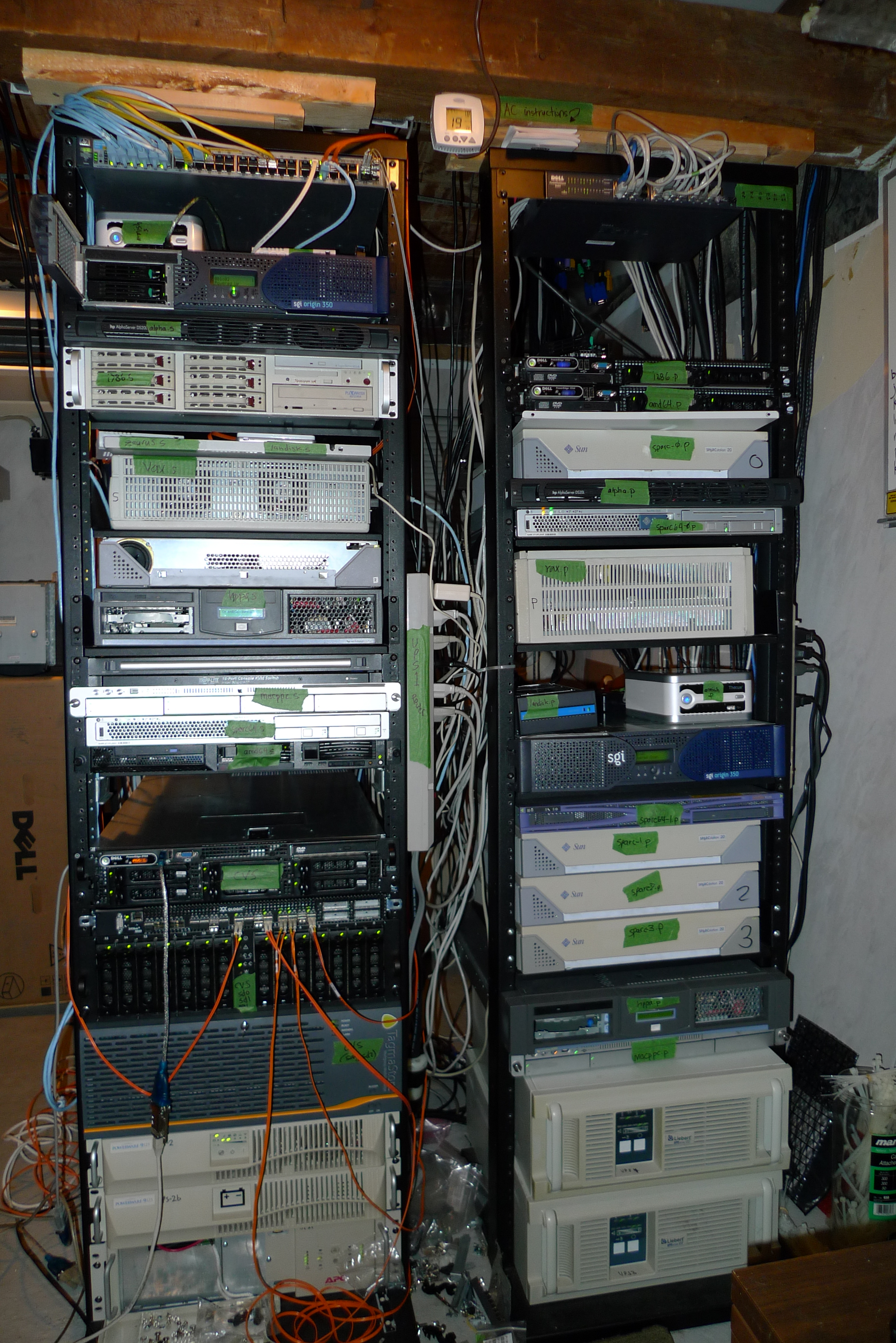
What about contacting the main developer of OpenBSD. I can't remember his name, but I believe he lives in Canada or something. Anyway, I saw a photo of the server farm for OpenBSD (a photo dated 2009 - still available on the www.openbsd.org website). Two huge racks with a huge variety of architectures in there. Maybe he would be willing to give somebody a limited account on a MIPS system for testing. Open open source project help out another. Just a thought.

Here is the photo.

http://www.openbsd.org/images/rack2009.jpg

Regards,   - Graeme - _______________________________________________ fpGUI - a cross-platform Free Pascal GUI toolkit http://fpgui.sourceforge.net

Reply by email

Michael Schnell
to Florian Klämpfl: Main problem with MIPS is to get hands on a reasonable development system (full fledged…

IMHO, the MIPS port is interesting, too, as the NIOS CPU that is available as soft core for Altera FPGA uses a very similar instruction set and supposedly can be handled as a sub-arch.

There is a very active community for NIOS-Linux that now provides a quite decent MMU-enabled Linux port (including the necessary Distribution generating Make-based tool chain).

For quite some time I played with NIOS using a "NEEK" Dev-Kit from Altera. Nice stuff.

-Michael

Reply by email

Mark Morgan Lloyd
to Graeme Geldenhuys: What about contacting the main developer of OpenBSD. I can't remember his name, but I…
Graeme Geldenhuys wrote 16 lines
On 29 January 2012 17:52, Pierre Free Pascal wrote: > It seems that lots of developers have the same issue about finding > MIPS machines for testing …. What about contacting the main developer of OpenBSD. I can't remember his name, but I believe he lives in Canada or something. Anyway, I saw a photo of the server farm for OpenBSD (a photo dated 2009 - still available on the www.openbsd.org website). Two huge racks with a huge variety of architectures in there. Maybe he would be willing to give somebody a limited account on a MIPS system for testing. Open open source project help out another. Just a thought. Here is the photo. http://www.openbsd.org/images/rack2009.jpg

One caveat is that (working from memory) SGI systems are hard-wired as big-endian while most appliance-scale devices are little-endian (although some development boards might be switchable).

Mark Morgan Lloyd markMLl .AT. telemetry.co .DOT. uk [Opinions above are the author's, not those of his employers or colleagues]

Reply by email

Nikolay Nikolov
to Florian Klämpfl: Main problem with MIPS is to get hands on a reasonable development system (full fledged…
Florian Klämpfl wrote 7 lines
Main problem with MIPS is to get hands on a reasonable development system (full fledged unix like Debian Linux, *BSD, CPU in the range of 1 GHz, 128 MB or more RAM, at least 1 GB of HD/SSD). Cross compiling is possible of course, but it makes testing and bug fixing very tedious. If ssh to such a system is available, I'll look into fixing the MIPS port without any bounty.

FYI, the Lemote Yeeloong is a nice MIPS netbook designed for hardcore free/opensource geeks:

http://www.amazon.com/Screen-Lemote-Yeeloong-8089_B-Netbook/dp/B005SYBJYE

It has: "Loongson 2f 64-bit MIPS-compatible processor, 1GB RAM, 160GB Hard Drive"

Disclaimer: I don't have it, I just know that it exists and sounds like a great option for doing a FPC port.

Reply by email

Nikolai Zhubr
to Jy V: uname -a on the WNDR3800 the OpenWRT installed gives uname -a Linux OpenWrt 2.6.32.27 #5…

Hi,
29.01.2012 19:32, Jy V:
[...]

on the WNDR3800 the OpenWRT installed gives uname -a Linux OpenWrt 2.6.32.27 #5 Wed Dec 21 01:59:33 CET 2011 mips GNU/Linux

I've got wndr3800 too, and moreover I don't use it for the moment. So instead of collecting dust it could do something usefull. Installing debian on it will probably not be as quick and easy as openwrt but still if debian mips userspace is able to run on it, I could give it a try and then ssh will be available for FPC developers if installation succeeds. It is apparently big endian though. Would it make sense to try?

Nikolai

Show quoted text 25 lines
cat /proc/cpuinfo system type : Atheros AR7161 rev 2 machine : NETGEAR WNDR3700v2 processor : 0 cpu model : MIPS 24Kc V7.4 BogoMIPS : 452.19 wait instruction : yes microsecond timers : yes tlb_entries : 16 extra interrupt vector : yes hardware watchpoint : yes, count: 4, address/irw mask: [0x0000, 0x0ff8, 0x0f f8, 0x0ff8] ASEs implemented : mips16 shadow register sets : 1 core : 0 VCED exceptions : not available VCEI exceptions : not available the router devices are almost all the same, using the MIPS Atheros the 20 euros target device http://wiki.openwrt.org/toh/tp-link/tl-wr703n is using similar MIPS from Atheros Jerome.

Reply by email

Mark Morgan Lloyd
to Nikolai Zhubr
Nikolai Zhubr wrote 13 lines
Hi, 29.01.2012 19:32, Jy V: [...] > on the WNDR3800 the OpenWRT installed gives > uname -a > Linux OpenWrt 2.6.32.27 #5 Wed Dec 21 01:59:33 CET 2011 mips GNU/Linux I've got wndr3800 too, and moreover I don't use it for the moment. So instead of collecting dust it could do something usefull. Installing debian on it will probably not be as quick and easy as openwrt but still if debian mips userspace is able to run on it, I could give it a try and then ssh will be available for FPC developers if installation succeeds. It is apparently big endian though. Would it make sense to try?

Bear in mind that there's Debian for both endiannesses of MIPS, I'm running mipsel via Qemu to reasonable effect. Experience with small ARM systems suggests that having enough memory is crucial, 128Mb with swap to 512 should be OK but these days I'd not like to try smaller.

But I don't know to what extent trying to implement the compiler and runtimes for mips and mipsel simultaneously would complicate things.

Mark Morgan Lloyd markMLl .AT. telemetry.co .DOT. uk [Opinions above are the author's, not those of his employers or colleagues]

Reply by email

Mark Morgan Lloyd
to Michael Schnell: IMHO, the MIPS port is interesting, too, as the NIOS CPU that is available as soft core…
Michael Schnell wrote 10 lines
IMHO, the MIPS port is interesting, too, as the NIOS CPU that is available as soft core for Altera FPGA uses a very similar instruction set and supposedly can be handled as a sub-arch. There is a very active community for NIOS-Linux that now provides a quite decent MMU-enabled Linux port (including the necessary Distribution generating Make-based tool chain). For quite some time I played with NIOS using a "NEEK" Dev-Kit from Altera. Nice stuff.

Would you like to fill in a bit more detail on this in fpc-other?

Mark Morgan Lloyd markMLl .AT. telemetry.co .DOT. uk [Opinions above are the author's, not those of his employers or colleagues]

Reply by email

Nikolai Zhubr
to Mark Morgan Lloyd: Bear in mind that there's Debian for both endiannesses of MIPS, I'm running mipsel via…

30.01.2012 16:19, Mark Morgan Lloyd:

Bear in mind that there's Debian for both endiannesses of MIPS, I'm running mipsel via Qemu to reasonable effect. Experience with small ARM systems suggests that having enough memory is crucial, 128Mb with swap to 512 should be OK but these days I'd not like to try smaller.

128Mb RAM + 512Mb swap is no problem here.

But I don't know to what extent trying to implement the compiler and runtimes for mips and mipsel simultaneously would complicate things.

I'd guess so. That's why I'm asking before even trying to install, as it might appear rather useless (and I'm not a debian user actually, and anyway openwrt seems much more comprehensible on such small devices)

Nikolai

Reply by email

Mark Morgan Lloyd
to Nikolai Zhubr
Nikolai Zhubr wrote 14 lines
30.01.2012 16:19, Mark Morgan Lloyd: > Bear in mind that there's Debian for both endiannesses of MIPS, I'm > running mipsel via Qemu to reasonable effect. Experience with small ARM > systems suggests that having enough memory is crucial, 128Mb with swap > to 512 should be OK but these days I'd not like to try smaller. 128Mb RAM + 512Mb swap is no problem here. > But I don't know to what extent trying to implement the compiler and > runtimes for mips and mipsel simultaneously would complicate things. I'd guess so. That's why I'm asking before even trying to install, as it might appear rather useless (and I'm not a debian user actually, and anyway openwrt seems much more comprehensible on such small devices)

Debian's no big deal, with the benefit that Debian on one architecture is almost identical to Debian on a different one: once booted, ARM or S/390 is almost indistinguishable from a PC.

Mark Morgan Lloyd markMLl .AT. telemetry.co .DOT. uk [Opinions above are the author's, not those of his employers or colleagues]

Reply by email

Mark Morgan Lloyd
Michael Schnell wrote 12 lines
On 01/30/2012 01:48 PM, Mark Morgan Lloyd wrote: > Michael Schnell wrote: >> IMHO, the MIPS port is interesting, too, as the NIOS CPU that is >> available as soft core for Altera FPGA uses a very similar >> instruction set and supposedly can be handled as a sub-arch. >> >> There is a very active community for NIOS-Linux that now provides a >> quite decent MMU-enabled Linux port (including the necessary >> Distribution generating Make-based tool chain). >> >> For quite some time I played with NIOS using a "NEEK" Dev-Kit from >> Altera. Nice stuff.

I remember mentioning NIOS as a MIPS variant in earlier discussion. Did you ever conclude just how close they were, i.e. could one backend target both?

Show quoted text 11 lines
> Would you like to fill in a bit more detail on this in fpc-other? > As I'm not on fpc-other: What would you like to know ? Is there already an ongoing discussion on that ? I stopped working on NIOS several about a year ago and I'm just monitoring some groups on same. So I don't think i can be very helpful besides providing some pointers.

There were a couple of threads oriented towards hardware which were continued there since they were out of place in the more focussed MLs. Somebody specifically mentioned FPGAs in the context that he believed Wirth was tinkering with them, it would be interesting to have input from somebody who's actually used that technology e.g. to tell us why a high-level language such as Pascal can contribute.

Mark Morgan Lloyd markMLl .AT. telemetry.co .DOT. uk [Opinions above are the author's, not those of his employers or colleagues]

Reply by email

Felipe Monteiro de Carvalho
to Mark Morgan Lloyd
Mark Morgan Lloyd wrote
was tinkering with them, it would be interesting to have input from somebody who's actually used that technology e.g. to tell us why a high-level language such as Pascal can contribute.

If you cut features then Pascal can be just as low level as C.

In the specific case of FPGA I don't see why one would want to use Pascal because the hardware languages have a lot of specificities geared to hardware development and parallelity and 1 more important thing: Many hardware languages are very pascal-ish, so they are already similar to Pascal. VHDL for example is quite pascal-ish.

See: http://en.wikipedia.org/wiki/File:Vhdl_signed_adder.png

So why modify Pascal to try to make it usable in FPGA when the main language for FPGA development is already pascalish?

Felipe Monteiro de Carvalho

Reply by email

Michael Schnell
to Mark Morgan Lloyd: I remember mentioning NIOS as a MIPS variant in earlier discussion. Did you ever conclude…
Mark Morgan Lloyd wrote
I remember mentioning NIOS as a MIPS variant in earlier discussion. Did you ever conclude just how close they were, i.e. could one backend target both?

Not really. This is what the FAE told me when he did an introduction on NIOS. I understand that the register structure is very similar and most the instructions can be translated 1:1 regarding some dedicated MIPS variant (supposedly the most simple one). As I never did any work with MIPS, I can't be more specific. At the time I got this lesson, there was no MMU enable NIOS design yet. But now, IMHO, the way to go with NIOS on Linux is to use the MMU enhanced variant.

it would be interesting to have input from somebody who's actually used that technology e.g. to tell us why a high-level language such as Pascal can contribute.

I did bring up a Linux system on the NIOS hardware and did some research on what we can do with that. Of course it's great to have a combination of a Linux enabled CPU and very fast custom-"hardware" in a single chip, even though the CPU is not very fast. But at least it can happily do TCP/IP on a 100MBit line.

If we would have decided to do a project on NIOS, I might have started trying to do an FPC compiler for same, to allow for porting some of the currently used Pascal based PC software. But here, all NIOS activity has died. The cause that there now is the TI 335x chip that has a ten times faster (ARM Cortex A8) CPU for Linux plus two Cortex M3 cores that - independently of the main CPU - can do most of what we would require an FPGA form. ARM-Linux, of course, is a lot more "Standard" than NIOS-Linux, and FPC is no problem either.

-Michael

Reply by email

Mark Morgan Lloyd
to Felipe Monteiro de Carvalho: On Mon, Jan 30, 2012 at 2:51 PM, Mark Morgan Lloyd If you cut features then Pascal can be…
Felipe Monteiro de Carvalho wrote 18 lines
On Mon, Jan 30, 2012 at 2:51 PM, Mark Morgan Lloyd wrote: > was tinkering with them, it would be interesting to have input from somebody > who's actually used that technology e.g. to tell us why a high-level > language such as Pascal can contribute. If you cut features then Pascal can be just as low level as C. In the specific case of FPGA I don't see why one would want to use Pascal because the hardware languages have a lot of specificities geared to hardware development and parallelity and 1 more important thing: Many hardware languages are very pascal-ish, so they are already similar to Pascal. VHDL for example is quite pascal-ish. See: http://en.wikipedia.org/wiki/File:Vhdl_signed_adder.png So why modify Pascal to try to make it usable in FPGA when the main language for FPGA development is already pascalish?

Presumably for the same reasons that people are trying to translate C to FPGA functionality. NOT that I'm suggesting that as a viable project.

I think a lot of MIPS's viability rests with the Chinese. I'm obviously aware of Loongson etc., but it's very unclear just how many are bing shipped- they certainly seem to have stepped back from their threat that they were going to use it for a super.

Mark Morgan Lloyd markMLl .AT. telemetry.co .DOT. uk [Opinions above are the author's, not those of his employers or colleagues]

Reply by email

Pierre Free Pascal
to Jy V: Would you consider the NetGear WNDR3800 680Mhz, 128MB RAM with a USB Flash drive of 32GB…
Show quoted text 11 lines
>Anyhow, I just discovered that >the /home directory is 99% full on that GCC compile farm machine, >meaning that only remote tests will be possible ☹ > >It seems that lots of developers have the same issue about finding >MIPS machines for testing …. Would you consider the NetGear WNDR3800 680Mhz, 128MB RAM with a USB Flash drive of 32GB to be good enough for the development of the FPC toolchain ? (in this case, I can purchase and ship such device to your place), or would you consider that only a qemu virtual MIPS machine which can handle more memory and more disk space to be suitable for the development ?

I just googled a bit and read that the
USB flash drives are considered as having only a limited number of writes before that fail... (http://en.wikipedia.org/wiki/USB_flash_drive) So I wonder how long such a system like that would last (it probably also depends on the USB key quality itself?) if I run the testsuite each night on it...

Would a small USB hard drive be better? But does the device have enough power to support such an external drive? Would the speed be significantly lower or is the USB 2.0 speed the real limitation?

Pierre Muller

Reply by email

Mark Morgan Lloyd
to Pierre Free Pascal
Pierre Free Pascal wrote 22 lines
>> Anyhow, I just discovered that >> the /home directory is 99% full on that GCC compile farm machine, >> meaning that only remote tests will be possible ☹ >> >> It seems that lots of developers have the same issue about finding >> MIPS machines for testing …. > Would you consider the NetGear WNDR3800 680Mhz, 128MB RAM with a USB Flash drive of 32GB to be good enough for the development of the FPC toolchain ? > (in this case, I can purchase and ship such device to your place), > > or would you consider that only a qemu virtual MIPS machine which can handle more memory and more disk space to be suitable for the development ? I just googled a bit and read that the USB flash drives are considered as having only a limited number of writes before that fail... (http://en.wikipedia.org/wiki/USB_flash_drive) So I wonder how long such a system like that would last (it probably also depends on the USB key quality itself?) if I run the testsuite each night on it... Would a small USB hard drive be better? But does the device have enough power to support such an external drive? Would the speed be significantly lower or is the USB 2.0 speed the real limitation?

My understanding is that "naked" Flash devices have limited write capability, but that "thumb drives" have an embedded microcontroller that levels the wear. There is still the issue that some filesystems work better with this type of device than others.

My experience with external USB-connected drives is that their power demands exceed that of most (internal and external) USB hubs, that they might not describe themselves accurately to the hub, and that in many cases they lack an external PSU socket. In practice, the ports on the back of an NSLU2 "Slug" will drive the notebook-style drives I've got.

I've also got an external (Buffalo?) USB-connected drive which has a 200Gb SATA internally, this has its own PSU. I can't remember whether I've compared the speed of this with the notebook-style drives, I'd expect it to be faster.

Mark Morgan Lloyd markMLl .AT. telemetry.co .DOT. uk [Opinions above are the author's, not those of his employers or colleagues]

Reply by email

Andrew Haines
to Mark Morgan Lloyd: Bear in mind that there's Debian for both endiannesses of MIPS, I'm running mipsel via…
Mark Morgan Lloyd wrote 23 lines
Nikolai Zhubr wrote: > Hi, > 29.01.2012 19:32, Jy V: > [...] >> on the WNDR3800 the OpenWRT installed gives >> uname -a >> Linux OpenWrt 2.6.32.27 #5 Wed Dec 21 01:59:33 CET 2011 mips GNU/Linux > > I've got wndr3800 too, and moreover I don't use it for the moment. So > instead of collecting dust it could do something usefull. Installing > debian on it will probably not be as quick and easy as openwrt but > still if debian mips userspace is able to run on it, I could give it a > try and then ssh will be available for FPC developers if installation > succeeds. It is apparently big endian though. Would it make sense to try? Bear in mind that there's Debian for both endiannesses of MIPS, I'm running mipsel via Qemu to reasonable effect. Experience with small ARM systems suggests that having enough memory is crucial, 128Mb with swap to 512 should be OK but these days I'd not like to try smaller. But I don't know to what extent trying to implement the compiler and runtimes for mips and mipsel simultaneously would complicate things.

I spent a little time researching qemu with MIPS but couldn't find anything current. Can you give me some pointers on setting that up?

Andrew

Reply by email

Mark Morgan Lloyd
to Andrew Haines
Andrew Haines wrote 25 lines
On 01/30/12 07:19, Mark Morgan Lloyd wrote: > Nikolai Zhubr wrote: >> Hi, >> 29.01.2012 19:32, Jy V: >> [...] >>> on the WNDR3800 the OpenWRT installed gives >>> uname -a >>> Linux OpenWrt 2.6.32.27 #5 Wed Dec 21 01:59:33 CET 2011 mips GNU/Linux >> I've got wndr3800 too, and moreover I don't use it for the moment. So >> instead of collecting dust it could do something usefull. Installing >> debian on it will probably not be as quick and easy as openwrt but >> still if debian mips userspace is able to run on it, I could give it a >> try and then ssh will be available for FPC developers if installation >> succeeds. It is apparently big endian though. Would it make sense to try? > Bear in mind that there's Debian for both endiannesses of MIPS, I'm > running mipsel via Qemu to reasonable effect. Experience with small ARM > systems suggests that having enough memory is crucial, 128Mb with swap > to 512 should be OK but these days I'd not like to try smaller. > > But I don't know to what extent trying to implement the compiler and > runtimes for mips and mipsel simultaneously would complicate things. > I spent a little time researching qemu with MIPS but couldn't find anything current. Can you give me some pointers on setting that up?

http://wiki.lazarus.freepascal.org/Qemu_and_other_emulators

Note that on that page I've rolled several Debian guest systems together into one section, showing appropriate differences in configuration files etc. Some of the scripts I've given are probably a bit idiosyncratic, but they're what I've found has worked for me over the 5+ years I've been using Qemu on various systems.

Most guest systems are built (not by me) to expect that they can display their console in an xterm. I normally start up in a VNC session, then log in over SSH.

Please yell if anything's unclear.

Mark Morgan Lloyd markMLl .AT. telemetry.co .DOT. uk [Opinions above are the author's, not those of his employers or colleagues]

Reply by email

Michael Schnell
to Mark Morgan Lloyd: My understanding is that "naked" Flash devices have limited write capability, but that…
Mark Morgan Lloyd wrote 5 lines
My understanding is that "naked" Flash devices have limited write capability, but that "thumb drives" have an embedded microcontroller that levels the wear. There is still the issue that some filesystems work better with this type of device than others.

On naked Flash in fact FAT is very bad (not only) on that behalf, while Linux does provide several file systems that internally do the necessary wear leveling for naked flash chips. The file system issue in fact is one of things the system the wear leveling controller on those drives leverages. But while it improves the wear-out issue greatly, still any flash drive will die once all available spare memory blocks are used up.

This is why unnecessary writes should be avoided (e.g. updating the "last read" file-date) AFAIK, all Linux file systems can be configured that way.

-Michael

Reply by email

Michael Schnell
to Mark Morgan Lloyd: Presumably for the same reasons that people are trying to translate C to FPGA…
Mark Morgan Lloyd wrote
Presumably for the same reasons that people are trying to translate C to FPGA functionality. NOT that I'm suggesting that as a viable project.

There are special "parallel" C dialects that are useful for this.

Moreover the most modern way of system design is to do a complete system description (functionality and restrains) in a C like language and have some (expensive) software decide automatically (based on available FPGA resources) what to implement in programmable hardware and what to implement in software, in the end creating compiled files that can be loaded appropriately to get a running system.

-Michael

Reply by email

Marco van de Voort
to Mark Morgan Lloyd: My understanding is that "naked" Flash devices have limited write capability, but that…

In our previous episode, Mark Morgan Lloyd said:

Show quoted text 9 lines
capability, but that "thumb drives" have an embedded microcontroller that levels the wear. There is still the issue that some filesystems work better with this type of device than others. My experience with external USB-connected drives is that their power demands exceed that of most (internal and external) USB hubs, that they might not describe themselves accurately to the hub, and that in many cases they lack an external PSU socket. In practice, the ports on the back of an NSLU2 "Slug" will drive the notebook-style drives I've got.

I've seen 2.5" usb-only HDD's crash laptops, and my experiences with other arm devices (Sheeva, goflex are the same).

In short, no devices that don't have an own PSU.

Reply by email

Hans-Peter Diettrich
to Marco van de Voort
I've seen 2.5" usb-only HDD's crash laptops, and my experiences with other arm devices (Sheeva, goflex are the same). In short, no devices that don't have an own PSU.

My experience is quite different from yours. I've a couple of external 3.5" HHDs with external PSUs, which ceased to work a few days after warranty expired, with a hot cabinet and inoperative HDD, all data lost :-(

In contrast none of my external 2.5" HDDs with USB power failed (so far).

DoDi

Reply by email

Mark Morgan Lloyd
to Hans-Peter Diettrich
Hans-Peter Diettrich wrote 11 lines
Marco van de Voort schrieb: > I've seen 2.5" usb-only HDD's crash laptops, and my experiences with > other > arm devices (Sheeva, goflex are the same). > > In short, no devices that don't have an own PSU. My experience is quite different from yours. I've a couple of external 3.5" HHDs with external PSUs, which ceased to work a few days after warranty expired, with a hot cabinet and inoperative HDD, all data lost :-(

The Buffalo I've got here has adequate convection slots, and provision for a clipon fan.

In contrast none of my external 2.5" HDDs with USB power failed (so far).

I find I've got a (not very fast) laptop which will power an external (Maxtor) 2.5", despite it not working with desktop or server computers or with a commodity hub (I tried earlier). Comparing a USB-connected Buffalo (with its own PSU), USB-connected/powered Maxtor, and internal IDE drive I see hardly any difference in performance when I run my standard "torture test", provided that in all cases the filesystems are ext3.

If the filesystem is FAT performance is only 50%. But at the same time at least some Flash storage is known to be optimised for FAT, and reformatting for a different filesystem could impact its lifetime.

Trying to drag ourselves back on topic: when it comes to something "unusual" like a MIPS-based board or time on an IBM mainframe, we've just got to make do with what we can get. If a development board has an IDE (PATA/SATA) interface then it's probably worth using, but in all cases we can usefully be aware of the peculiarities of the underlying technology: i.e. whether it risks running hot, takes a lot of current or has constraints on its life.

Mark Morgan Lloyd markMLl .AT. telemetry.co .DOT. uk [Opinions above are the author's, not those of his employers or colleagues]

Reply by email

Nikolai Zhubr
to Pierre Free Pascal: I just googled a bit and read that the USB flash drives are considered as having only a…

Hi,
31.01.2012 0:08, Pierre Free Pascal:

Show quoted text 23 lines
>> Anyhow, I just discovered that >> the /home directory is 99% full on that GCC compile farm machine, >> meaning that only remote tests will be possible ☹ >> >> It seems that lots of developers have the same issue about finding >> MIPS machines for testing …. > > Would you consider the NetGear WNDR3800 680Mhz, 128MB RAM with a USB Flash drive of 32GB to be good enough for the development of the FPC toolchain ? > (in this case, I can purchase and ship such device to your place), > > or would you consider that only a qemu virtual MIPS machine which can handle more memory and more disk space to be suitable for the development ? I just googled a bit and read that the USB flash drives are considered as having only a limited number of writes before that fail... (http://en.wikipedia.org/wiki/USB_flash_drive) So I wonder how long such a system like that would last (it probably also depends on the USB key quality itself?) if I run the testsuite each night on it... Would a small USB hard drive be better? But does the device have enough power to support such an external drive? Would the speed be significantly lower or is the USB 2.0 speed the real limitation?

Ok. Debian installer ran amazingly smooth and apparently debian is quite happy with openwrt's kernel. You can see some numbers etc below. I wouldn't say it is blazingly fast, yet it is probably close to the best one can get of consumer-grade MIPS device at the moment. There is 10G / and 100G /home, hdd read/write speed is around 25Mb/s. I can set up ssh for any FPC developer(s) (though I'll need some time to fix cables etc then) Let me know. But be aware, it is big endian.

Nikolai

Debian GNU/Linux 6.0 wndr3800 ttyS0

wndr3800 login: root
Password:
Last login: Thu Jan 1 03:02:01 MSK 1970 from zhubr.lan on pts/0 Linux wndr3800 2.6.32.27openwrt #6 Thu Feb 2 23:45:12 MSK 2012 mips cat /proc/cpuinfo
system type : Atheros AR7161 rev 2
machine : NETGEAR WNDR3700v2
processor : 0
cpu model : MIPS 24Kc V7.4
BogoMIPS : 452.19
wait instruction : yes
microsecond timers : yes
tlb_entries : 16
extra interrupt vector : yes
hardware watchpoint : yes, count: 4, address/irw mask: [0x0ffc, 0x0ffc, 0x0ffb, 0x0ffb]
ASEs implemented : mips16
shadow register sets : 1
core : 0
VCED exceptions : not available
VCEI exceptions : not available

free
total used free shared buffers cached Mem: 126588 32884 93704 0 5376 19028 -/+ buffers/cache: 8480 118108
Swap: 522232 0 522232
df /
Filesystem 1K-blocks Used Available Use% Mounted on /dev/sda3 10317112 674588 9118444 7% / df /home
Filesystem 1K-blocks Used Available Use% Mounted on /dev/sda4 103727360 192132 98266188 1% /home hdparm -tT /dev/sda

/dev/sda:
Timing cached reads: 276 MB in 2.01 seconds = 137.35 MB/sec Timing buffered disk reads: 78 MB in 3.06 seconds = 25.48 MB/sec ld --version
GNU ld (GNU Binutils for Debian) 2.20.1-system.20100303 Copyright 2009 Free Software Foundation, Inc.
This program is free software; you may redistribute it under the terms of the GNU General Public License version 3 or (at your option) a later version.
This program has absolutely no warranty.
gcc --version
gcc (Debian 4.4.5-8) 4.4.5
Copyright (C) 2010 Free Software Foundation, Inc.
This is free software; see the source for copying conditions. There is NO warranty; not even for MERCHANTABILITY or FITNESS FOR A PARTICULAR PURPOSE.

gdb --version
GNU gdb (GDB) 7.0.1-debian
Copyright (C) 2009 Free Software Foundation, Inc.
License GPLv3+: GNU GPL version 3 or later
<http://gnu.org/licenses/gpl.html>
This is free software: you are free to change and redistribute it. There is NO WARRANTY, to the extent permitted by law. Type "show copying" and "show warranty" for details.
This GDB was configured as "mips-linux-gnu".
For bug reporting instructions, please see:
<http://www.gnu.org/software/gdb/bugs/>.

Show quoted text 9 lines
Pierre Muller _______________________________________________ fpc-devel maillist - http://lists.freepascal.org/mailman/listinfo/fpc-devel

Reply by email

Jy V
to Nikolai Zhubr

Excellent. this is nice to see interest from other developers with the Netgear WNDR3800,

not only I can ship a Netgear WNDR3800 to the home of any developer willing to spend time to port FPC for MIPS,
but I am also ready to offer a reasonable bounty to get motivated anyone that would help to catchup the MIPS support as of current state of FPC (2.6),
for each of the following item:
1. compiling a program for OpenWRT MIPS on the WNDR3800
2. cross-compiling a program for OpenWRT MIPS from Lazarus IDE on a PC Linux x64 (or Windows x64, up to your choice to simplify)
3. remote debugging in a QEMU MIPS VM running on the host Linux x64 (or Windows x64, up to your choice to simplify)
4. remote debugging of the target embedded device from the development PC Linux x64 (or Windows x64, up to your choice to simplify)

the goal is "hack for the poor" the low end 20 euros device TPLINK TL-WR703N (4MB flash, 32MB RAM) which is based on similar Atheros MIPS CPU as the Netgear WNDR3800,

I will be at Fosdem this week-end if anyone would be interested in discussing on-site about this community effort,

Jerome.

Reply by email

Florian Klaempfl
to Nikolai Zhubr: 31.01.2012 0:08, Pierre Free Pascal: Ok. Debian installer ran amazingly smooth and…
Nikolai Zhubr wrote 33 lines
Hi, 31.01.2012 0:08, Pierre Free Pascal: >>> Anyhow, I just discovered that >>> the /home directory is 99% full on that GCC compile farm machine, >>> meaning that only remote tests will be possible ☹ >>> >>> It seems that lots of developers have the same issue about finding >>> MIPS machines for testing …. >> >> Would you consider the NetGear WNDR3800 680Mhz, 128MB RAM with a USB >> Flash drive of 32GB to be good enough for the development of the FPC >> toolchain ? >> (in this case, I can purchase and ship such device to your place), >> >> or would you consider that only a qemu virtual MIPS machine which can >> handle more memory and more disk space to be suitable for the >> development ? > > I just googled a bit and read that the > USB flash drives are considered as having only a limited number of writes > before that fail... (http://en.wikipedia.org/wiki/USB_flash_drive) > So I wonder how long such a system like that would last (it probably > also depends on > the USB key quality itself?) if I run the testsuite each night > on it... > > Would a small USB hard drive be better? But does the device > have enough power to support such an external drive? > Would the speed be significantly lower or is the USB 2.0 > speed the real limitation? Ok. Debian installer ran amazingly smooth and apparently debian is quite happy with openwrt's kernel.

How did you install debian? Or is it a chroot'ed debian?

Reply by email

Nikolai Zhubr
to Florian Klaempfl

03.02.2012 14:26, Florian Klaempfl:

How did you install debian? Or is it a chroot'ed debian?

No, it it not chrooted.

Basically I took kernel from openwrt 10.03.1 build tree (it is also 2.6.32 but modified slightly to better support platform-specific peripherials), disabled NAND-related drivers, and enabled ehci, usb_storage, ext4, etc as built-in. Then I took debian net-based installer's initrd.gz for malta board
(http://ftp.debian.org/debian/dists/stable/main/installer-mips/current/images/malta/netboot/initrd.gz), unpacked it into ext2-formatted 1st (small) partiton of USB hard disk, keeping the rest of the disk available for adding more partitions later. Then I plugged this disk into wndr3800 and booted my kernel via tftp pointing it to /dev/sda1 as root. The only issue was that by default, openwrt kernel does not include inotify support which debain wants desperately, so I had to enable it and recompile. Other than that, all the rest was pretty much regular net-based install over serial console.

One inconvenience for now is that manual intervention is needed upon power-on to interrupt uboot before it proceeds normally to openwrt. I think it might be possible to arrange kexec'ing from the running openwrt but didn't try yet.

Nikolai

Show quoted text 5 lines
_______________________________________________ fpc-devel maillist - http://lists.freepascal.org/mailman/listinfo/fpc-devel

Reply by email

Nikolai Zhubr
to Nikolai Zhubr

03.02.2012 16:01, Nikolai Zhubr:

Show quoted text 5 lines
03.02.2012 14:26, Florian Klaempfl: > > How did you install debian? Or is it a chroot'ed debian? No, it it not chrooted.

And by the way. If you somehow obtain wndr3800 and want debian on it, I can probably prepare ready-to-use images for hard disk and internal flash (It will then be debian-only until reflashed through recovery)

Nikolai

Show quoted text 33 lines
Basically I took kernel from openwrt 10.03.1 build tree (it is also 2.6.32 but modified slightly to better support platform-specific peripherials), disabled NAND-related drivers, and enabled ehci, usb_storage, ext4, etc as built-in. Then I took debian net-based installer's initrd.gz for malta board (http://ftp.debian.org/debian/dists/stable/main/installer-mips/current/images/malta/netboot/initrd.gz), unpacked it into ext2-formatted 1st (small) partiton of USB hard disk, keeping the rest of the disk available for adding more partitions later. Then I plugged this disk into wndr3800 and booted my kernel via tftp pointing it to /dev/sda1 as root. The only issue was that by default, openwrt kernel does not include inotify support which debain wants desperately, so I had to enable it and recompile. Other than that, all the rest was pretty much regular net-based install over serial console. One inconvenience for now is that manual intervention is needed upon power-on to interrupt uboot before it proceeds normally to openwrt. I think it might be possible to arrange kexec'ing from the running openwrt but didn't try yet. Nikolai > _______________________________________________ > fpc-devel maillist - > http://lists.freepascal.org/mailman/listinfo/fpc-devel > > _______________________________________________ fpc-devel maillist - http://lists.freepascal.org/mailman/listinfo/fpc-devel

Reply by email

Mark Morgan Lloyd
to Nikolai Zhubr
Nikolai Zhubr wrote 10 lines
03.02.2012 16:01, Nikolai Zhubr: > 03.02.2012 14:26, Florian Klaempfl: >> >> How did you install debian? Or is it a chroot'ed debian? > > No, it it not chrooted. And by the way. If you somehow obtain wndr3800 and want debian on it, I can probably prepare ready-to-use images for hard disk and internal flash (It will then be debian-only until reflashed through recovery)

Nicely done. With this sort of thing available, I'd suggest that nobody tries buying an old SGI system via eBay: anything affordable probably won't run Linux, and even something like an Octane appears to be marginal.

Mark Morgan Lloyd markMLl .AT. telemetry.co .DOT. uk [Opinions above are the author's, not those of his employers or colleagues]

Reply by email

Nikolai Zhubr
to Florian Klämpfl

Hello Florian,
07.02.2012 1:49, Florian Klämpfl:

Show quoted text 8 lines
Am 03.02.2012 01:37, schrieb Nikolai Zhubr: > I can set up ssh > for any FPC developer(s) (though I'll need some time to fix cables etc > then) Let me know. It would be nice to get an account, currently I'am still busy with fixing compilation issue but I'd expect first compiled programs within a few days.

Ok, sorry for delay, I'm now fighting to hook shutdown to front panel button, otherwise all seems ready, hopefully it will be online permanently starting this weekend, and I'll then mail you login info (off list).

Nikolai

Show quoted text 5 lines
_______________________________________________ fpc-devel maillist - http://lists.freepascal.org/mailman/listinfo/fpc-devel

Reply by email